
Self-Hosted vs CloudStory Creation
Self-hosted story creation means running your own GPU plus open-source models — total control, full privacy, real weekends of setup. Cloud story creation means a managed platform like C2Story — finished illustrated children's book in minutes, no install. Both are valid. Here is when each one wins.
- Self-host wins on privacy, control, and high-volume cost-per-image
- Cloud wins on speed, character consistency, and print-ready output
- Hybrid stacks are often the smartest answer — and we show how
- C2Story grants full commercial rights — same as open-source self-host
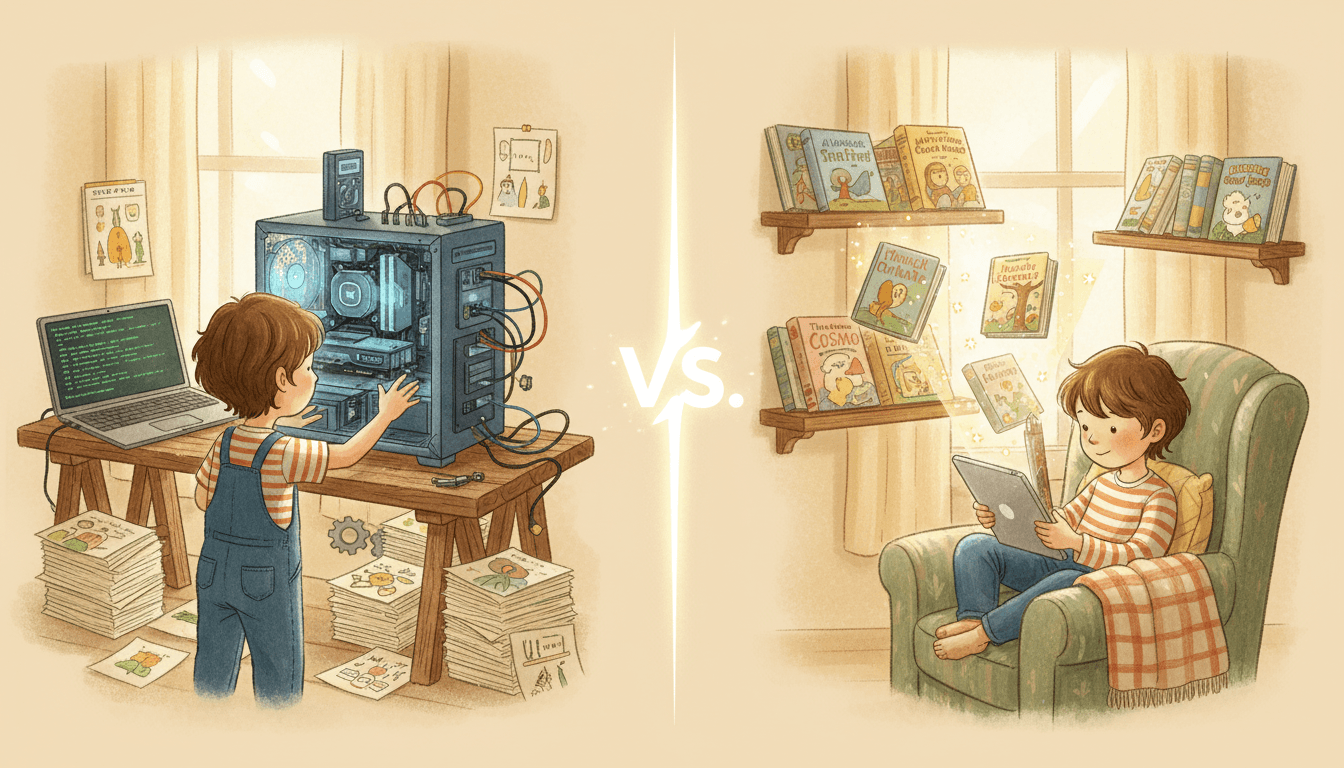
Two Honest Ways to Make Illustrated Children's Books with AI
The choice is not “which AI is better” — it is “what do you actually want to ship?”
Self-Hosted Story Creation
You spin up a GPU box (RTX 4090 / A6000 / cloud rental), install Stable Diffusion, ComfyUI, an open-source LLM like Llama or Mistral, wire them together with custom scripts, and generate spreads locally. Maximum control, zero per-image cost after hardware, full data privacy.
Best for
Tinkerers, privacy-first authors, AI researchers, studios with steady GPU workloads
Cloud Story Creation (C2Story)
You open c2story.com in your browser, paste a story idea, pick an art style, and a managed multi-agent system ships a finished illustrated children's book — character-consistent across every spread, 300 DPI print-ready PDF, no install, no servers, no model files.
Best for
Authors who want finished books, educators, parents, indie publishers, anyone shipping on a deadline
Self-Hosted Workbench vs. Cloud Tablet
Same goal — a finished illustrated children's book. Very different surface.
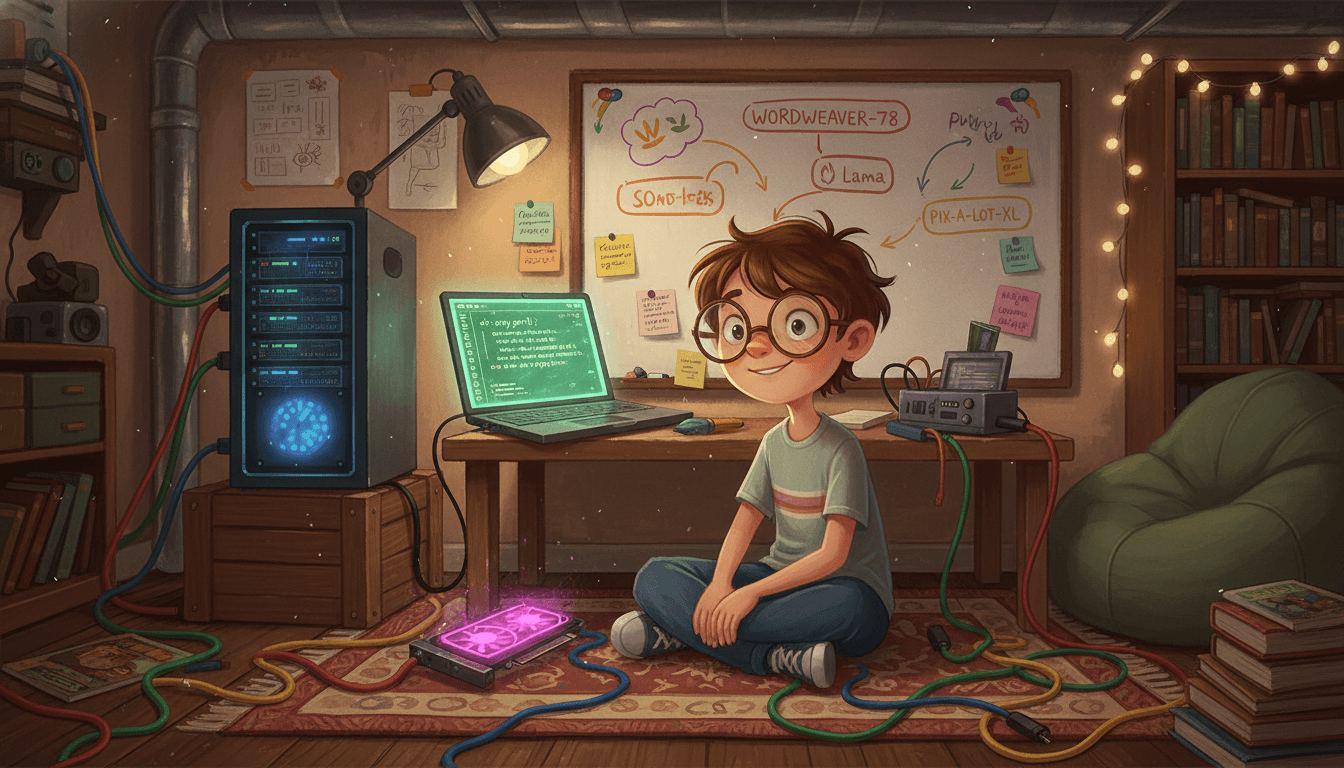
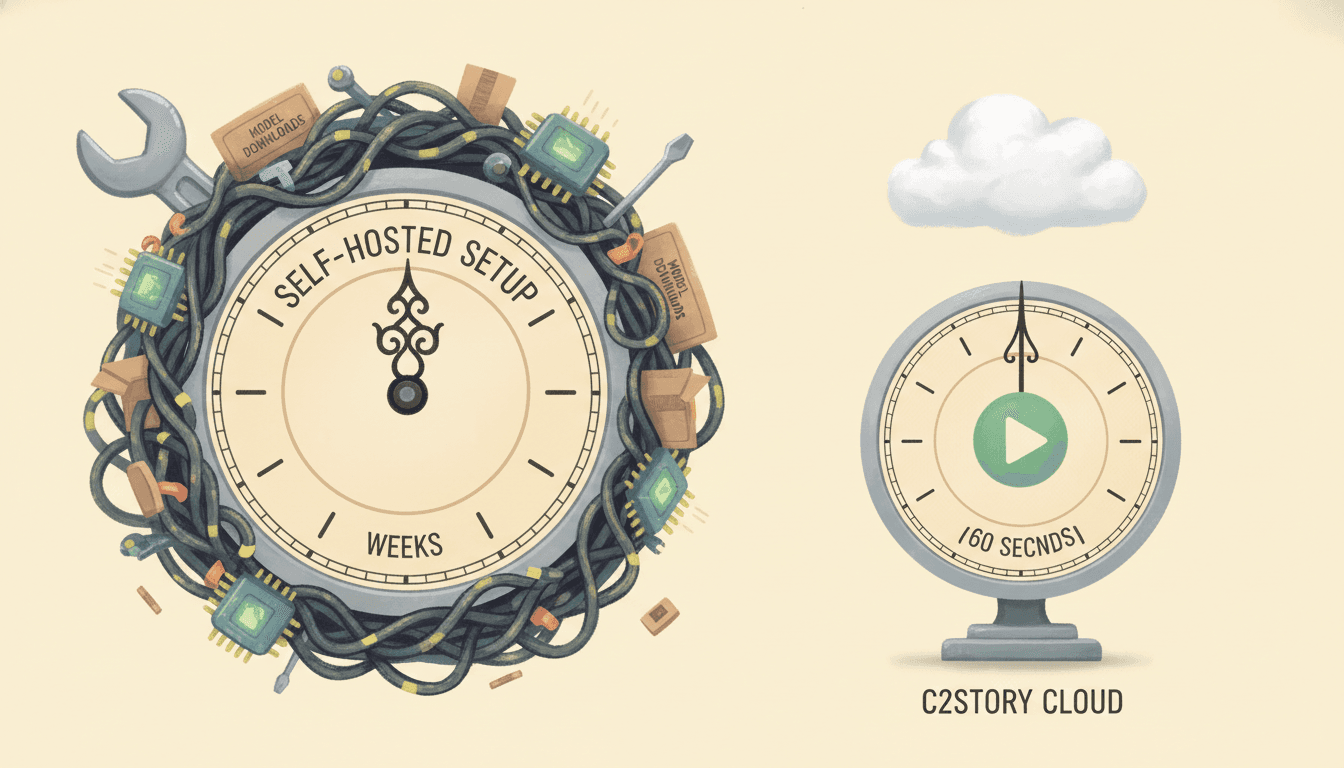
Weeks vs. 60 Seconds
The single biggest delta between self-hosted and cloud story creation is not quality — top-end open models can rival the cloud's raw illustration output. The delta is everything around the model.
Self-host: 2–4 weekends installing CUDA, ComfyUI, the right SDXL / Flux checkpoint, an open-source LLM, an IP-Adapter pipeline for character consistency, and a book-assembly tool. Cloud: 60 seconds from sign-up to your first illustrated spread.
If you have shipped fewer than five books, cloud almost always wins on time-to-first-result.
Honest Wins on Both Sides
Skipping the marketing — here is what each path actually does better.
Self-Hosted Wins
Your hardware, your rules
- Full data privacy — nothing leaves your network
- Zero per-image cost after the GPU is paid off
- Swap any model, any sampler, any LoRA — total control
- You can fine-tune the model on your own art
- Works fully offline once installed
Cloud Wins
Browser in, hardcover out
- Finished book in 5 minutes — no setup, no install
- Character-keeper agent locks the hero across spreads
- 50+ picture-book art styles pre-tuned for kids
- 300 DPI full-bleed PDF — Amazon KDP / Lulu / IngramSpark
- Runs in any browser — Mac, Windows, Chromebook, tablet
Step-by-Step on Both Paths
Same goal, two very different setup paths. The honest steps, in order.
Self-Hosted Path
Pick & Buy a GPU
RTX 4090 (24GB VRAM) is the sweet spot for picture-book generation. A6000, A100, or H100 if your budget allows. Or rent on Vast.ai / RunPod / Lambda Labs — hourly costs add up fast for daily work.
Install the Stack
CUDA + cuDNN + Python env. Then ComfyUI (or Automatic1111). Pull a base Stable Diffusion XL / Flux checkpoint. Stand up Ollama or vLLM for an open-source LLM (Llama 3, Mistral, Qwen) to draft prose. Plan for 1–2 weekends.
Build Character Consistency
For every character: IP-Adapter or LoRA reference, dial in classifier-free guidance, write a stable prompt template, save it. Without this, your hero drifts on every spread. This is the part most self-hosters underestimate.
Assemble & Print
Export every spread to PNG, lay out the book in InDesign / Affinity Publisher / Scribus, watch your bleed and gutter, export to 300 DPI PDF/X-1a, upload to KDP. Plan another evening per book.
Cloud Path (C2Story)
Open c2story.com
Any browser. Mac, Windows, Linux, Chromebook, iPad. No install, no GPU, no Python env. Sign in with Google.
Paste a Story Idea
One line, one paragraph, or a full chapter. Pick an age tier (2–4 / 5–7 / 8–10) and an art style — watercolor, cartoon, anime, manga, Pixar-3D, classic storybook, or any of 50+ pre-tuned options.
Lock Your Hero
Upload a photo or describe the character. The character-keeper agent saves them in your Character Library and locks them across every page, every book, every art style. No LoRA training required.
Export & Print
Read it live in the browser, share a link, or export the 300 DPI full-bleed PDF straight to Amazon KDP, Lulu, Blurb, or IngramSpark. Or order a hardcover gift copy directly. Done in 5–10 minutes.
How to Choose: The Six Things That Actually Matter
Plug your own situation into each row and the right choice falls out on its own.
Time to First Book
Self-hosted: 2–4 weekends installing CUDA, ComfyUI, the right Stable Diffusion checkpoint, a working LLM, and stitching them together. Cloud (C2Story): 60 seconds from sign-up to first illustrated spread on screen.
True Cost
Self-hosted: $1,200–$3,500 GPU + electricity + your weekends. Cloud: free tier to start, paid plans for high-volume creators. For a casual author shipping 1–3 books a year, cloud is cheaper. For a studio shipping daily, self-hosted amortizes.
Character Consistency
Self-hosted: you build your own IP-Adapter / LoRA / reference workflow per character. Cloud (C2Story): persistent Character Library with a managed character-keeper agent — the hero on page 1 is still that hero on page 16, in any of 50+ styles.
Picture-Book Art Styles
Self-hosted: every style is a prompt-engineering rabbit hole — find a checkpoint, dial in negative prompts, save presets. Cloud: 50+ picture-book styles pre-tuned (watercolor, cartoon, anime, manga, Pixar-3D, storybook, ink-wash, donghua) — one click each.
Print-Ready Output
Self-hosted: you assemble the book yourself in InDesign or Affinity, watch margins / gutter / bleed, export to 300 DPI. Cloud: the layout agent ships a KDP-ready PDF straight out of the door — full-bleed, dedication page, copyright page included.
Data Privacy
Self-hosted wins outright: nothing leaves your network, models run on your hardware, no cloud retention. Cloud: C2Story stores your books in your account; commercial rights are yours, but if "must run on-prem" is a hard requirement, self-host.
50+ Picture-Book Styles, One Click Each
On the self-hosted side every style is a prompt-engineering rabbit hole. On the cloud side they ship pre-tuned for children's books.


Plus 46+ more — Pixar-3D, manga, comic, cinematic, ink-wash, classic, minimalist, donghua, and more
Self-Hosted vs Cloud Story Creation — Full Comparison
No hot takes — twelve honest rows, each side wins some.
| Dimension | Self-Hosted | Cloud (C2Story) |
|---|---|---|
| Time to first finished book | 2–4 weekends installing the stack | 5–10 minutes from sign-up |
| Upfront hardware cost | $1,200–$3,500 GPU + electricity | Free tier — $0 to start |
| Per-image cost (high volume) | $0 after hardware is paid off | Paid plan above free tier |
| Character consistency across spreads | You build IP-Adapter / LoRA per character | Persistent Character Library — built in |
| Age-tuned children's-book prose | You prompt-engineer the LLM yourself | Writer agent tuned for ages 2–4 / 5–7 / 8–10 |
| Picture-book art styles | Roll your own per-style prompts and presets | 50+ pre-tuned book styles, one click each |
| Picture-book layout (spreads, bleed, gutter) | Assemble in InDesign / Affinity yourself | Layout agent — KDP-ready PDF out of the box |
| Print-ready 300 DPI export | Manual export and packaging | Built in — Amazon KDP / Lulu / IngramSpark ready |
| Data privacy — runs on your hardware | Yes — nothing leaves your network | Hosted on C2Story's infrastructure |
| Works offline | Yes — fully offline after install | Requires internet connection |
| Cross-device (laptop, tablet, Chromebook) | Tied to the GPU box | Any browser, anywhere |
| Commercial rights on output | Yes — open models you self-host | Yes — full commercial rights granted |
Recommendations by Audience
Find the bucket that fits you — the right path is usually obvious from there.
AI Researchers & Tinkerers
You enjoy the stack — Stable Diffusion XL, Flux, ComfyUI, Llama 3, IP-Adapter, custom LoRAs. Self-host. The fastest path to learning is owning the whole pipeline. Use C2Story as a reference for what a finished children's-book product looks like.
Indie Authors & KDP Self-Publishers
You want to ship illustrated children's books on Amazon KDP, Lulu, Blurb, or IngramSpark — not build infrastructure. Use cloud. The character-keeper agent + print-ready PDF solves the two hardest parts of the self-host path in one tool.
Educators & Homeschoolers
You need age-tuned reading material with consistent characters across a whole curriculum. Self-hosting is overkill — the prompt-engineering load is real teacher-hours. Use cloud and direct your time at the lesson, not the GPU.
Privacy-First & Regulated Markets
You work with sensitive client material, classroom data, or a regulated industry where nothing can leave your network. Self-host. Even if it is slower, the privacy guarantee is the requirement.
Studios with Daily Volume
You ship illustrated content every day at scale. Self-host the high-volume generations; use C2Story for the final character-consistent, print-ready book. Run a hybrid stack — that's where the economics actually win.
Parents & Gift-Givers
You want a personalized hardcover children's book where your kid is the hero on every page. Cloud is the obvious answer — upload a photo, the character-keeper locks the likeness, the printer ships in 5–7 days. Self-hosting is not the right tool here.
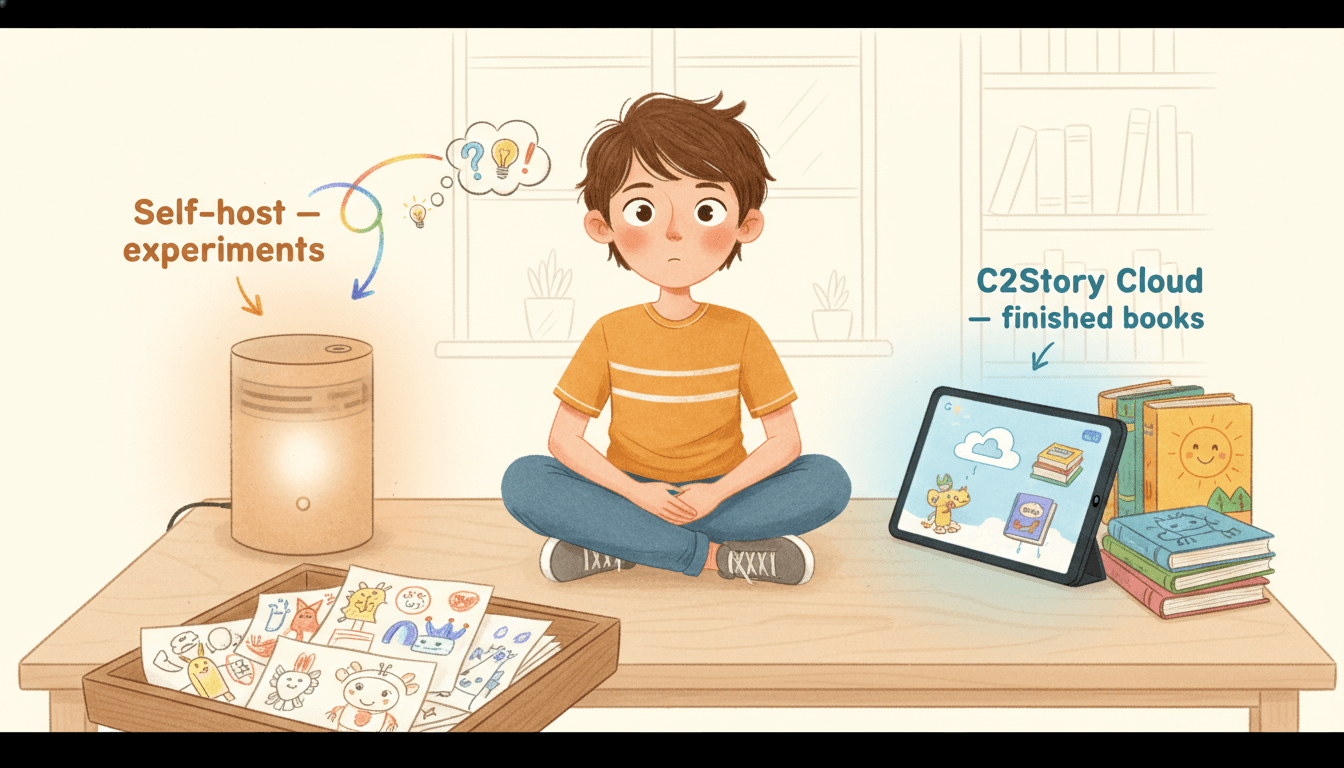
Run a Hybrid Stack — Self-Host for Experiments, Cloud for Finished Books
The most experienced AI illustrators and indie studios rarely pick just one. They self-host an experimental rig — Stable Diffusion XL, Flux, ComfyUI, custom LoRAs — for fine-tuning their own art style, batch-generating reference plates, and research.
Then they ship the actual finished book through C2Story's cloud — multi-agent collaboration, persistent Character Library, age-tuned prose, picture-book layout, 300 DPI KDP-ready PDF — because the cloud handles the parts where self-hosting is genuinely painful.
Both Paths Can Hit Print-Ready Quality
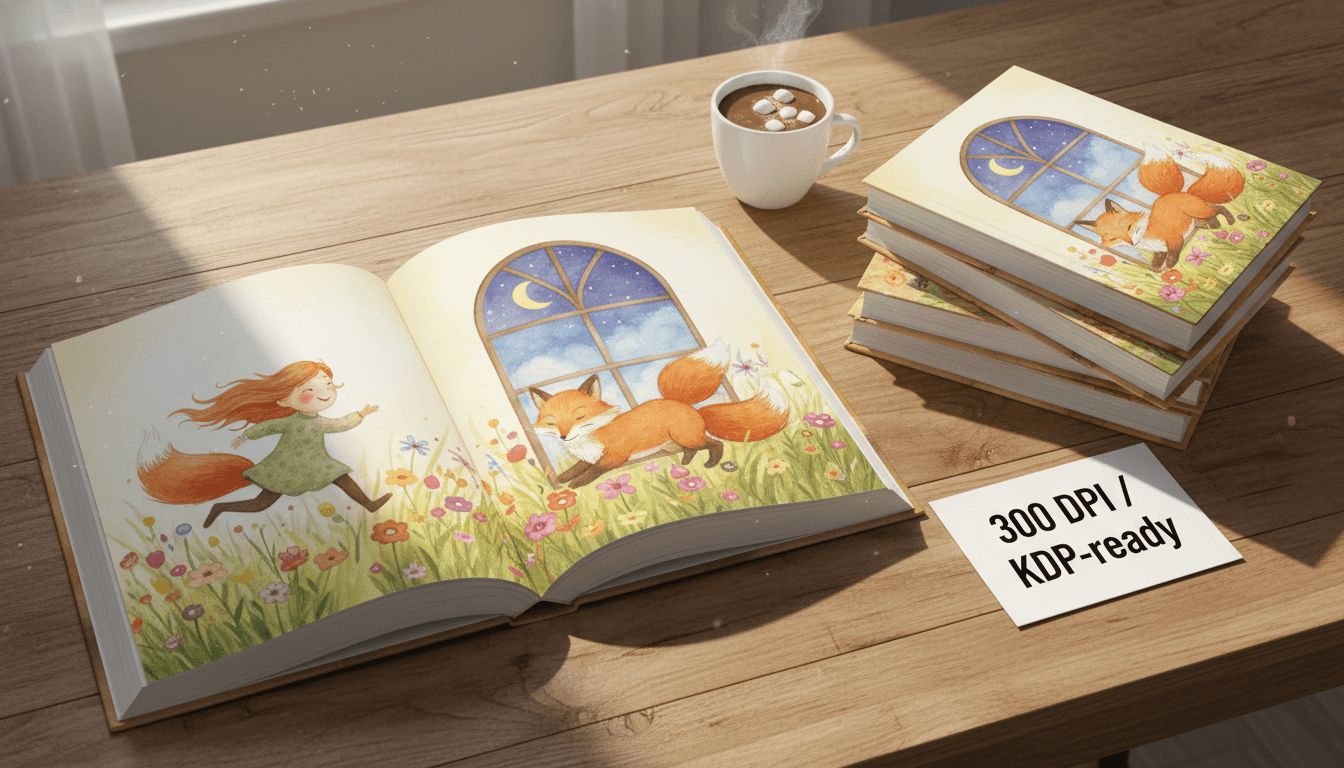
With enough effort, a self-hosted stack with a top-end Flux or SDXL checkpoint absolutely can produce print-ready 300 DPI children's book spreads. The cloud doesn't have a quality monopoly.
The difference is everything around the pixels — the layout, the dedication page, the copyright page, the bleed, the gutter, the assembled spreads, and the KDP-clean PDF. On the cloud, that is one button. On self-host, it is your evening with InDesign.
Family-Safe by Default
C2Story's cloud is tuned for children's books — family-safe defaults, no NSFW drift. Self-hosted, you set the safety policy yourself.
You Own the Output
Both paths grant full commercial rights. Open-source self-host: the model license. Cloud (C2Story): full commercial rights on every book.
Print-Ready PDF Export
Cloud ships a 300 DPI, full-bleed PDF straight to Amazon KDP, Lulu, Blurb, or IngramSpark — no conversion. Self-host: bring your own packaging.
Self-Hosted vs Cloud Story Creation FAQ
Explore More Story Ideas
Discover more styles, tools, and story types

Animal Stories
Charming tales with cute creatures
Explore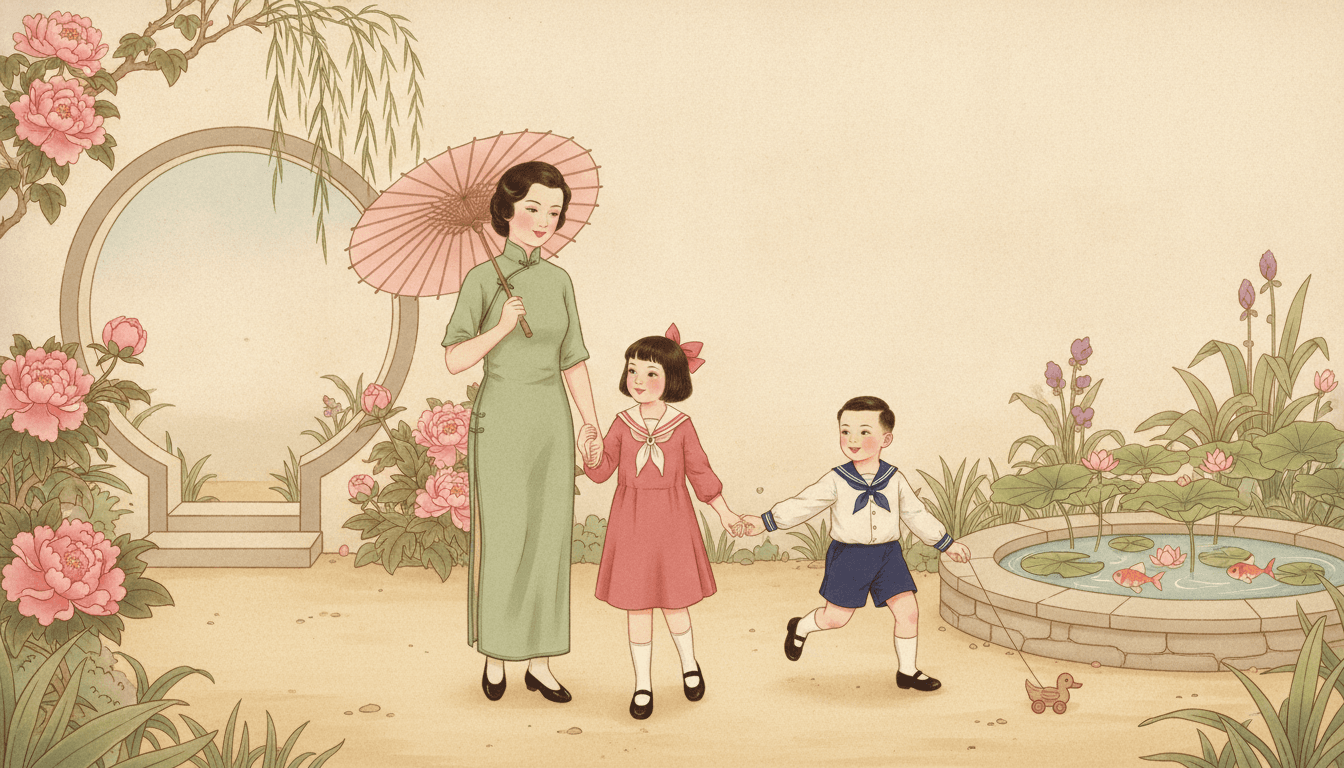
Shanghai Poster Picture Books
Soft airbrushed 1930s calendar-poster colour, with your whole cast dressed for the year it is set in
Explore
AI Story Generator
Generate complete stories with AI
Explore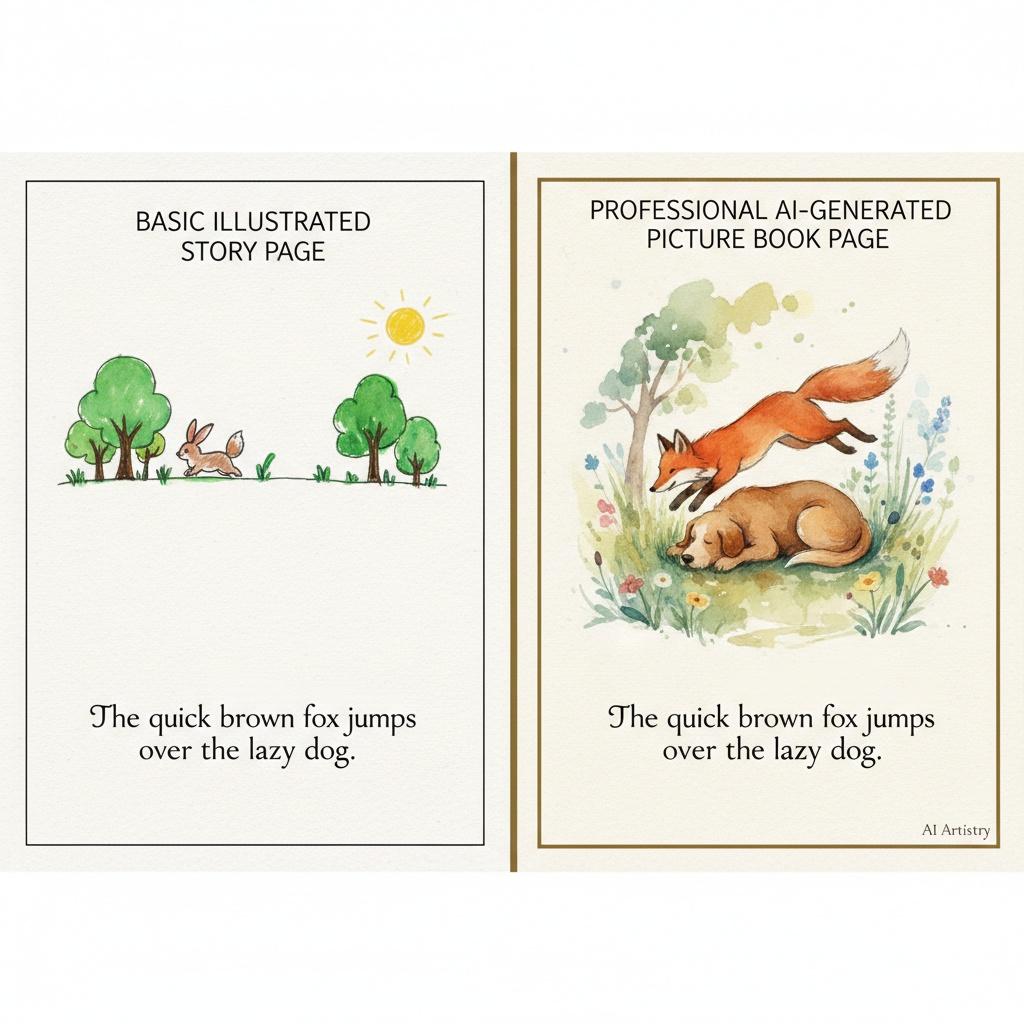
Storybird Alternative
Better AI story creation
Explore
Skip the GPU. Start with Cloud Story Creation Today.
Self-hosting is a great long-term project. But your next illustrated children's book doesn't need to wait for your CUDA install. Start free in your browser — finish a book in minutes.
Self-Hosted vs Cloud Story Creation — The Honest Guide for Children's Book AI
Self-hosted vs cloud story creation is the first real fork an AI children's-book author hits. The self-hosted path means buying or renting a GPU (RTX 4090, A6000, A100), installing CUDA and ComfyUI, pulling a Stable Diffusion XL or Flux checkpoint, standing up an open-source LLM like Llama or Mistral, and wiring it all together with custom scripts. You own everything: the model weights, the data, the workflow, the cost-per-image floor (zero, once the hardware is paid off). The cloud path means opening c2story.com in any browser and using a managed multi-agent story creation system — a writer agent, illustrator agent, character-keeper agent, layout agent, and editor agent — that ships a finished, character-consistent, print-ready illustrated children's book in minutes. Both are legitimate; neither is universally better.
The honest case for self-hosted AI story generators: full data privacy (nothing leaves your network — critical for sensitive client work or regulated industries), zero per-image cost after the GPU is paid off (the math wins at high daily volume), total control over which model and which sampler you use, the ability to fine-tune on your own art style, and the option to run fully offline. The honest case for cloud-based AI book creators like C2Story: 60 seconds from sign-up to your first illustrated spread, a persistent Character Library that locks your hero's appearance across every page of every book (the single hardest problem on the self-host path), 50+ picture-book art styles pre-tuned for children's books, a 300 DPI full-bleed PDF that uploads cleanly to Amazon KDP / Lulu / Blurb / IngramSpark, and the freedom to work from any device — laptop, tablet, Chromebook, library computer. Pick by deciding what you want to ship.
When the answer is self-host: you are an AI researcher, a privacy-first author, a studio with daily GPU workload, or a tinkerer who enjoys the stack and has the weekends. When the answer is cloud (C2Story): you are an indie author shipping 1–10 illustrated children's books a year on Amazon KDP, a teacher building age-tuned classroom storybooks, a homeschooler running monthly reading material, a parent making a personalized birthday gift, or any creator with a real deadline. And there is a third honest answer that the experienced practitioners increasingly pick: hybrid story creation workflow — self-host for experiments, fine-tuning on your own art, and high-volume reference generation; cloud for the finished, character-consistent, print-ready book. The two paths are not exclusive; treat them as complementary tools for an illustrated-book pipeline that actually ships.
C2Story grants full commercial rights on every illustrated book the cloud-based AI book creator produces — the same ownership story you get from open-source self-hosting, without the GPU purchase, the CUDA install, or the weekend stuck debugging ComfyUI. If you want to ship a children's book this week, start with the cloud path. If you want to build infrastructure and own the whole stack, the self-hosted path is genuinely powerful — and C2Story is still the right tool for the finished printable book at the end of it. Two valid paths for AI story hosting solutions; choose the one that matches what you actually want to put in the world.