Is It Legal to Use AI to Illustrate a Children’s Book?
Short answer: yes — and Amazon KDP publishes AI-illustrated books every day. The rules that actually bind you are narrower than the internet suggests: disclose it, hold the rights, and know which parts of the book copyright will cover.
- What KDP asks you at title setup — and what it does not
- The AI-generated vs AI-assisted line, in plain English
- Which parts of your book copyright still protects
- The five-point check to run before you upload
50,000+
Stories Created
Allowed
AI Art on KDP
1 Question
The Disclosure
5 Checks
Before You Upload
The Short Answer
It is legal to use AI to illustrate a children’s book. No jurisdiction bans it, and Amazon KDP explicitly permits AI-generated content. Three conditions come with that: you disclose the AI illustrations to KDP when you set the title up, you must be able to warrant that you hold the rights to publish everything in the book, and you should expect copyright to protect your text and page arrangement while excluding the generated images themselves.
Everything below is the detail behind those three sentences — what the disclosure actually asks, where the generated/assisted line falls, what a copyright registration looks like for a book like this, and the handful of mistakes that genuinely do get books removed.
This is general information, not legal advice. Platform policies and copyright guidance are both moving quickly — this guide was last reviewed in September 2026. Check KDP’s current Content Guidelines in the KDP Help Center before you upload, and speak to a lawyer in your own country for anything that matters financially.
Five Rules Before You Publish an AI-Illustrated Book
Most of the anxiety about whether it is legal to use AI to illustrate a children’s book comes from mixing together five separate questions. Here they are, separated.
Disclose the AI Illustrations to KDP
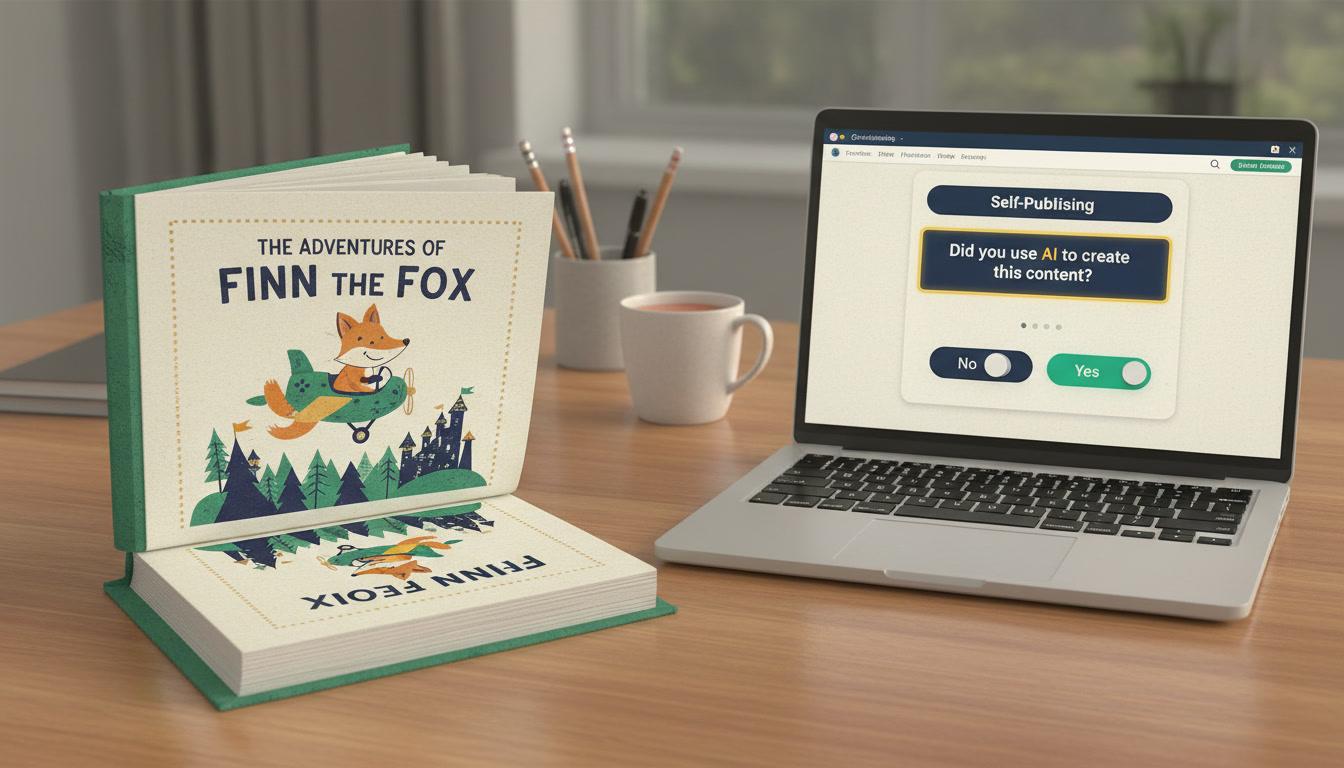
Amazon asks, during title setup, whether your book contains AI-generated content — text, images or translations. If an AI tool produced your illustrations from your prompts, the honest answer is yes, and you tick it. It is a question inside the KDP dashboard, not a label you print on the cover or write into your blurb.
Answering yes does not block publication. Answering dishonestly is what puts an account at risk.
Know the Generated / Assisted Line
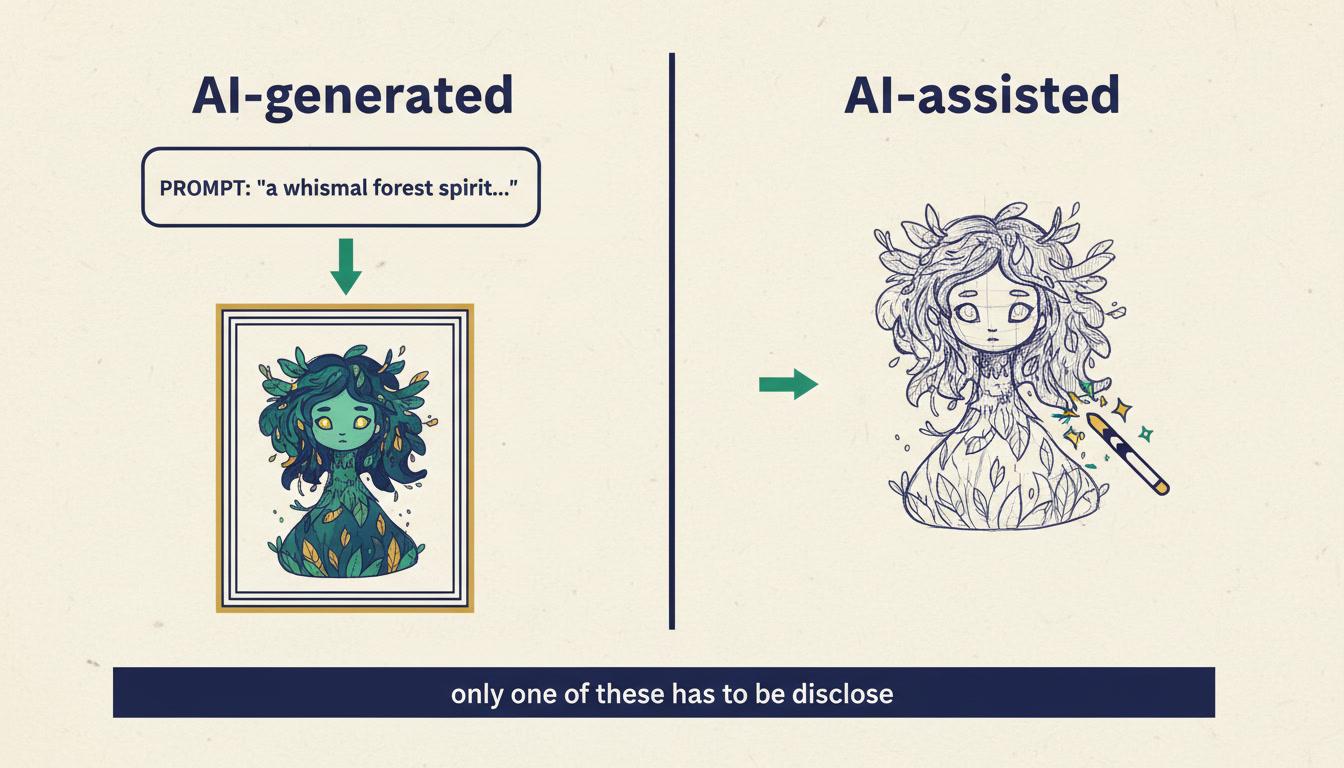
Amazon distinguishes AI-generated content, which it asks you to disclose, from AI-assisted content, which it does not. Generated means the tool created the material and you supplied the prompts — even if you edited the result afterwards. Assisted means you made the thing and used AI to refine, correct or brainstorm around it. Prompt-to-picture illustration sits on the generated side of that line.
Heavy editing of a generated image does not move it into the assisted column.
Confirm You Hold the Rights to Everything
Every KDP upload includes a warranty that you own or are otherwise entitled to publish the content. That applies to AI illustrations exactly as it applies to a photograph or a hired artist’s work, so the terms of the tool that made your images matter — a generator that keeps commercial rights, or grants you nothing in writing, is a genuine problem at this step.
Save a copy of your tool’s terms on the day you publish. Terms change.
Understand What Copyright Will and Will Not Cover
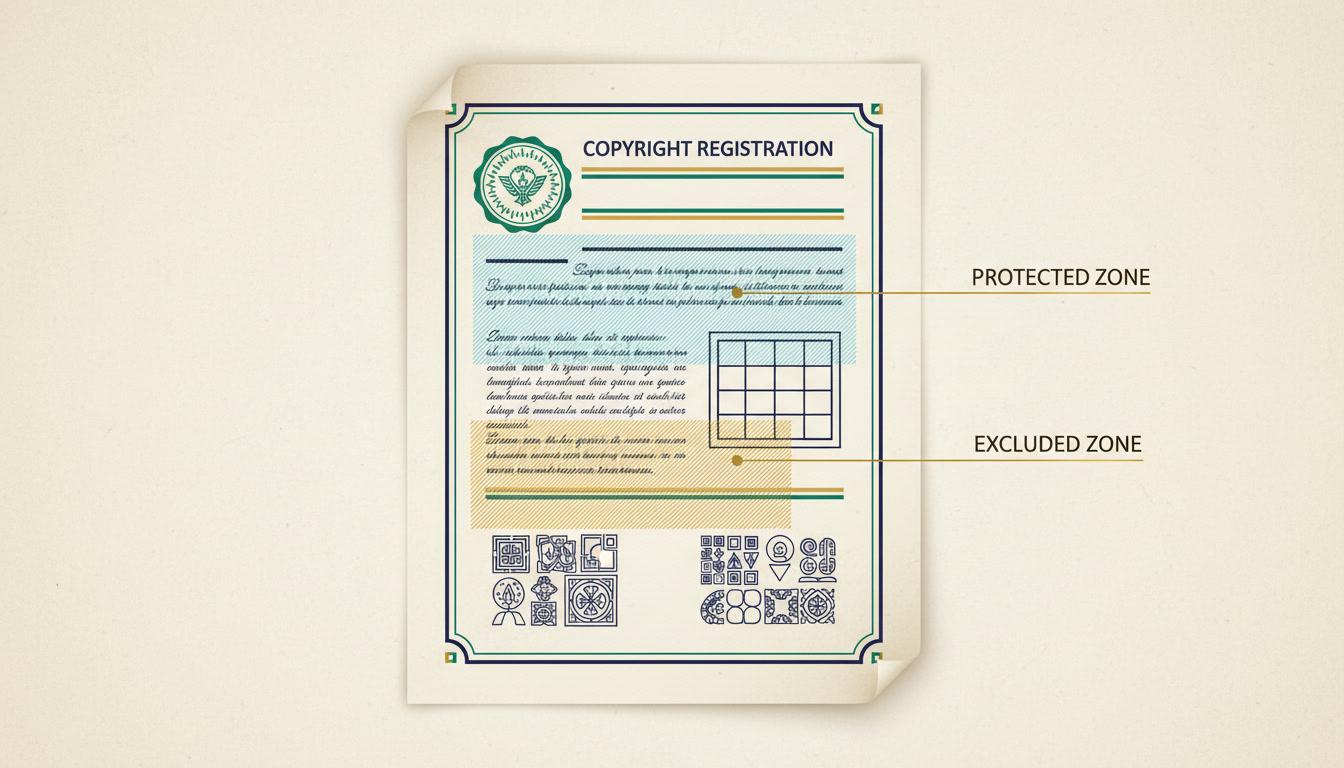
In the United States, the Copyright Office has been consistent that material generated by AI from a prompt is not protected by copyright, because it lacks human authorship. Your manuscript is protected. Your selection, ordering and editing of the pages is protected. The illustrations themselves, if a model made them, generally are not. You can still publish and sell the book — you simply cannot stop someone copying those particular pictures.
When registering, you disclaim the AI-generated material and claim the human-authored parts.
Keep Other People’s Property Out of Your Prompts
The fastest way to get an AI-illustrated book removed has nothing to do with AI policy. It is prompting for a trademarked character, a recognisable film still, a living illustrator by name, or a real child’s likeness. Those are ordinary infringement claims, and a generator does not launder them. Write prompts that describe your own characters.
Describe the character. Never name an artist or a franchise.
Does KDP Allow AI Illustrations? Yes — If You Disclose Them
Amazon does not ask whether AI touched your book. It asks whether AI generated any of it. Sorting your material into these two columns takes about five minutes and answers the disclosure question for you.
AI-Generated → Disclose
The tool made it from your prompt. Editing afterwards does not change this.
- Illustrations produced by a model from your text prompts
- Pages a model wrote, even if you rewrote them afterwards
- A machine translation of your manuscript into another language
- A cover image generated and then edited in an image editor
AI-Assisted → No Disclosure
You made it. A tool helped you improve it.
- ○ Your own drawing, cleaned up or upscaled with a tool
- ○ Your own manuscript, spell-checked and line-edited by AI
- ○ Ideas and outlines you brainstormed with a chatbot then wrote yourself
- ○ Blurb suggestions you rewrote in your own words
Almost every AI picture book lands in the left column, and that is fine. The disclosure is a dashboard question with no visible consequence for your listing — it is only a problem if you answer it dishonestly.
Six Myths About AI Illustrations and KDP Policy
Almost all of the fear in self-publishing forums traces back to one of these six, and all six are either wrong or half-right.
Generated vs Assisted
What Copyright Covers
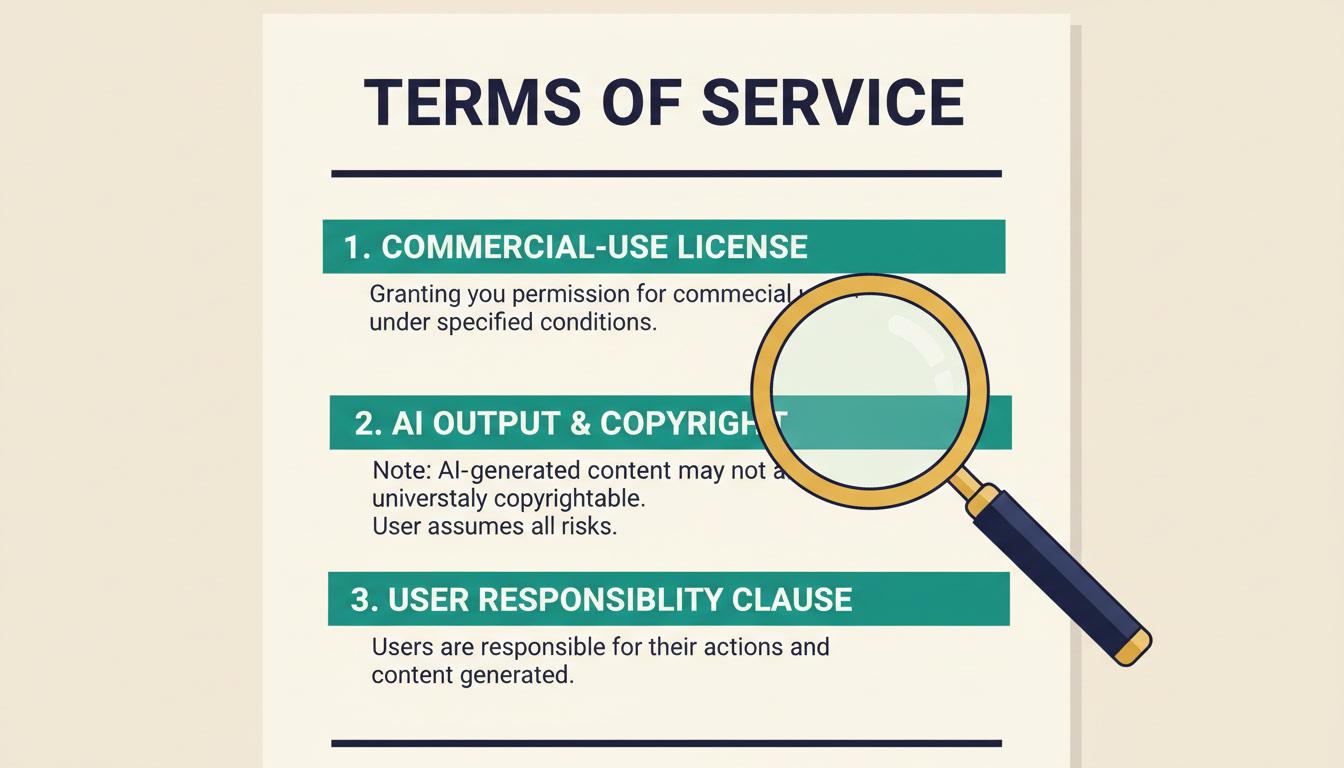
Read the Tool’s Terms
“KDP bans AI illustrations.”
It does not. It asks you to disclose them during title setup and holds you to the same rights warranty as any other artwork.
“Disclosing AI puts a warning label on my book page.”
The disclosure is a question you answer inside the KDP dashboard, not a badge printed on your listing or your cover.
“If I edit the image enough, it stops being AI-generated.”
Under Amazon’s wording, content a tool generated from your prompts stays generated no matter how much you edit it afterwards.
“Uncopyrightable illustrations means I cannot sell the book.”
Copyright and the right to sell are different things. You can publish and earn from it; you just have weaker grounds to stop copying of those images.
“My whole book is uncopyrightable because the art is AI.”
Your text, and your selection and arrangement of the pages, are human-authored and protectable. You disclaim only the generated material.
“The rules are the same everywhere.”
They are not. The United States, the United Kingdom, the European Union and China have taken visibly different positions, and several are still moving.
What Copyright Covers in an AI-Illustrated Children’s Book
“Can I publish it?” and “can I stop other people copying it?” are different questions with different answers. Confusing them is what makes this topic feel frightening.
Protected — You Wrote It
Claim these on a registration.
- The manuscript, line by line
- Your characters as written descriptions
- Your selection and ordering of the pages
- Any art you drew or meaningfully altered yourself
Generally Not Protected
Disclaim these on a registration.
- ✕ Illustrations a model produced from a prompt
- ✕ A generated cover image
- ✕ The prompts themselves, as a rule
- ✕ Machine-translated editions
The practical consequence: publish and sell freely, but assume the pictures are the weakest part of your book legally and the strongest part commercially. That is an argument for putting your value where the law still protects it — a story worth reading, and characters defined well enough in words that they survive being redrawn. It is also why a written character bible is worth keeping alongside the art.
The Rules Are Not the Same Everywhere
KDP is a global store, so your book meets several legal systems at once. None of them ban AI illustration; they disagree about what you end up owning.
United States
The Copyright Office requires human authorship. Purely prompt-generated images are refused registration, while the text you wrote and the way you selected and arranged the pages remain protectable. You disclaim the AI material on the application rather than hiding it.
United Kingdom
UK law has a long-standing provision for computer-generated works with no human author, giving a shorter term than ordinary copyright. It has been under review for years and its application to modern generative models is genuinely unsettled, so do not build a business on it.
Elsewhere
The EU is working through the AI Act’s transparency obligations, and Chinese courts have gone further than most in recognising rights in some AI-assisted images. If you sell internationally, the safe design is a book whose value sits in text and characters you authored.
What Actually Gets an AI-Illustrated Book Removed
“Used AI” is not on this list. These six things are, and every one of them is avoidable before you upload.
Undisclosed AI Content
The disclosure itself costs nothing. Getting caught having answered no to a question where the answer was yes is a content-guidelines violation, and KDP treats account honesty seriously.
Borrowed Characters and Styles
A prompt naming a franchise, a mascot or a living illustrator can produce an image that infringes on its face. The claim lands on you as the publisher, and the fact that a model drew it is not a defence.
Low-Effort Volume Publishing
Amazon has tightened limits on how many new titles an account can upload per day, aimed squarely at bulk AI output. One carefully made book is not the target of any of that — a flood of near-identical ones is.
Misleading Claims
Describing an AI-illustrated book as hand-painted, or inventing an illustrator who does not exist, turns a policy question into a straightforward misrepresentation problem. Say how it was made.
Real People in the Art
Uploading a photo of a child and generating a character from it raises likeness and, for other people’s children, consent questions that sit outside copyright entirely. Get permission or invent the child.
A Tool With No Written Licence
If your generator’s terms never grant you commercial use, your KDP rights warranty is resting on nothing. This is the single most-skipped check in the whole process.
Read What Your AI Illustration Tool Grants You
Your KDP rights warranty is only as strong as the licence behind your images. Three clauses decide it.
Is commercial use granted, in writing?
Not implied, not "we don’t mind" on a forum. C2Story’s terms grant you a non-exclusive, worldwide licence to use, download, share and commercially use the content created through your account — which is the sentence your KDP warranty leans on.
What does the provider keep?
Some services reserve broad rights to your outputs, or limit commercial use to paid tiers while quietly allowing free-tier generation. Read what is reserved, not only what is granted.
Is the tool honest about copyright?
C2Story’s terms say outright that AI-generated content may not be eligible for copyright protection in all jurisdictions, and that you are responsible for lawful use. A provider that promises you own full copyright in generated images is telling you something no provider can actually deliver.
You can read C2Story’s full terms of service and privacy policy before you generate a single page.
The Five-Point Pre-Publish Check
Run these five and you have covered essentially everything KDP policy and copyright law are going to ask of an AI-illustrated children’s book.
Disclose It
Tick the box in KDP
Hold the Rights
Check your tool’s licence
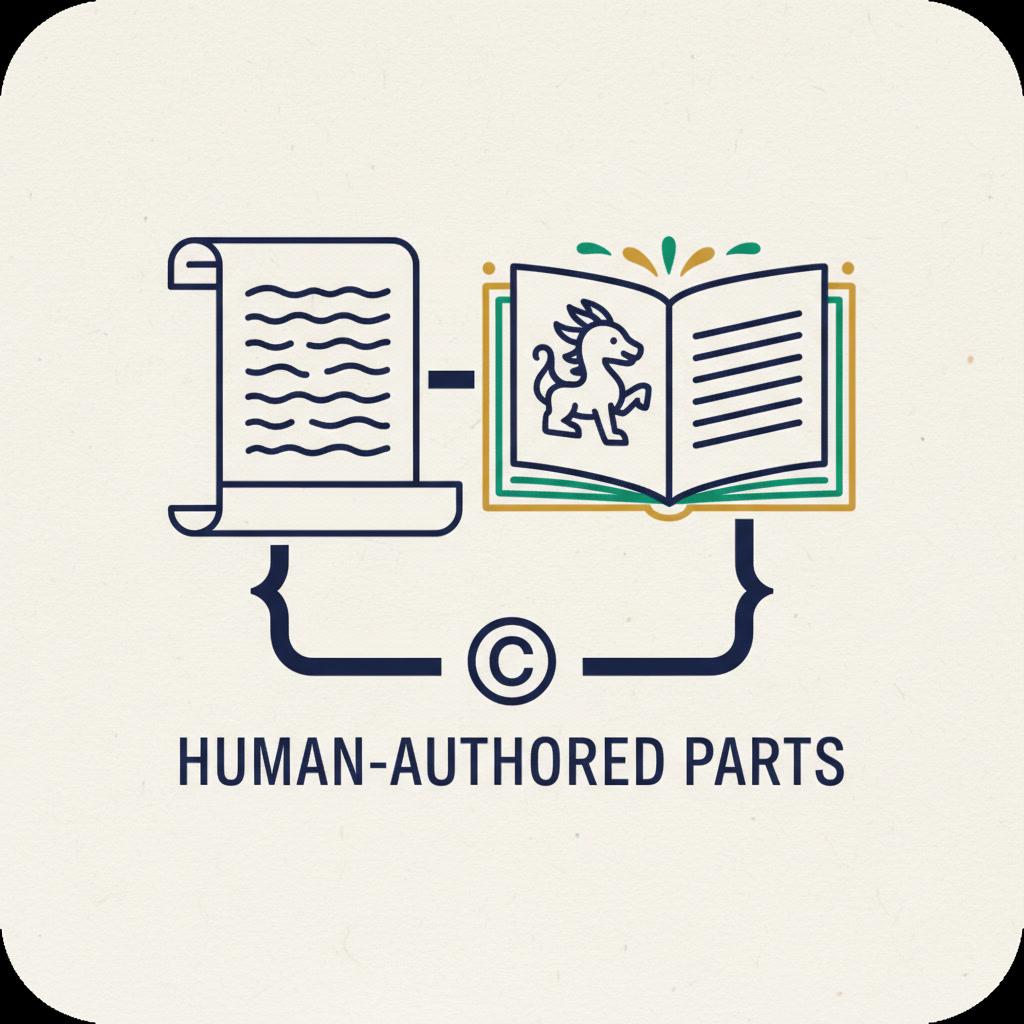
Register the Text
Claim the human parts
No Borrowed IP
Keep prompts original
Say It Plainly
Credit the method
Legal Is Not the Same as Well-Received
A lot of people asking whether it is legal to use AI to illustrate a children’s book are really asking whether they will be criticised for it. That is a fair thing to worry about. The children’s book community has a real and well-argued attachment to illustration as a craft, and illustrators have watched commissions disappear. Pretending otherwise helps nobody.
The approach that holds up is to be an author who uses a tool, not an author who hides one. Write the book. Make the design decisions — the characters, the palette, the page turns, what each spread has to show. Use AI for the rendering, say so on the copyright page, and do not invent an illustrator. If your budget ever allows a human illustrator, hire one; a good one will bring things no model will.
Practically, honesty is also the lower-risk position. A book that quietly claims hand-drawn art and is later identified as AI takes far more damage than one that said so from the start. The disclosure KDP collects is private, but your relationship with readers is not.
Terms You Will Meet on the Way to Publishing
None of these are jargon for its own sake — each one names something a self-publishing author has to decide or declare.
From the Rules to a Finished Picture Book
Everything C2Story makes comes with commercial use granted in writing and a print-ready export, so the compliance side is settled before you start.
Publishing to Amazon KDP
Trim sizes, bleed, and the print-ready PDF export path from a finished C2Story book to a KDP listing.
Self-publish a children’s book
The whole indie route end to end — writing, illustrating, formatting and getting it on sale.
Make the picture book
Turn a manuscript into an illustrated picture book with one cast held on-model across every spread.
Illustration, as a craft
Composition, palette and page turns — the decisions that stay yours no matter who or what does the rendering.
Keep the cast consistent
Design each character once and reuse that design, so your hero looks the same on page twenty-eight as on page one.
What happens to your data
What is stored, what is not, and what that means if you are drafting an unpublished manuscript in a browser.
Frequently Asked Questions
Explore More Story Ideas
Discover more styles, tools, and story types
Garden Stories
Planting seeds, sunflowers, butterflies and the veggie patch
Explore
Mid-Century Modern Books
Flat colour blocks & hard-edged geometry
Explore
Children's Book Creator
Design beautiful kids books
Explore
Storybird Alternative
Better AI story creation
ExploreIs It Legal to Use AI to Illustrate a Children’s Book? The Rules, in Plain English
Authors ask whether it is legal to use AI to illustrate a children’s book and get back a wall of forum arguments about ethics, lawsuits and model training. The legal question underneath is narrow and has a clear answer: there is no law against it, and Amazon KDP allows AI-generated content. What KDP requires is a disclosure — during title setup you are asked whether your book contains AI-generated text, images or translations, and if an AI tool produced your illustrations from your prompts, that is a yes. The disclosure lives in the KDP dashboard. It is not a badge on your product page and it does not stop the book going live.
The distinction that decides your answer is AI-generated versus AI-assisted. Generated means the tool made the material from your prompts, and Amazon is explicit that this remains true even if you edited the output substantially afterwards. Assisted means you created the content and used AI to refine, correct or brainstorm around it — your own drawing upscaled, your own manuscript line-edited. Only generated content has to be disclosed. Prompt-to-picture illustration is generated, so AI illustrations on KDP get ticked, and that is the end of the policy question. The other half of the upload is the rights warranty every KDP publisher makes: you must be entitled to publish everything in the book, which makes your generator’s licence terms a compliance document rather than boilerplate.
Copyright is where expectations need adjusting, not where permission is refused. The US Copyright Office has held consistently that material generated by AI from a prompt lacks the human authorship copyright requires, so those illustrations are excluded from protection — while your manuscript, your characters as you wrote them, and your selection and arrangement of the pages remain yours. On a registration you claim the human-authored elements and disclaim the generated ones. Selling the book and owning the pictures are separate questions: you can do the first without the second. Other jurisdictions have landed differently — the UK has an old computer-generated works provision under long-running review, the EU is working through AI Act transparency duties, and Chinese courts have been more willing to find protectable authorship in AI-assisted images — so an internationally sold book is safest when its value sits in the writing.
What actually gets books removed is rarely the AI. It is undisclosed AI content, prompts that reproduce a trademarked character or name a living illustrator, misleading claims about how the art was made, real people’s likenesses used without consent, and bulk uploads that trip Amazon’s daily title limits. Avoid those five and an AI-illustrated children’s book is an ordinary self-published book. C2Story’s terms grant a non-exclusive, worldwide licence to commercially use what you create and state plainly that AI output may not be copyrightable everywhere; from there, the picture book maker and the KDP publishing guide take you to a print-ready file. This page is general information reviewed in September 2026, not legal advice — check KDP’s current Content Guidelines and take proper advice for anything that matters.