The Character Wardrobe TimelineNobody Changes Coats Mid‑Chapter
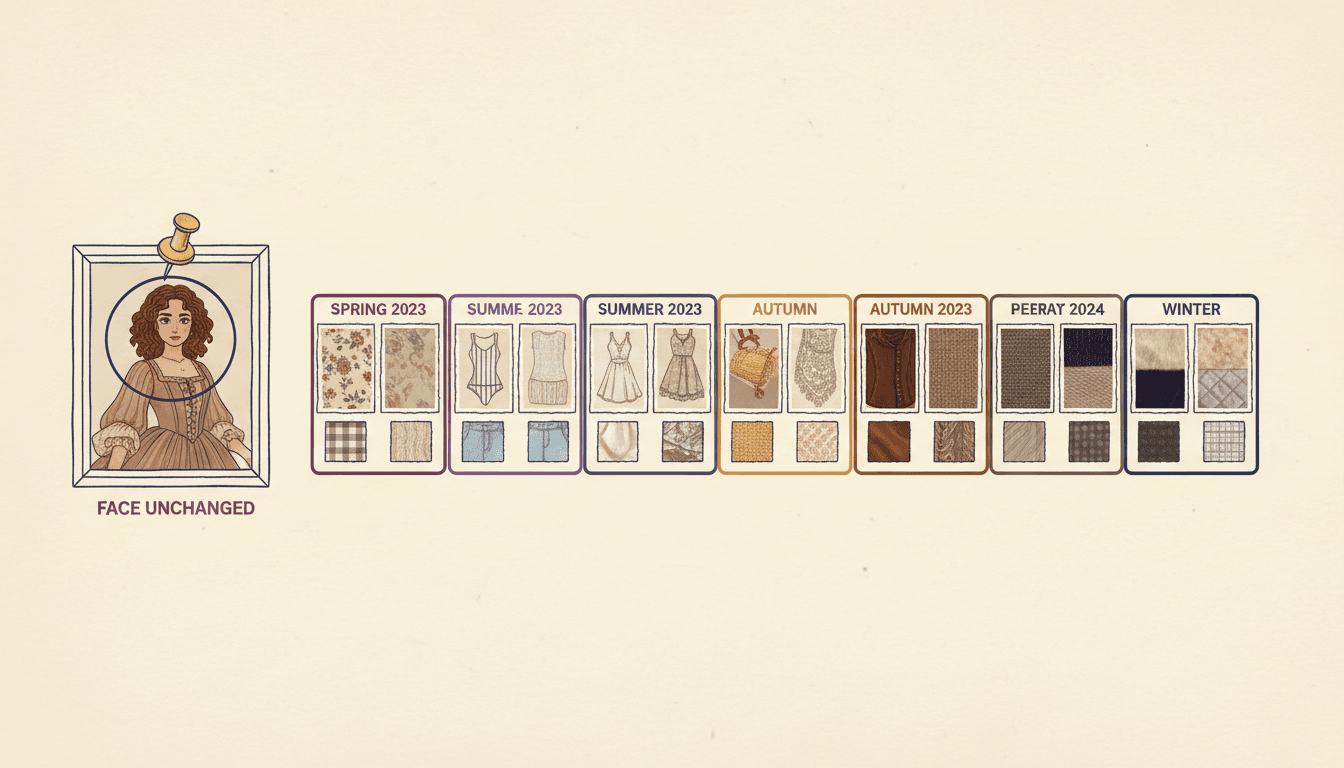
Keep track of what everyone is wearing, scene by scene. The face is locked to one reference and never moves — the clothes are on the story’s own clock, so the same day keeps the same outfit and a new day brings a fresh one.
- Pages grouped into time segments that share one outfit
- Every page placed on a real date, so clothes change when days do
- One season per chapter — never short sleeves beside a winter coat
- A signature look (always in black, that red scarf) held in every scene
250,000+
Stories Created
80,000+
Characters Saved
45+
Art Styles
4.9/5
Creator Rating
How a Character Wardrobe Timeline Works
Three steps, and the order is the whole trick: the story is put on a calendar before anybody decides what to wear.
Every Page Gets a Day
Your pages are placed on a real calendar, reasoned from the text in whatever language it is written in. One continuous moment shares a date; a scene change or a hint of time passing advances it. Dates never run backwards.
pages 1–4 → Mar 12 · pages 5–9 → Mar 13
Each Day Gets an Outfit
Pages sharing a date share an outfit, worded identically every time so nothing is left to improvise. A new date means a genuinely different outfit — still the same person's taste, dressed for that date's occasion, place and season.
Mar 12 — school uniform · Mar 13 — raincoat, boots
The Face Never Moves
Identity is handled separately and stays pinned to the character's saved reference. Every page draws the same face, hair and build from the same portrait, so changing the coat can never change the person wearing it.
identity: locked ✓ · wardrobe: on the timeline ✓
Consistency is not sameness — and this is the page that admits it
Every consistency feature in every AI book tool pulls in one direction: keep it the same. That is exactly right for a face and exactly wrong for clothing. A character in one identical outfit across a chapter that spans a fortnight is not consistent, they are frozen — and the book reads as a single endless afternoon. So wardrobe is deliberately split out from identity and given its own clock. If what you actually need is the face to stop drifting, that is the character consistency tool, and the two work together rather than instead of each other.
Character Outfit Consistency Without Freezing the Clothes
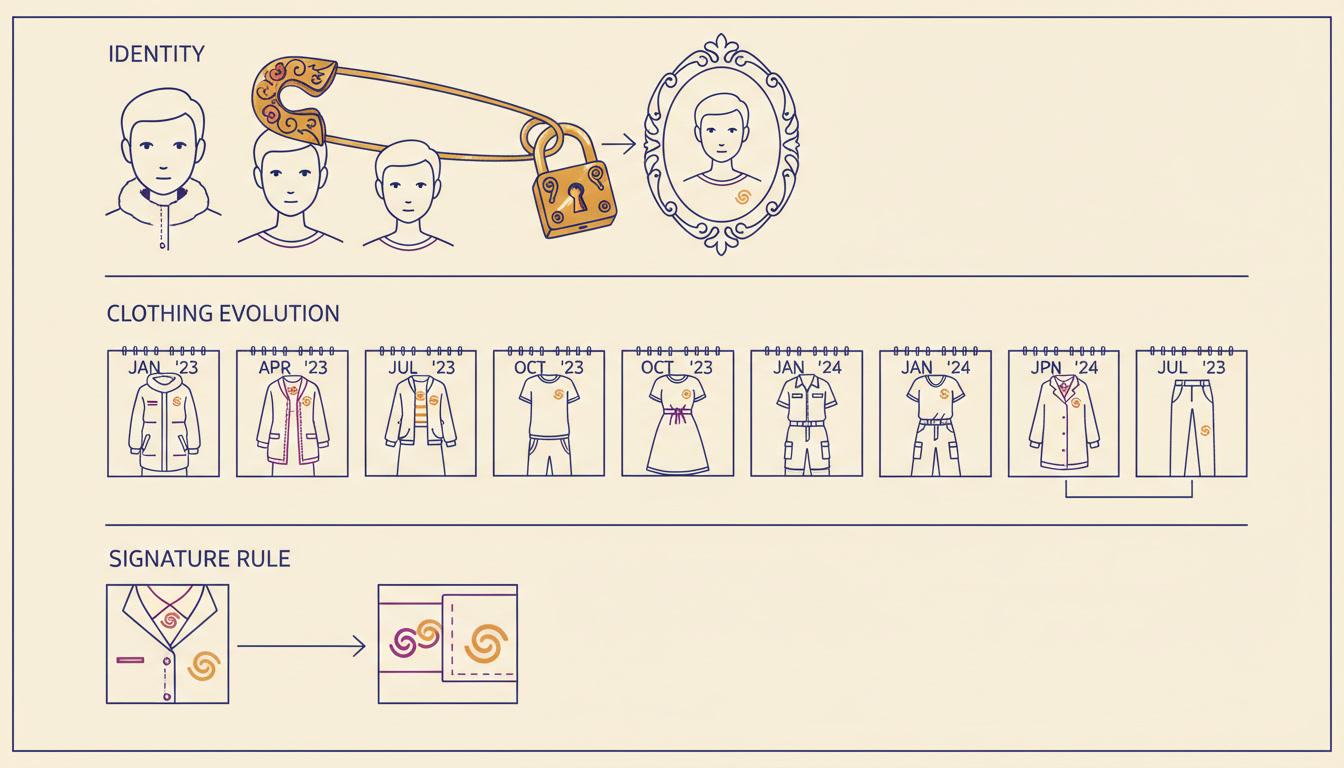
A character is not one look. They are an identity that must never change, a wardrobe that must change on schedule, and a taste that runs through both.
Lane one
Identity — Never Changes
Face, hair, build, the things that make someone recognisable. Pinned to one saved reference portrait and drawn from it on every page. Nothing in the wardrobe system is allowed to touch this lane, which is why a costume change cannot accidentally become a different child.
Lane two
Wardrobe — Changes on Schedule
Clothing, tracked per page against a date and a time segment. Identical within a stretch of story, different once the story moves to a new day, and always dressed for the occasion, location, weather and hour the scene actually describes.
Lane three
Taste — Runs Through Both
The standing rule read out of the character's own description: always in black, never a suit, only traditional dress, never without that scarf. Held in every scene as a property rather than an outfit, so the garments vary and the person does not.
Identity Is Locked, Clothing Is Not
This is the split the whole page rests on. The face, hair, build and identity are pinned to the character's saved reference and never move. The clothing is separated out and reasoned from the scene it appears in — its occasion, its location, its weather, its hour of the day. Every other consistency tool treats a character as one indivisible look. A wardrobe timeline treats them as a person who owns more than one shirt.
Every Page Gets a Day
Before any clothing is decided, the pages are placed on a real calendar. Shots that are one continuous unbroken moment share a date; when the scene changes or the text implies time passing, the date advances, and dates only ever move forwards. That calendar is what wardrobe is driven by: the same day means the same outfit, and a new day means a fresh one. The clothes are downstream of the clock, not of a guess.
No Costume Backfill
A character's clothing on any page may only reflect attire the story has introduced up to that page. If the animals put on choir robes when they join the choir on page seven, pages one to six show them without robes — playing, talking, in their everyday look. Special costumes are attached to the scene that calls for them and to no page before it. This is written down as a rule because it is the mistake nearly every generator makes.
One Chapter, One Season
A story that unfolds over days or weeks is one season. It is decided once, inferred from whatever the text gives — a cold morning, a holiday, cherry blossom, the heating on — and then every page's clothing has to fit it. No short sleeves on one page and a sweater on the next. Indoors a coat can come off, but the layer underneath stays seasonal: winter indoors is knitwear, not a summer tee.
A Signature Look Survives Every Change
Some characters have a standing dressing rule — always in black, never a suit, only ever traditional dress, that one red scarf. Those rules are read straight out of the character's own description and held in every scene, while the specific garments still change with the day. The rule is stored as a property rather than an outfit: every garment is black. So the character varies a black tee and black jeans against a black coat, and never turns up in beige.
The Place Outranks the Calendar
A date gives a season and a season is only a hint, because a calendar does not know where your story is. A tropical island is hot in December. A mild coastal city is cool in winter, not freezing. The southern hemisphere is the other way round entirely. So the season label is passed as a suggestion and the real decision is reasoned from the scene's own location and climate — which is why nobody ends up in a parka in the Maldives.
Continuity details that only a wardrobe timeline gets right
Wardrobe Continuity: Auto or Locked?
Both are legitimate and the story decides which. Get this one choice right and most outfit problems never appear.
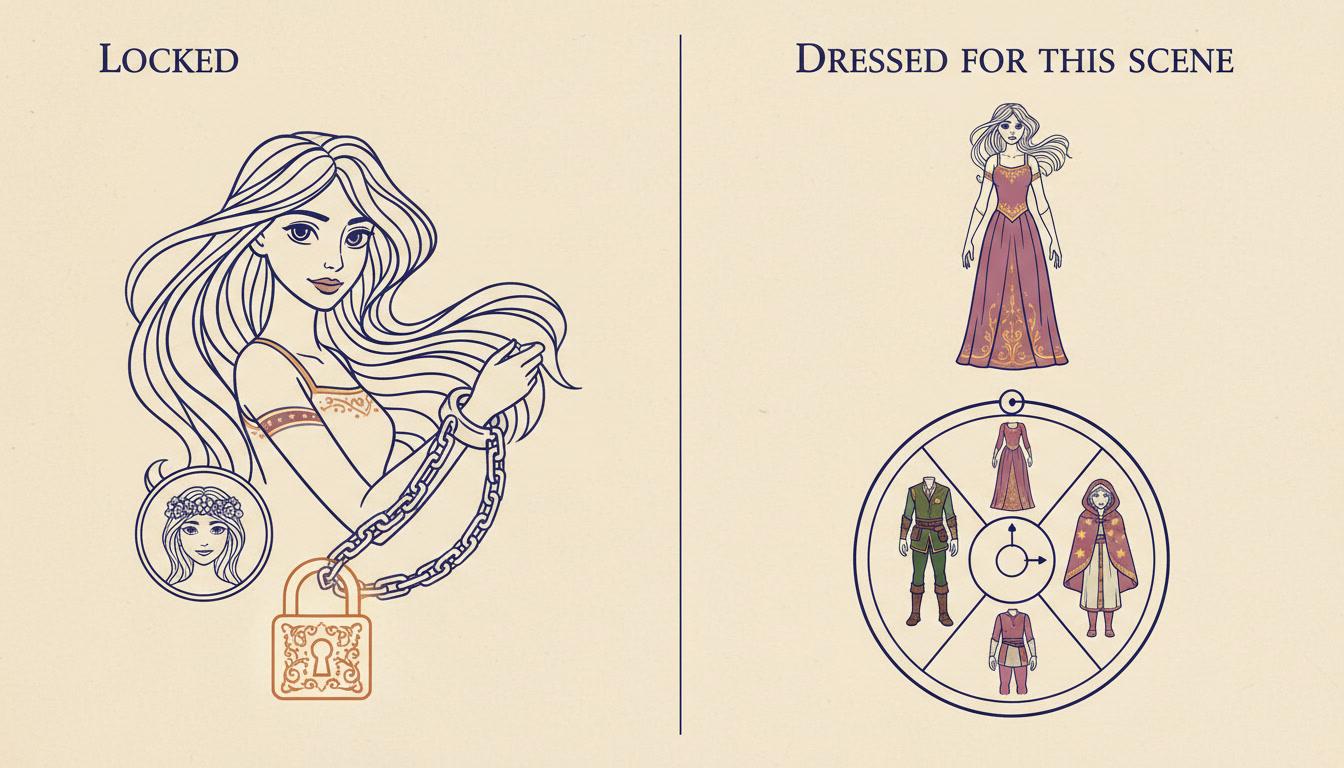
Auto — the default
- Face, hair, body and identity stay locked to the reference
- Clothing is dressed for each scene’s occasion and weather
- Reasoned from the text — never a hardcoded season table
- Best for anything spanning days, weeks or seasons
Locked — one outfit throughout
- The reference image’s exact outfit, in every single scene
- Nothing about the look is reasoned or varied
- Best for mascots, superheroes and uniforms
- Best for short books set inside one afternoon
Never invent an event just to change clothes
This is the guardrail that keeps auto mode safe, and it is stated outright in the instruction the illustrator receives. Clothing is a visual detail, not a plot point. The outfit is reasoned from what the scene’s own text already describes — so a page that mentions a downpour may add a raincoat, and a page that mentions nothing new does not get a shopping trip, a costume party or a sudden change of profession to justify a new jacket. Within a single image the outfit also stays fixed, because a character whose clothes shift inside one picture is a far stranger problem than one who never changes at all. If you want the story itself altered rather than the clothing, that belongs on editing an AI-generated book.
Where Character Clothes Tracking Usually Breaks
Almost every wardrobe error in an illustrated book is one of these two, and neither is obvious until you see it printed.
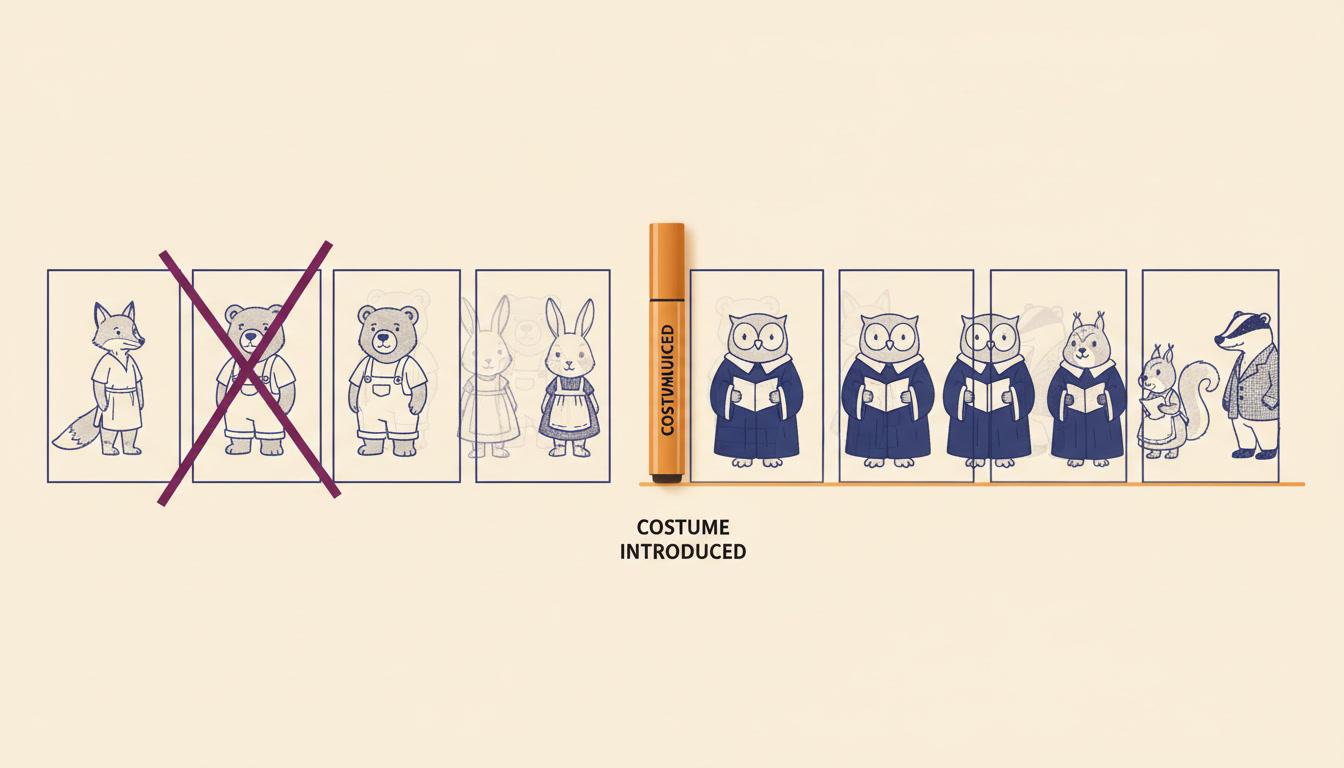
Case One: the Costume That Arrives Early
Give a generator the whole chapter at once and it reads ahead. It sees the choir on page seven, decides the animals are choir animals, and puts the robes on from page one — so your story about a group of friends who become a choir now opens with a choir. The robe has quietly spoiled the ending.
The rule that fixes it is absolute: a character’s clothing on any page may reflect only attire the story has introduced up to that page. Special costumes — robes, uniforms, gowns, armour, party clothes — are attached to the scene that actually places the character in them and to no page before it. Pages one to six show the everyday look, and a test in the codebase exists purely to prove the later robe never leaks backwards.
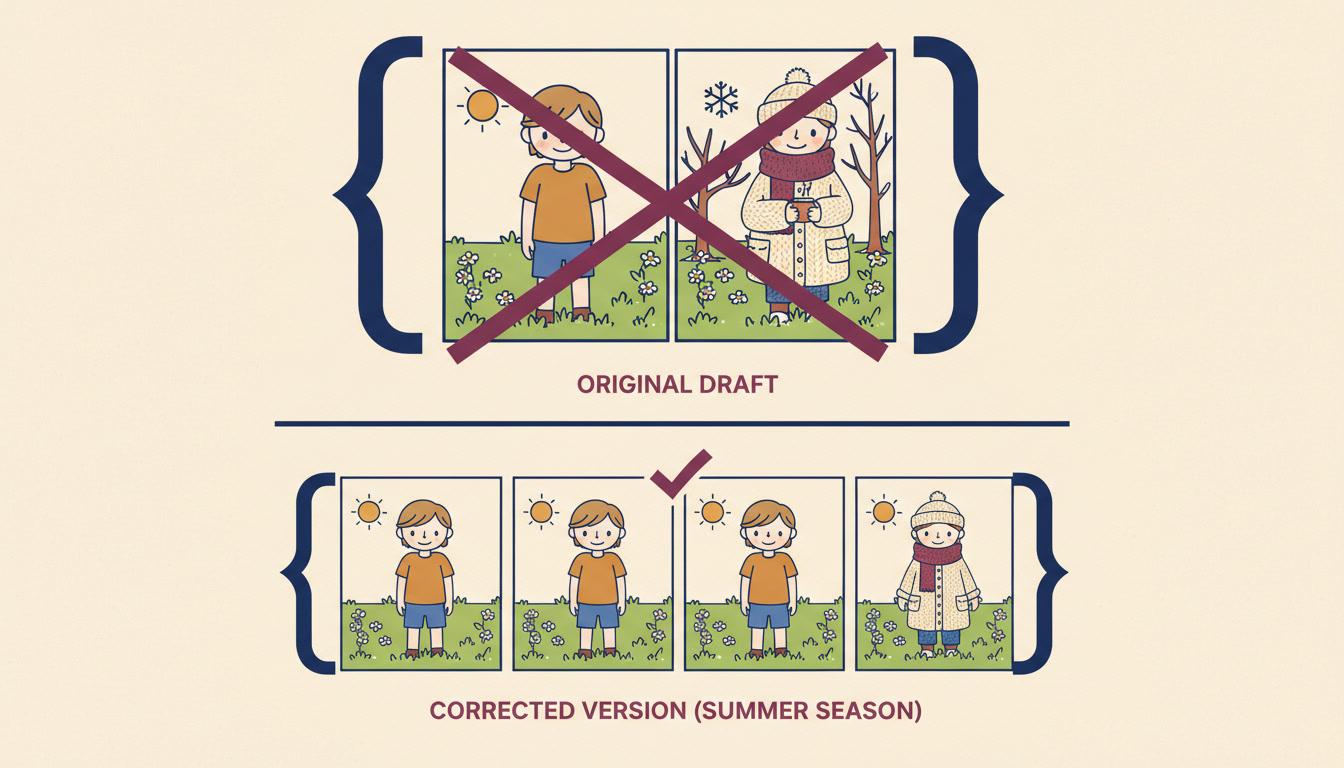
Case Two: the Chapter With Two Winters in It
Illustrate pages one at a time and each one picks its own weather. Page three gets a cardigan because the room felt cosy, page four gets short sleeves because the garden felt bright, and a reader turning between them sees the temperature swing thirty degrees inside one afternoon.
So the season is chosen once for the chapter, inferred from whatever the text gives — a cold morning, a holiday, blossom, the heating on — and with no cue at all a neutral spring or autumn is chosen and held. Then every page’s garments are checked against it: summer means light fabric and no coat, winter adds the layers. Indoors a coat comes off, but what is underneath is still seasonal. Multi-panel pages get a second pass whose only job is to enforce one climate across every panel.
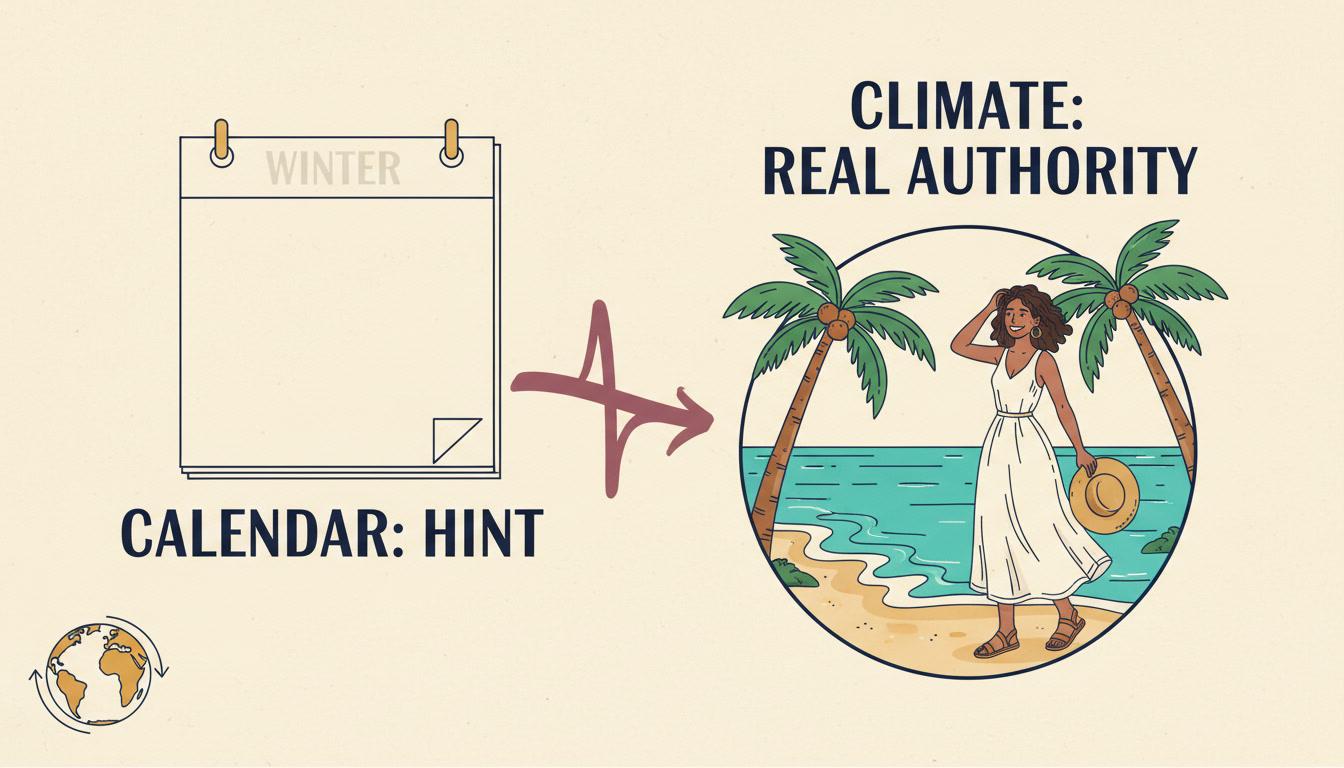
And the Trap Inside the Fix
Once a date drives a season, there is an obvious new way to be wrong: December is not cold everywhere. A story set on a tropical island is hot at Christmas. A mild coastal city is cool in winter rather than freezing. South of the equator the whole calendar flips.
So the season derived from the date is passed along explicitly as only a hint, and the actual decision is reasoned from the scene’s own location and its real climate. The calendar proposes; the place decides. It is a small thing that prevents an entire category of absurd illustration, and it is the reason this works for stories set anywhere rather than only in a northern temperate autumn.
One Timeline for the Whole Book
A chapter that is internally perfect can still contradict the chapter before it. The join is where wardrobe continuity is usually lost.
The Story Has a Start Date
Your whole project is analysed once into an ordered set of timeline beats — each with a label in the story's own language, how many days it sits after the story's first day, and its season if the text implies one. A real start date sits on top, inferred from the story's background and then yours to adjust. Every beat's absolute date is the start plus its offset, so moving the story from July to January is one edit and the wardrobe follows.
Chapters Hand Over to Each Other
When a chapter is directed, the previous chapter's final shot comes with it — its date and the description of who was in it and what they were wearing — handed over as continuity from earlier chapters. If this chapter opens on the same date, those outfits carry straight across. Only when the calendar moves to a new day does anybody get changed.
One Director, Not Twelve
The brief for every shot in a chapter is written in a single pass rather than shot by shot in isolation. That is what makes a continuity bible possible at all: outfits, carried props, time of day and locations are decided with the whole chapter visible at once, instead of each page making its own reasonable guess in the dark.
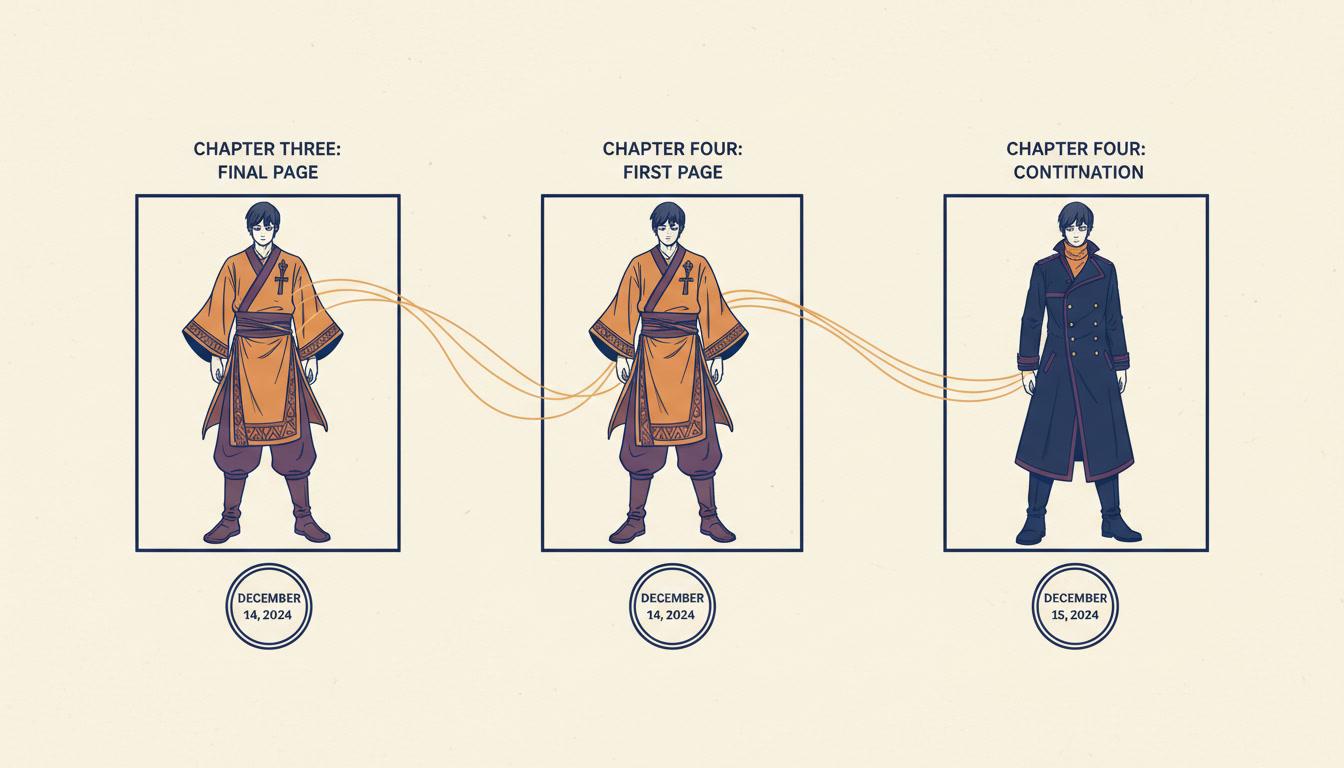
A Series Keeps Its Wardrobe Too
Outfits are written into each page’s brief in the same words every time, and the character’s persona — their taste, their signature look, how someone like them dresses — lives on the character record rather than in a chapter. That is why book three still dresses the same person the same way book one did.
If you are building a long series and want the whole cast’s looks, names and history in one reusable record, that is the job of an AI character bible, and keeping the same cast across several books is what a story series generator is for.
What Wardrobe Continuity Sounds Like
No spreadsheets, no costume database, no re-describing an outfit twenty-four times. You say when the clothes may change and the timeline does the rest.
Three Lanes
No Backfill
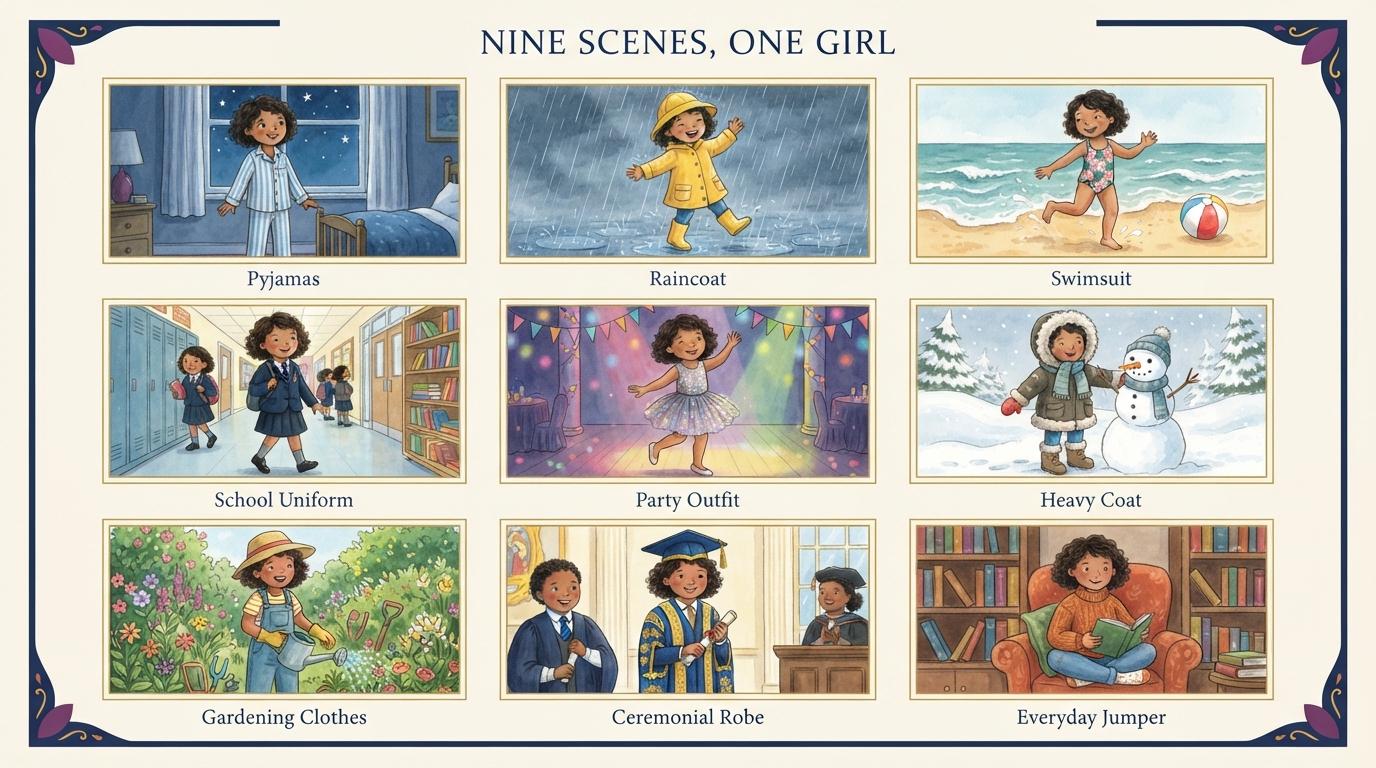
One Cast, Many Clothes
“Keep her in the same outfit for the whole breakfast scene”
“It is the next morning now — she should be dressed differently”
“This chapter is midsummer; nobody wears a coat in it”
“He is always in black — vary the clothes, never the colour”
“The robes only appear once they join the choir on page seven”
“Chapter four opens on the same day chapter three ended”
The Segment
Same stretch, same clothes
The Date
A new day, new clothes
The Season
One chapter, one climate
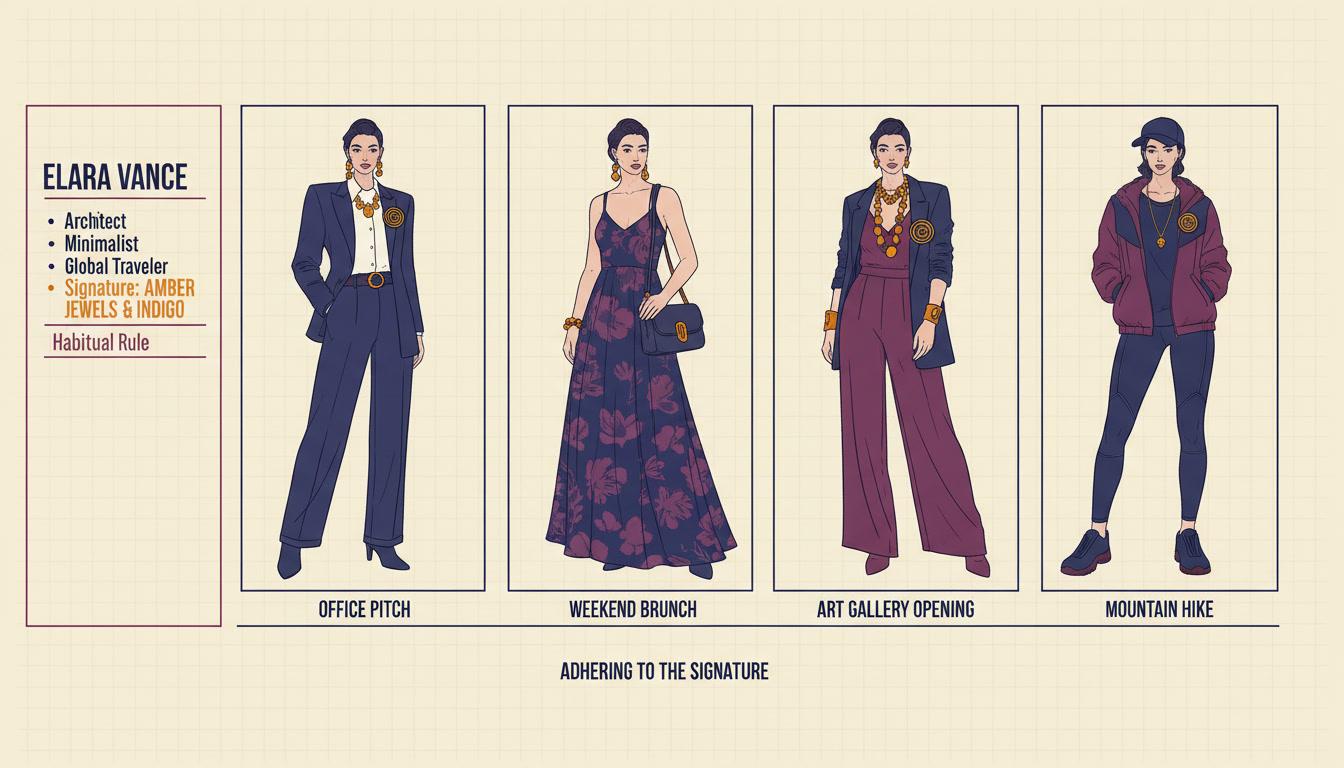
The Rule
Always in black
The Place
Location beats the label
What a Character Wardrobe Timeline Will Not Do
The edges, said plainly. Wardrobe is the most-failed rule in the whole brief, and a page that pretended otherwise would be selling you something.
It Is a Rule, Not a Guarantee
Wardrobe is enforced by instructions given to an illustrator, checked shot by shot, and it is flagged internally as the single most-failed rule in the brief. That is why it is repeated on every shot rather than stated once. It gets it right the overwhelming majority of the time, and it is not a deterministic lock — read the book before you print it.
No Garment Database
There is no wardrobe closet you populate with items and assign by SKU. Outfits are described in words on each page, carried forward by date and held to your character's taste and rules. If you need one exact garment reproduced precisely on every page, the honest answer is locked mode, or a reference image of that garment.
Clothing Is Not the Face
This system deliberately never touches identity. If a character's face or build is drifting between pages, no amount of wardrobe tracking will help and it is a different tool entirely. Fix the identity first with a locked character reference; wardrobe continuity only becomes visible once the person underneath is stable.
A Story With No Clock Gets No Timeline
If your text never implies time passing, everything sensibly lands on one date and everybody keeps one outfit — which is correct, not a failure. Timelines earn their keep on stories that move: days, seasons, a growing child, a journey. A single-afternoon picture book barely needs one.
It Will Not Invent Plot for Fashion
Outfits are reasoned from what the scene already says. The system is explicitly forbidden from inventing an event just to justify a change of clothes, so if you want a character in a ball gown, the story needs a ball in it. A wardrobe that writes your plot would be a worse problem than a repeated coat.
Seasons Come From Cues, Not Magic
The season is inferred from what your text actually gives. With no cue at all a neutral spring or autumn is chosen and held consistently, which is sensible but may not be your intent. If the season matters to you, one line of text saying so is worth more than any amount of inference.
Wardrobe is the kind of detail nobody notices when it is right and nobody can un-notice once it is wrong. Stating where the edges are is how you know which pages to look at twice.
Stories Where the Clothes Have to Move
The longer the story and the more time it covers, the louder a frozen wardrobe becomes.
Chapter Books & Novels
Twelve chapters covering a school year. Nothing exposes a frozen wardrobe faster than a character who wears the same jumper from September to June.
Bedtime Books With a Bedtime
A story that starts at breakfast and ends at lights-out needs pyjamas at the end and not at the beginning. A tiny detail that children notice instantly.
Story Videos & Trailers
Motion makes a costume error unmissable. The auto and locked switch lives on the video side precisely because a clip cannot hide what a still page can.
Series With a Recurring Cast
Book four has to dress the same people as book one, in clothes that suit book four. Persona and taste live on the character, not the chapter.
Large Casts
Six characters in one scene means six wardrobes on one timeline, each dressed to their own taste — not six variations of the same outfit.
Seasonal & Holiday Stories
A book built around a season lives or dies on its clothing. One consistent climate per chapter, reasoned from the place, is the whole job.
Is the Wardrobe Really the Problem?
This page is for people whose characters’ clothes are misbehaving. If it is something else, one of these starts closer to where you are — and they all share the same saved characters.
Yes — put my story on a timeline
Start here. Write or paste the story, and let the pages be dated before anybody decides what to wear.
The face keeps changing, not the coat
Lock each design once from a reference so every page draws the same person instead of guessing again.
I keep losing track of who is who
Pin looks, names, taste and history into one reusable record so book three still agrees with book one.
Fix the outfit on a page already drawn
Change one page, one illustration or one character description in a book you have already finished.
Show me the pages before they render
See the book as a board with its dates and shots laid out, so wardrobe problems are caught before the art exists.
The same cast, story after story
Build characters designed to come back, with the taste and looks that make them recognisable every time.
I have a long manuscript
Upload the whole text and have it split into dated chapters and illustrated pages from the start.
My series needs one source of truth
Keep continuity — cast, places, timeline — organised across every book instead of in your head.
I do not have a book yet
Make the illustrated book first. Everything on this page is waiting for you afterwards.
Give each character their own voice
Casting rather than costume — a voice saved onto the character record so chapter twelve sounds like chapter one.
I want a different art style
Browse the illustration styles a book can be drawn in, from watercolour to cel-shaded anime.
Show me everything else
The full tool shelf — generators, converters and editors, all working off one saved character library.
Frequently Asked Questions
Explore More Story Ideas
Discover more styles, tools, and story types
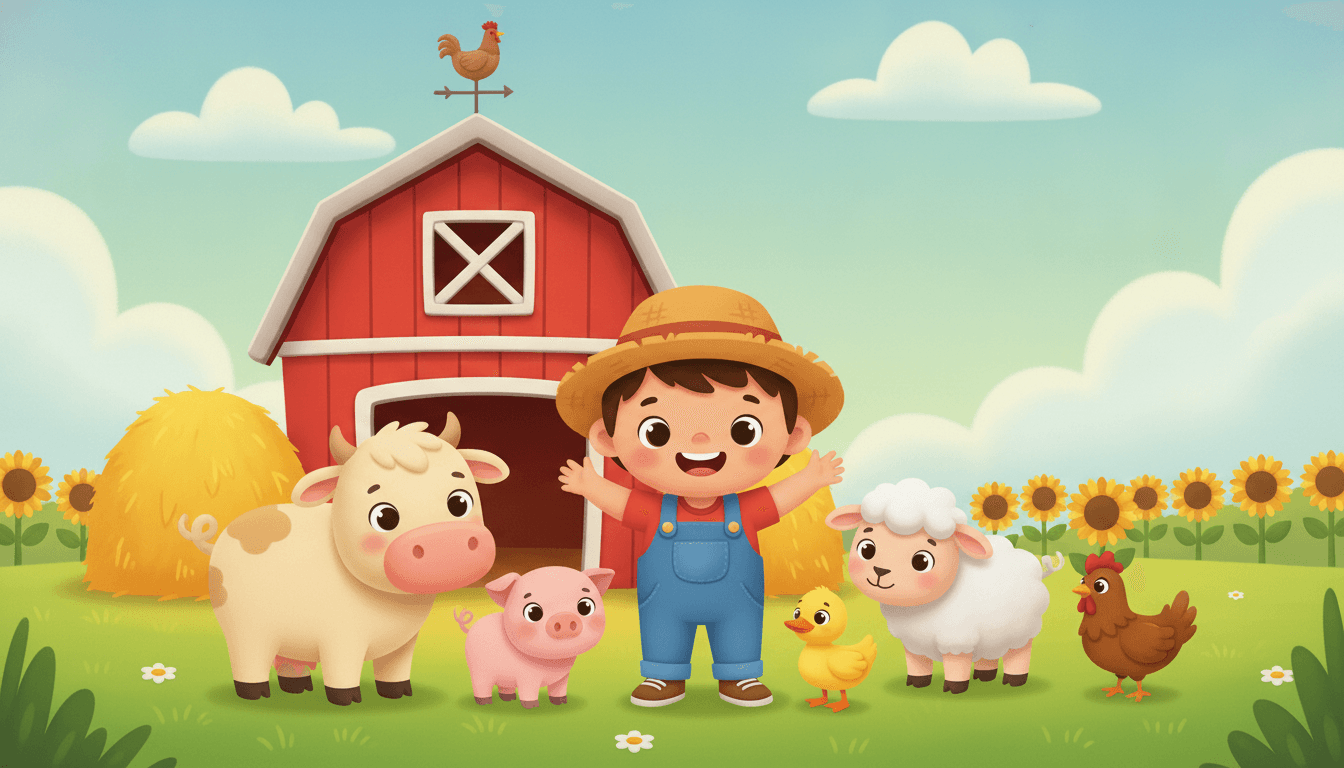
Farm Stories
Friendly farm animals and barnyard fun
Explore
Watercolor Picture Books
Soft washes & dreamy textures
Explore
Bedtime Stories for Anxious Kids
Calming tales that soothe worries
Explore
ChatGPT vs C2Story
Purpose-built for picture books
ExploreCharacter Wardrobe Timeline: One Locked Face, a Whole Calendar of Clothes
There are two ways to get a character’s clothes wrong in an illustrated book, and almost every tool only protects you from one of them. The famous failure is the one everybody names: a character who changes coats between two halves of the same conversation, or loses a scarf crossing a room. The other failure is quieter, much more common, and considerably worse for the book — a character locked into one identical outfit for twenty-four pages that are supposed to span a fortnight. Nothing about it looks like an error on any single page. It just makes the entire story read as one very long afternoon. A character wardrobe timeline exists because both of those are continuity bugs, and fixing only the first one causes the second.
So C2Story splits a character in two. Identity — the face, the hair, the build, everything that makes someone recognisable — is pinned to a saved reference portrait and never moves. Clothing is pulled out as a separate concern with its own rules, its own instruction block and its own clock. On the video side this is a plain two-position switch: locked keeps the reference image’s exact outfit in every single scene, and auto keeps the face, hair, body and identity identical to the reference while dressing each character for this scene — its occasion, its location, its weather, its hour of the day. Auto is the default, because most stories move. Locked is genuinely right for mascots, uniforms, superheroes and books that happen in one afternoon, and it is one click away.
What makes character outfit consistency work rather than merely sound good is the order of operations. The clothes are not decided page by page. First the pages are placed on a real calendar, reasoned from the text itself in whatever language it happens to be written in: shots that are one continuous unbroken moment share a date, a scene change or an implied passage of time advances it, and the dates only ever move forwards. Only then is wardrobe decided, and it is decided from that calendar. The same day means the identical outfit, worded the same way every time so there is nothing left to improvise. A new day means a genuinely different outfit, dressed for that day’s season. A chapter spanning several days must show several outfits, and that is stated as a requirement rather than left as a hope.
Inside a chapter the same idea appears as a time segment on each page. Pages in one segment keep one outfit; the segment increments on a real break — the next morning, after going home, a week later, that evening — or on an occasion a person would actually change for, like a ceremony, a party, a big meeting, a workout or a trip to the beach. An outfit description is attached only when a change is warranted, and deliberately left empty when the clothes genuinely stay the same. That empty field is doing more work than it looks like: a system that re-describes an outfit on every page is a system whose outfits drift.
Then there is the rule that stops a generator from spoiling your ending, which is worth the whole feature on its own. Given a chapter to illustrate, a model reads ahead. It notices the animals join a choir on page seven, concludes that these are choir animals, and dresses them in robes from page one — so a story about friends who become a choir now opens with a choir. The rule against it is absolute: a character’s clothing on any page may reflect only attire the story has introduced up to that page. Special costumes — robes, uniforms, gowns, armour, party clothes — attach to the scene that actually places the character in them and to no page before it. Pages one to six show the everyday look, and there is a test in the codebase whose only purpose is to prove that page seven’s robe never leaks backwards onto page six.
Wardrobe continuity also means one climate per chapter. Illustrate pages independently and each picks its own weather: a cardigan here because the room felt cosy, short sleeves there because the garden felt bright, and a reader turning between them watches the temperature swing thirty degrees in an afternoon. So the season is chosen once, inferred from whatever the text offers — a cold morning, a holiday, blossom, the heating on — and every page’s garments are then checked against it directly: summer means light fabric and no coat, winter adds the layers, indoors the coat can come off but what is underneath stays seasonal. Multi-panel pages get a second pass whose entire job is enforcing one season across every panel, because that is the place where a single image can contradict itself.
And there is a trap inside that fix which is easy to miss: December is not cold everywhere. A story set on a tropical island is hot at Christmas, a mild coastal city is cool in winter rather than freezing, and the southern hemisphere flips the whole calendar. So the season derived from a date is passed along explicitly as only a hint, and the real decision is reasoned from the scene’s own location and its actual climate. The calendar proposes; the place decides. Alongside it runs a character’s own standing rule, read straight out of their description — always in black, never a suit, only traditional dress, never without that red scarf — and kept as a property rather than an outfit, so a character who is always in black wears a black tee on the beach and a black overcoat in the snow and is unmistakably themselves in both.
None of it would hold together page by page, which is why the brief for every shot in a chapter is written in a single pass with the whole chapter visible at once: a continuity bible covering outfits, carried props, time of day and locations, rather than twelve pages each making its own reasonable guess in the dark. Across the join between chapters the previous chapter’s final shot is handed over with its date and its wardrobe, so if the new chapter opens on the same day the clothes carry straight across and only change when the calendar does. Above all of it sits the project’s timeline: an ordered set of beats, each with a day offset and a season, anchored to a start date you can adjust — which means moving your story from July to January is one edit and the wardrobe follows the new months.
One honest caveat, because wardrobe is flagged internally as the most-failed rule in the entire brief. This is enforcement by instruction, checked shot by shot and repeated on every shot for exactly that reason — not a deterministic lock. It is right the overwhelming majority of the time and you should still read the book before you print it. There is also no garment database to populate: outfits are described in words, carried forward by date, and held to your character’s taste. If you need one exact garment reproduced pixel-perfectly on every page, locked mode is the honest answer.
Ready to stop anybody changing coats mid-chapter? Start a story at create and let the pages be dated before the clothes are chosen. If the problem is really the face rather than the coat, fix that first with the character consistency tool. To pin a whole cast’s looks, taste and history into one reusable record, build an AI character bible; to keep that cast straight across a whole series, use the series bible organizer. If the outfit is wrong on a page that already exists, the fix lives on editing an AI-generated book, and if you would rather catch wardrobe problems before any art is rendered at all, lay the book out first with the AI storyboard generator. Or open your character library, write one line about how someone dresses, and watch it hold for the rest of the book.