Personalised Christening BookThe Reader Is Five Years Away
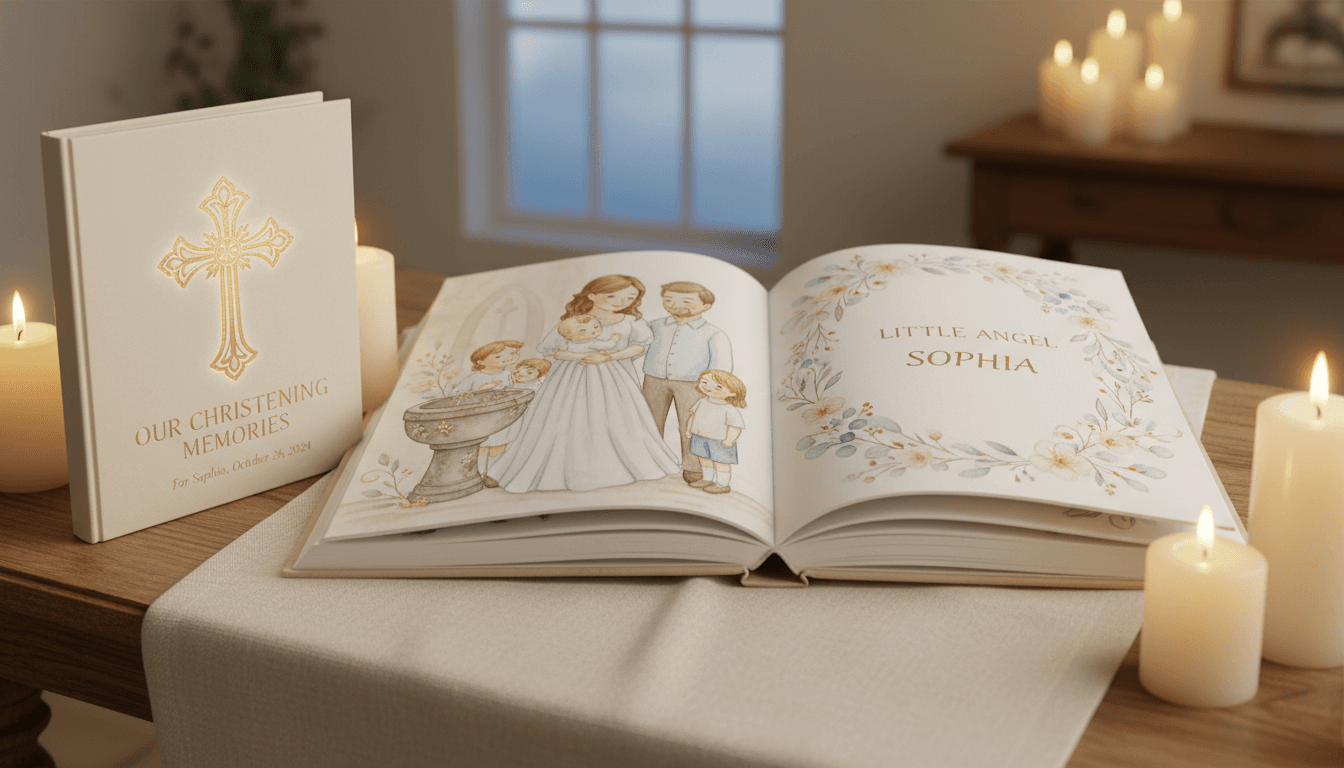
A personalised christening book is the one gift handed to someone who cannot read a word of it yet. So make it for who they will be, not for the room: their name, their day, the people who promised something on their behalf — and a dedication written straight to the seven-year-old who will open it.
- The full name, the date, the church — the things that matter in twenty years
- Godparents and grandparents drawn as themselves on every page
- A dedication page written as a letter, not a caption
- As much faith, or as little, as your family actually wants
250,000+
Stories Created
80,000+
Characters Saved
45+
Art Styles
4.9/5
Creator Rating
How to Make a Personalised Christening Book
Three steps, and the first one is the boring one that decides whether the book is still good in fifteen years.
Get the Names Right First
The full baptismal name, spelled the family's way. The date. The church, the hall, the town. Gather them before you write anything — these are the details that carry the whole object once the day itself has gone fuzzy.
Saoirse Máire Devlin · 14 June · St Brigid's
Cast the People Who Came
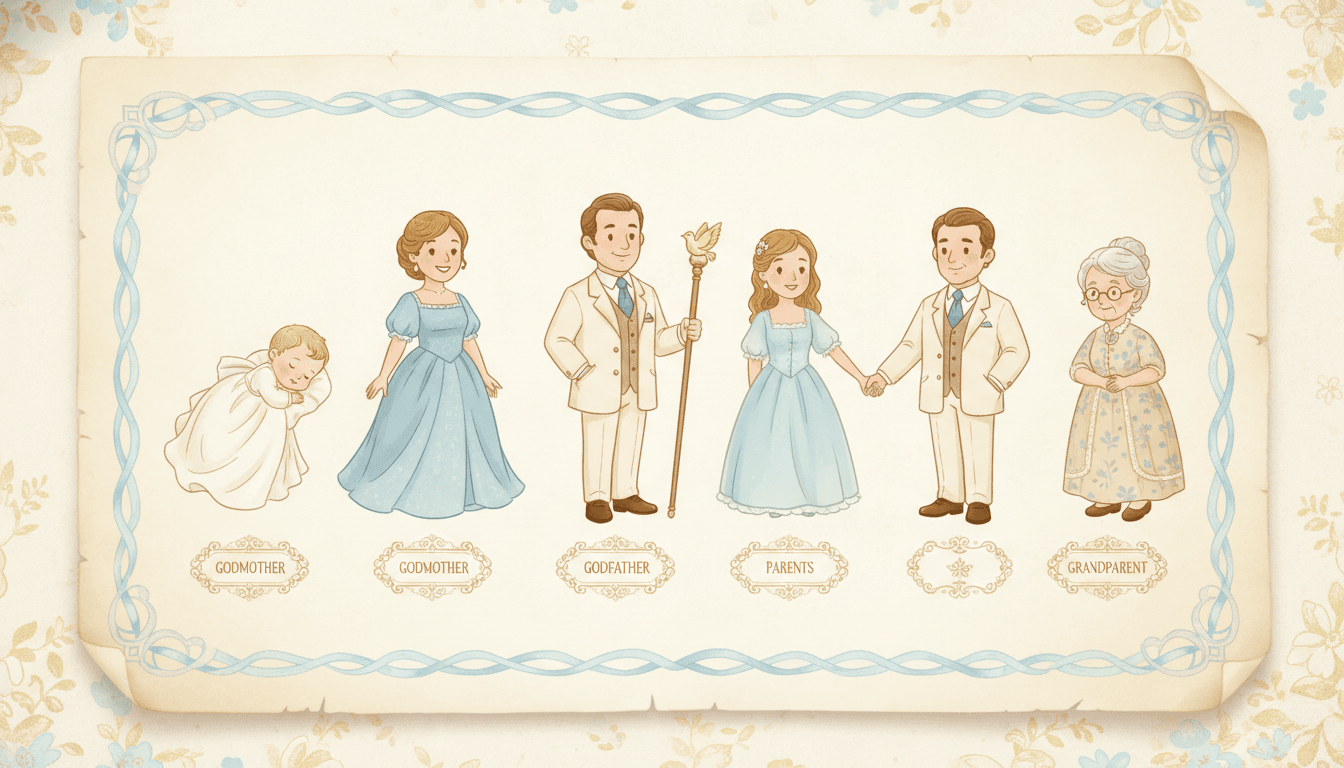
Parents, godparents, grandparents, the unimpressed sibling. Each is saved as their own character with a fixed design, so the godfather on page three is the same man on page eleven instead of a new stranger.
6 people saved → 1 illustrated cast page
Write the Dedication Last
Once you have seen the book, write the one page that is addressed directly to the child. Not a caption, not a blessing off the internet — a letter from you, to whoever they turn out to be.
from a godmother, to be read in 2033
Why the names come before the story
Because they are the part that does not age. Fifteen years from now nobody will care whether the plot of the book was charming; they will care that it says her grandmother's name was Máire and that it is spelled correctly. Names are also the most annoying thing to fix late — a misspelling caught after eleven illustrated pages exist means editing eleven pages. So gather them first, type them once, and let the story be built around details that are already right. If you would rather the child be the hero of an invented adventure instead, that is a personalised children's book and it is a different and perfectly good thing to make.
A Christening Keepsake Book Is Written Forward
It is given on a day the child will not remember, to be opened on a day you will not be there for. Everything else follows from that.
The Reader Is Five Years Away
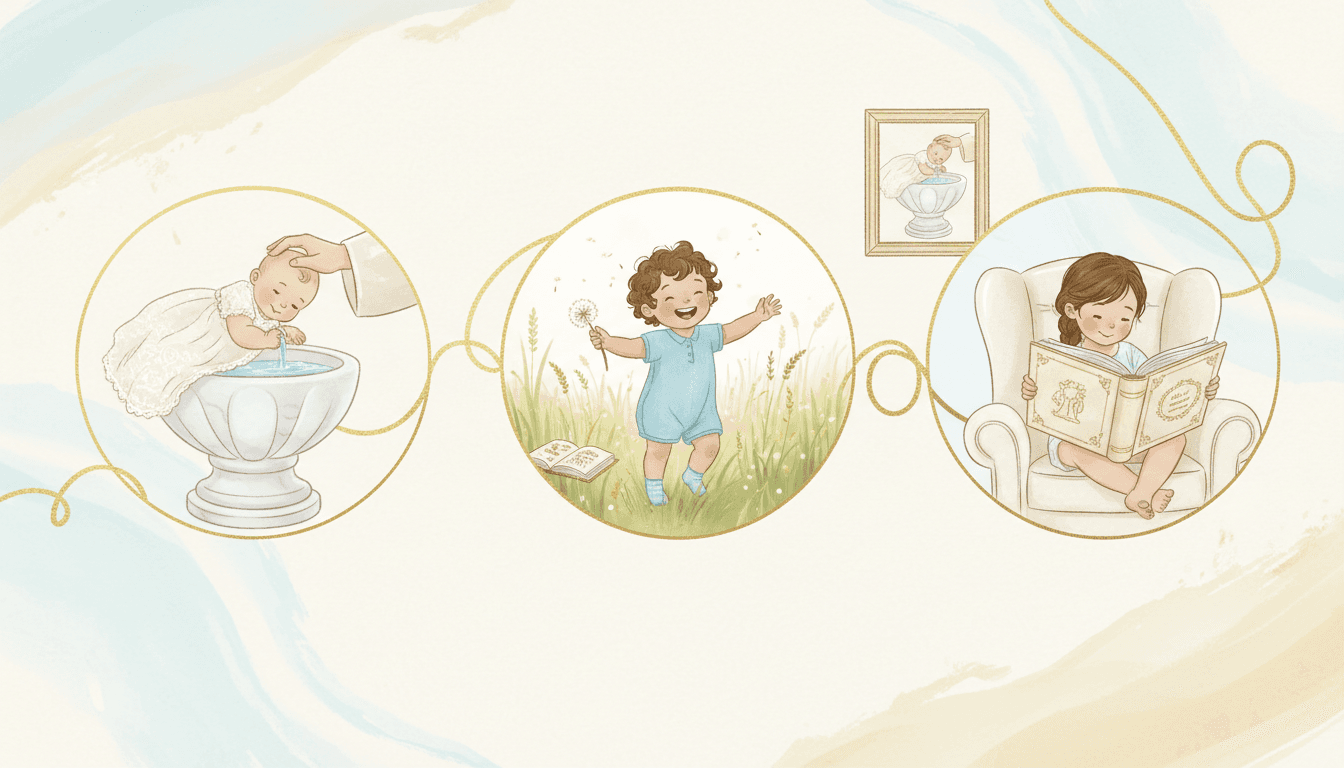
Every other personalised book is made for a child to enjoy this week. A christening book is handed to someone who will not read a word of it for half a decade. That single fact should change what goes in it — and usually does not. A book written for a baby is written for the adults holding the baby, which is why so many christening gifts read like a card and get shelved by August.
A Newborn Has Not Done Anything Yet
The usual personalised-book engine makes the child the hero of an adventure. A six-week-old has no personality to write to, no favourite animal, no best friend — so an adventure starring them is fiction about a stranger. The honest subject of a christening book is the day and the people at it: who came, who promised what, what the light was like.
The Dedication Is the Point, Not the Nicety
On most gift books the dedication is a line above the title page. Here it is the reason the object exists: it is the one part written directly to the person who will open it years from now, by someone who cannot know who they will have become. Write it as a letter, not a caption. It is the page they will actually come back to.
Godparents Are Characters, Not Footnotes
Godparents, grandparents and the friend who drove four hours are the cast of this story. Each one is saved as their own character record with a fixed design, so the godmother on page three is recognisably the same person on page eleven — and you can put every one of them on a single illustrated cast page at the front.
A Photo Becomes an Illustration, Never a Photograph
You can upload a photo of the baby so the drawn child actually resembles them. What comes back is a painted storybook character — the image prompt explicitly rules out a photorealistic real person, every time, by design. A christening book full of face-swapped photographs is unsettling in a way nobody asks for.
The Church Is a Place, Not a Face
Locations and objects are handled separately from people on purpose. A church, a font, a family house — these carry no likeness, so a photo of the baby is never used as the drawing guide for the building. It sounds obvious. It is the exact bug that makes a nave come back looking like somebody portrait.
Things worth putting in a christening book that nobody thinks of on the day
Write the Dedication Like a Letter
Of everything in the book, this is the page that gets re-read. It is also the page most christening gifts waste on a quotation somebody found online.
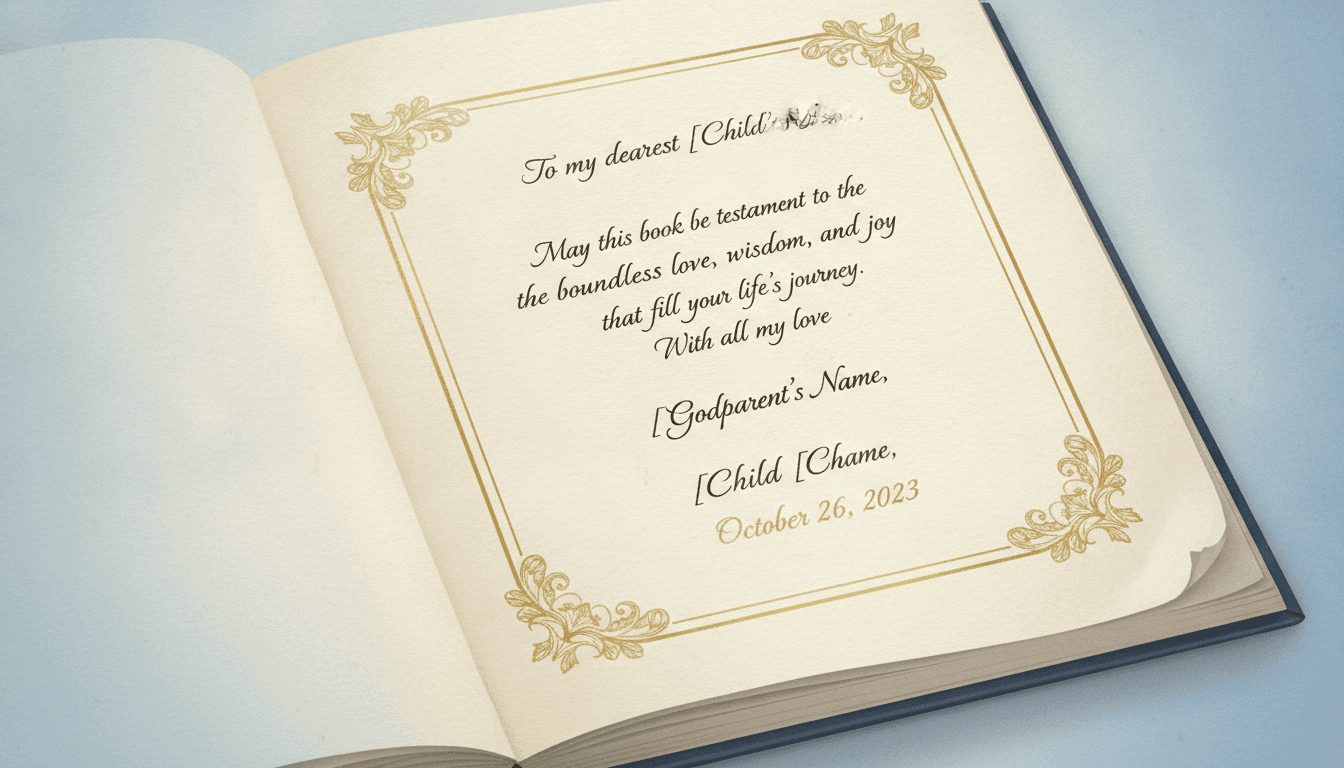
Write to the person, not the occasion
- Say who you are — they will not remember meeting you
- Say what you promised and that you meant it
- Name one small true thing about the day
- Date it and sign it in your own words
What to leave off it
- A blessing copied from the first search result
- Advice for a life you cannot predict
- Anything addressed to the parents instead
- Jokes that need the room to explain them
Write it after you have seen the book, not before
Dedications written first are always about the writer. Dedications written last are about the book — you have just spent an evening choosing which six people belong in it and what the afternoon actually looked like, and that work tells you what the letter needs to say. It is also the cheapest page to change: text costs nothing to rewrite, whereas illustrations cost credits, so leave the words open for as long as possible and spend your revisions there.
Godparents, Grandparents and the Baby, On Model
A christening book has an unusually large cast for a picture book, and every one of them is somebody who will open it and look for themselves.
The photo
Upload It, Get an Illustration
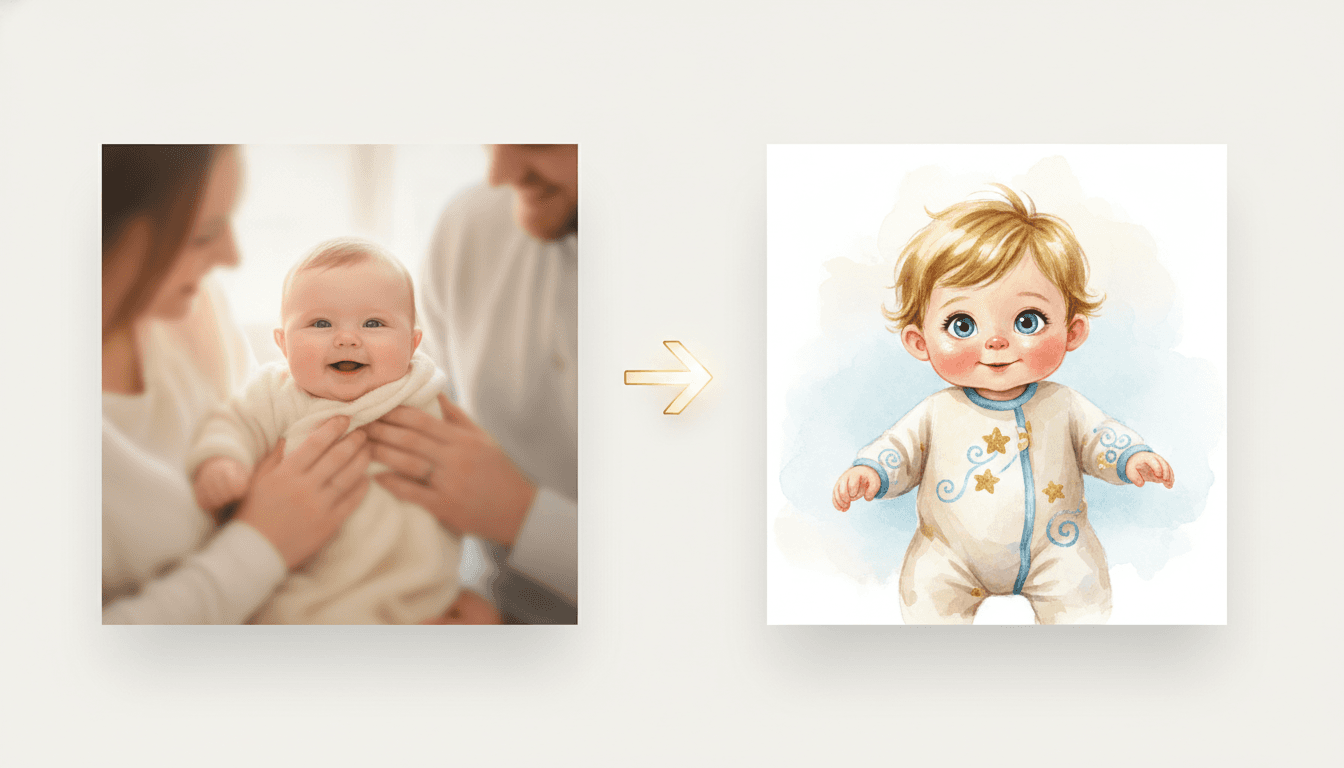
There is a "making it for someone? upload their photo" step when you add a person. The photo becomes the likeness reference for a painted character — the prompt behind every character image explicitly rules out a photograph or a real person, so you cannot end up with a face pasted into a watercolour.
The record
Saved, Not Re-Described
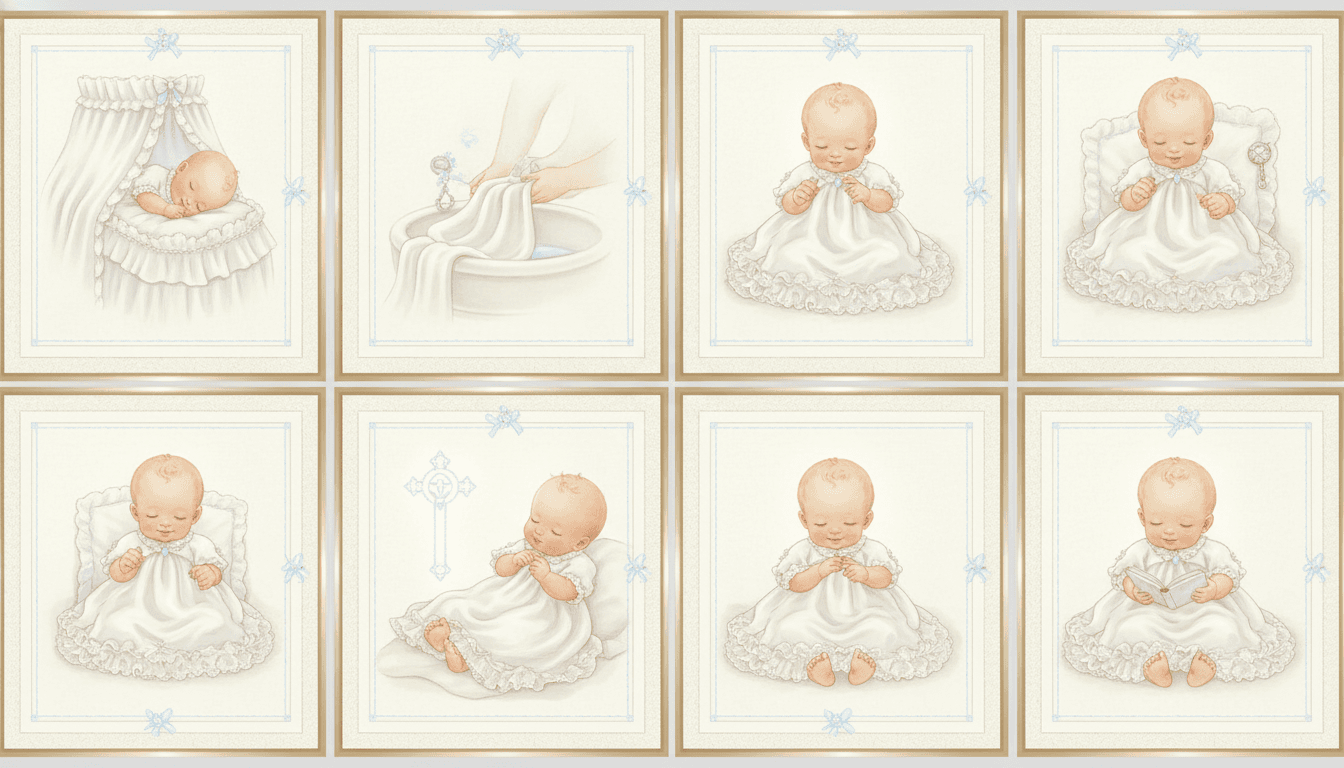
Each person becomes a saved character rather than a sentence retyped on every page. That is the difference between a godmother who is recognisably one woman through the book and eleven different women who happen to share a name.
The redraw
A Regeneration Cannot Lose Them
If you redraw a page, the saved portrait is still the reference. This is guarded specifically: without that fallback a single regeneration could permanently replace an uploaded likeness with a generic drawn face that no redraw would bring back.
The sheet
One Illustrated Cast Page
Two or more characters can be composed onto a single tiled character sheet — the whole christening party on one opening at the front of the book, which is the page grandparents go to first and the one that ages best.
The church
Places Are Not People
Locations and objects are deliberately excluded from likeness handling. A font, a nave, a family kitchen has no face to match, so the baby's photo is never handed over as the drawing guide for a building — which is exactly how a church ends up looking like somebody's portrait.
The style
Pick a Tone and Hold It
Soft watercolour, warm gouache, gentle line and wash, classic storybook. Choose once and the whole book is drawn that way. For a christening keepsake the quiet styles almost always beat the bright ones, because the object is meant to sit on a shelf for two decades.
A photograph is a reference, not a page
A picture of the child, so the drawn character actually resembles them rather than being a generic baby with the right name printed underneath.
It is used as a drawing reference for your book. It is not the thing that appears on the page.
A painted storybook character. Every character prompt states outright that the result is an illustration and not a photograph or a real person.
Which is the correct answer for a keepsake. A photorealistic infant rendered by a model is not a thing families want on a shelf.
If you would rather work the other way round — a real photograph placed in a book as a photograph — that is a photo book, and it is a different craft with a different tool.
As Much Faith as You Actually Want
Christening covers a lot of different afternoons. Nothing religious is added on your behalf, and nothing is assumed from the word.
A full church baptism
The rite as your family kept it, the reading you actually chose, the godparents' answers, the candle and the water. Written the way your denomination does it rather than a generic version of it.
A gentle christening
The water, the promise, the names, and not much more. This is where most keepsake books land: the shape of the day is there, the theology stays light, and the book reads warmly to everyone at the party.
A secular naming day
No scripture at all. A group of people gathered, gave a child a name and committed to them out loud — which is a complete and entirely sufficient subject for a keepsake book on its own terms.
This is a keepsake, not a record of the sacrament
The official record of a baptism is the parish register and the certificate issued from it, and a book made here does not stand in for either. Denominations also differ genuinely and substantially — infant baptism, believer's baptism, dedication, a civil naming ceremony are not the same thing and are not held to mean the same thing — and C2Story takes no position on any of it. You write what your family did, in the words your family uses.
Five Pages a Christening Keepsake Book Usually Has
Not a fixed template — just the openings that turn up in almost every good one.
The Dedication
A letter to a future reader
The Years
Given now, read later
The Likeness
A photo, redrawn
The Cast
Everyone who showed up
The Font
The place it happened
The Same Child on Every Page
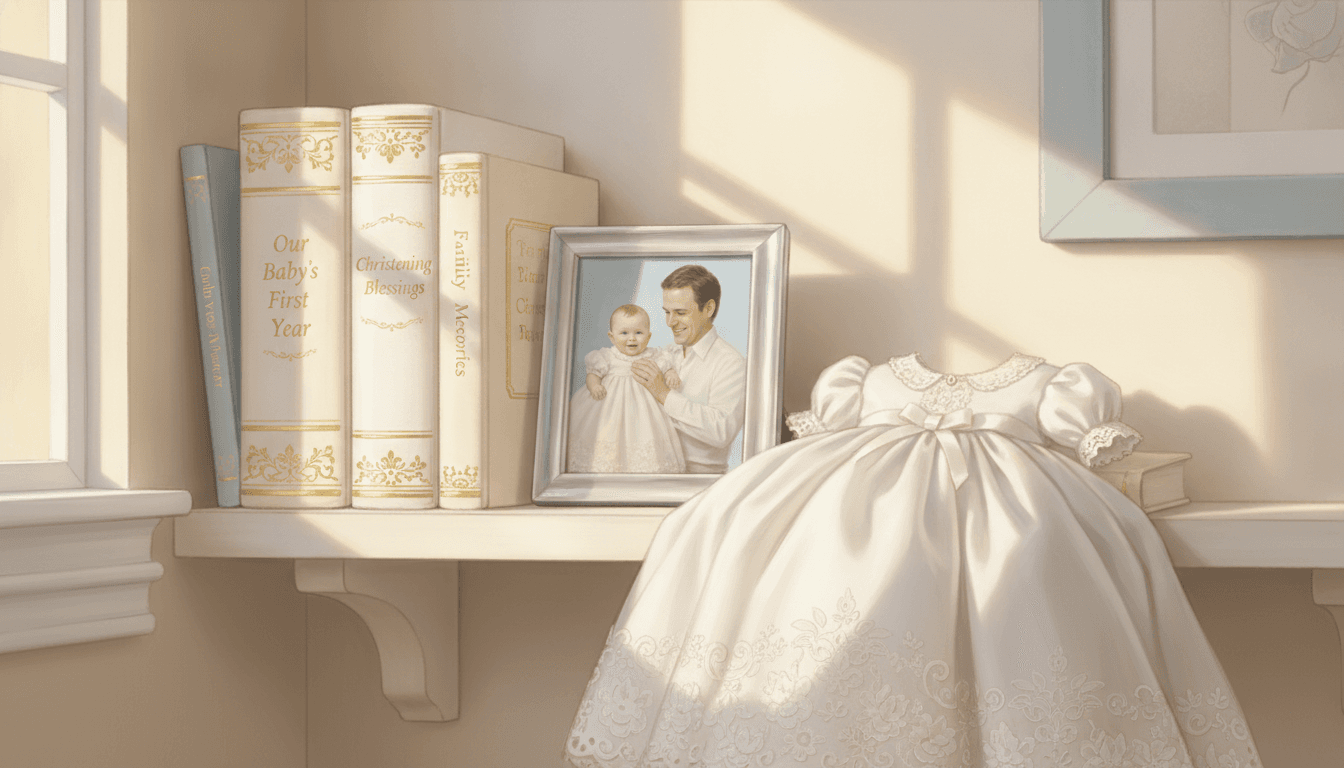
Made to Sit on a Shelf
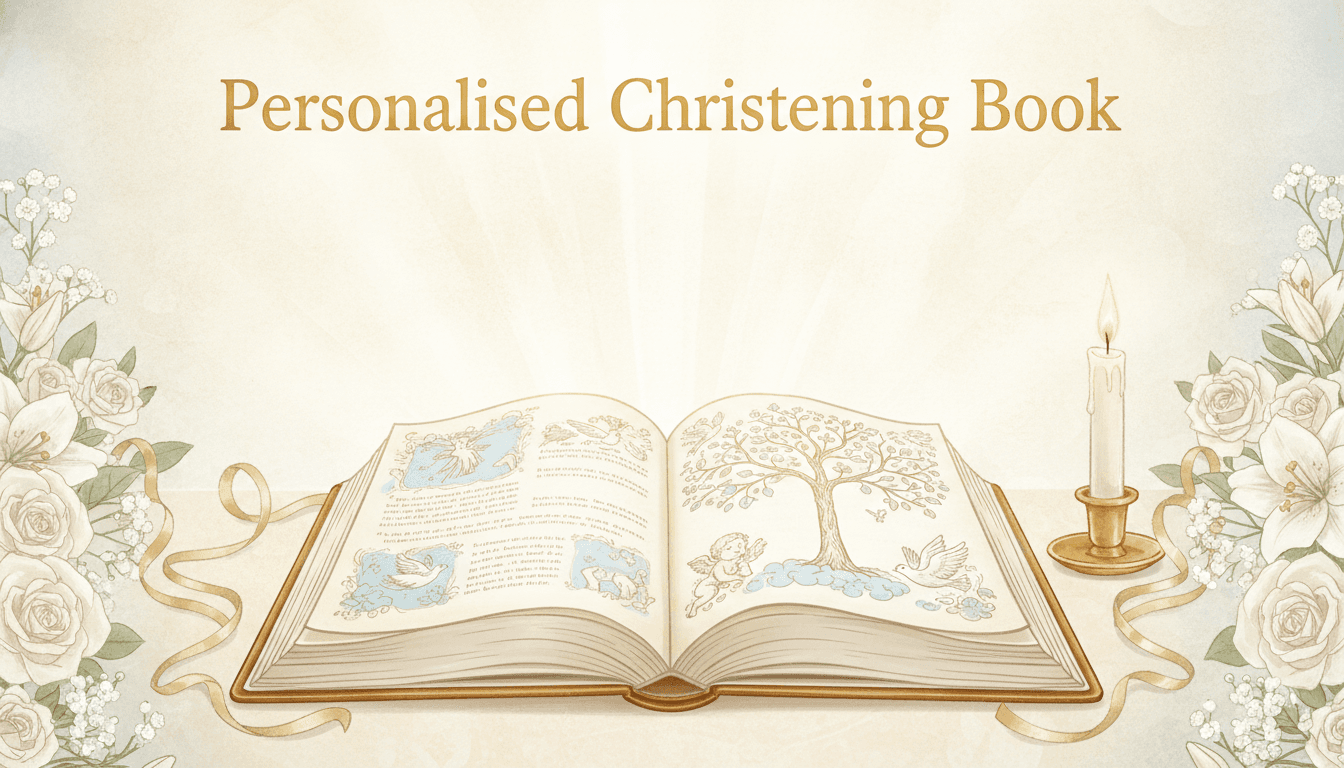
Handed Over on the Day
What a Personalised Christening Book Will Not Do
A christening gift has a date attached to it, so these are worth knowing this week rather than the night before.
Nobody Posts You a Hardcover
There is no printing or shipping service behind this. You can buy a PDF download of your book — a per-book purchase, yours to keep, print or share — and the physical keepsake is what you make from that file at a print shop, a photobook service, or at home. Allow a few days for whoever prints it.
It Is Not a Baptismal Certificate
A keepsake book is made by a family; the record of the rite is the parish register and the certificate that comes from it. If somebody needs proof of baptism — for a school, for a wedding, for a confirmation — it comes from the church, not from a picture book.
It Will Not Tell You Your Own Theology
Denominations differ on what baptism is and who it is for, and C2Story has no opinion to offer. It will not supply the right reading, correct your wording, or fill in doctrine you left out. It writes what you tell it your family did, which is the only version worth keeping anyway.
A Late Name Fix Is a Slow Fix
Change a spelling after eleven illustrated pages exist and you are editing eleven pages. Nothing breaks, but it is an evening rather than a minute. This is the entire argument for gathering the names, dates and places before you start rather than filling them in as you go.
A Newborn Cannot Carry a Plot
If you push for a real adventure story with a six-week-old protagonist, you will get one, and it will feel like fiction about a stranger. The format works because it records a day rather than inventing a quest. Keep the ambition on the dedication and the cast.
Words Are Free, Pictures Are Not
Writing, restructuring, renaming and rewriting the dedication cost nothing. Generating illustrations is where credits go. So settle the text and the cast first and generate pictures once you have stopped changing your mind about who is in the book.
The useful version of a limits list is the one you read before the deadline. If the christening is on Saturday and you want something printed, start the file today.
Is a Christening Keepsake What You Meant?
This page is for a book about one day and the people at it. If you pictured something else, one of these starts closer — and they all share the same saved characters.
Yes — make the keepsake
Their name, their day, the cast who came, and a dedication written to whoever they grow into.
It is a new baby, not a christening
The arrival itself — the first weeks, the first faces, the book made before any ceremony.
The baby has not arrived yet
A gift for the shower, made while everyone is still guessing at the name.
I want them to be the hero
The child-as-protagonist adventure, for an age that can follow one and argue about it.
It is a birthday
A book for a reader who is present, awake, and will tell you which page is wrong.
It is from the grandparents
The long-distance version — a book sent instead of being handed over in person.
It is a whole family history
More than one day: the people, the house, the years, gathered into one illustrated record.
It is a different occasion entirely
Weddings, anniversaries, graduations, retirements — the full occasion shelf in one place.
I want to start from a photograph
Upload the faces and build the book around them rather than describing everyone in words.
The faces keep changing
Lock each design once so the godmother on page eleven is the woman from page three.
Two families, two languages
Make the second copy for the other side of the family, in the language they read in.
Show me everything else
The full shelf of generators, converters and editors, all built on one character library.
Frequently Asked Questions
Explore More Story Ideas
Discover more styles, tools, and story types
Garden Stories
Planting seeds, sunflowers, butterflies and the veggie patch
Explore
Mid-Century Modern Books
Flat colour blocks & hard-edged geometry
Explore
Bedtime Story Generator
Cozy goodnight stories for kids
Explore
ChatGPT vs C2Story
Purpose-built for picture books
ExploreA Personalised Christening Book Is Written for a Reader Who Has Not Arrived Yet
Almost every personalised book is made for a child to enjoy this week. A personalised christening book is the exception, and it is the reason so many christening gifts quietly fail: the book is handed to a baby who will not read a word of it for five years, so it gets written for the adults in the room instead, full of blessings and soft-focus sentiment, and is shelved by August. The useful instinct is the opposite one. Write it forward. The person who will actually open this book is a seven-year-old you have not met, and the thing they will want from it is not a poem — it is information. Who was I. Who came. What did they promise. What was my grandmother's name.
That is why a christening keepsake book starts with the boring part. The full baptismal name, spelled the way the family spells it. The date. The church, or the hall, or the garden. The town. These are the details that do not age, and they are also the ones that are painful to fix late — a misspelling discovered after eleven illustrated pages exist means editing eleven pages rather than one line. Gather them, type them once, and build the book around facts that are already correct. Everything charming about the book can be decided afterwards; nothing charming survives the grandchild noticing that the name is wrong.
The second thing a christening book needs is its cast, and it is a bigger cast than most picture books carry. Parents, godparents, grandparents, the sibling who was two and thoroughly unimpressed, the friend who drove four hours. Each of them is saved as their own character record with a fixed design, so the godmother on page three is recognisably the same woman on page eleven rather than a new stranger with the same name, and two or more of them can be composed onto a single illustrated cast page at the front — which is the opening grandparents turn to first and the one that ages best. You can also upload a photograph of the child so that the drawn character genuinely resembles them: the option appears as making it for someone? upload their photo when you add a person, and the photo is used as a likeness reference. What comes back is a painted storybook character. Every character image prompt states outright that the result is an illustration and not a photograph or a real person, which is the right answer for a keepsake, because a photorealistic infant rendered by a model is not something families want sitting on a shelf for twenty years.
A detail worth knowing, because it is the kind of thing that ruins a book quietly: places and objects are handled separately from people. A font, a nave, a family kitchen carries no likeness, so a photograph of the baby is never handed over as the drawing guide for a building. Without that separation a church comes back looking unnervingly like somebody's portrait, and nobody can quite say why the page feels wrong. Likenesses are also durable across regenerations — if you redraw a page, the saved portrait is still the reference, so a single regeneration cannot permanently swap an uploaded likeness for a generic drawn face that no amount of redrawing brings back. This is the same consistency machinery the character consistency tool exists for; on a christening book it simply matters more, because every person in the cast is going to open the book and look for themselves.
Then the dedication, which is the whole point and is almost always the wasted page. On an ordinary gift book the dedication is a line above the title. In a personalised baptism book it is the only part addressed directly to the person who will eventually read it, written by someone who cannot possibly know who they will have become. Say who you are, because they will not remember meeting you. Say what you promised and that you meant it. Name one small true thing about the day — the rain, the wrong-sized gown, the fact that they slept through all of it. Date it and sign it in your own words. What it should not be is a blessing lifted from the first search result, or advice about a life you cannot predict, or a note that is secretly addressed to the parents. And write it last, after you have seen the book: dedications written first are about the writer, dedications written last are about the child. Text costs nothing to rewrite, so leave the words open as long as you can.
Christening covers a wide range of afternoons, and nothing religious is inserted on your behalf. A full church baptism can be written as your denomination actually keeps it, with the reading your family chose and the answers the godparents gave. A gentler christening — the water, the promise, the names, and not much more — is where most keepsake books land, because the shape of the day is intact while the theology stays light enough that the book reads warmly to everyone at the party. And a secular naming day with no scripture at all works perfectly on its own terms: a group of people gathered, gave a child a name, and committed to them out loud, which is a complete subject for a book. What this is not is a record of the sacrament. The official record of a baptism is the parish register and the certificate issued from it, denominations differ genuinely about what the rite means, and C2Story takes no position on any of that. You write what your family did, in the words your family uses.
On the practical side, be clear about what you end up holding. You make the book online and you can buy a PDF download of it — a per-book purchase, yours to keep, print or share. What does not happen is somebody manufacturing a hardcover and posting it to you; there is no printing or shipping operation behind this, so the physical object is whatever you make from that file, at a local print shop, through a photobook service, or at home with a decent printer and a binder. Since christenings come with a fixed date, that is worth knowing this week rather than on Friday night, because a print shop will want a few days. Writing, restructuring and rewriting are free; generating illustrations is the part that spends credits, so settle the text and the cast before you commit to pictures.
Godparents are very often the ones who build the book rather than the parents, and it works better that way than it sounds. It changes who the dedication is from, not how any of it functions, and it means the gift can be made without the family knowing — which is the usual situation with a christening present anyway. If you are the godparent who lives eight time zones away and has been feeling like the card and the silver spoon were not enough, this is the version of the gift that the local relatives did not think to make. Start with the names, cast the people who were there, and then write the letter. If a christening is not quite what you are marking, a baby book covers the arrival itself, a baby shower gift book comes earlier still, and the full range of storybooks for special occasions covers the weddings, anniversaries and graduations on the other end of a life.