
Ink Mascot Picture BooksTall, and Not Reacting
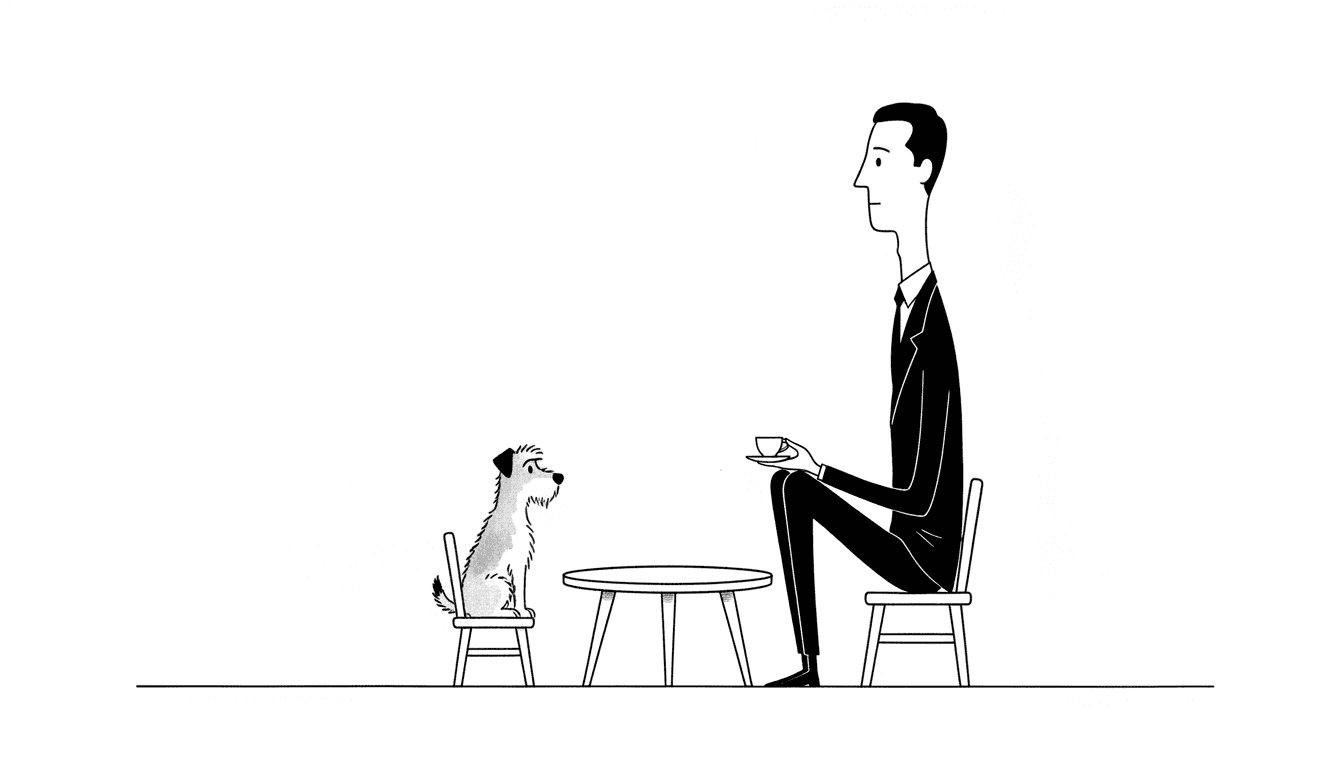
Plenty of styles do a straight face. This is the only one that puts it on a very long body. Ink mascot picture books are drawn in black brush-and-pen ink on white paper: tall, slender grown-ups in suits and long coats, one face that never changes, and a world that is always a size too small for them.
- Tall, elongated grown-ups in adult clothes
- One deadpan face, the same on every page
- Black ink, white paper, one grey at most
- Free credits by request, no card
50,000+
Stories Created
10,000+
Active Creators
50+
Art Styles
4.9/5
User Rating
What Makes Ink Mascot Illustration Different
Every style here is a written brief: a palette, a light, a line weight and a short list of refusals. Four things in this one decide the look, and most of the words that carry them appear in no other brief of the seventy-eight.
The only deadpan brief with long bodies
Every style in C2Story runs on a short written brief: a palette, a lighting note, a line weight and a few things to avoid. Seven briefs ask for deadpan. Four of them keep the face straight on every page: one draws little round-headed people, one sculpts them in clay, one puts them in a fully drawn room. This is the one that asks for tall, slender, elongated characters. Tall appears in only one other brief, and there the characters have no faces at all.
One face, kept still
The brief asks for deadpan straight faces, and only one other brief in the library uses the words straight-faced. Two dots and a short line, and it does not move from page to page. That is what makes a character from this brief work as a mascot. The reader learns the face on page one and then watches the world happen to it.
A brush line that tapers
Its line weight is a confident tapering ink line, and no other brief in the library asks for a line that tapers. It is the only one that says brush-and-pen: a line that starts full, thins to a point, and leaves solid black for a coat or a hat. There is no hatching and no heavy shading. The black is flat and the white is paper.
Black, white and one grey
The palette is black ink, bright white and an occasional grey accent, and colour is the first thing it refuses. The light is flat minimal lighting, the only lighting note in the library with minimal in it, so nothing casts a shadow. It is black and white because the brief is, not because of a setting you switch on.
Why the Room Is Cut Down to a Stool
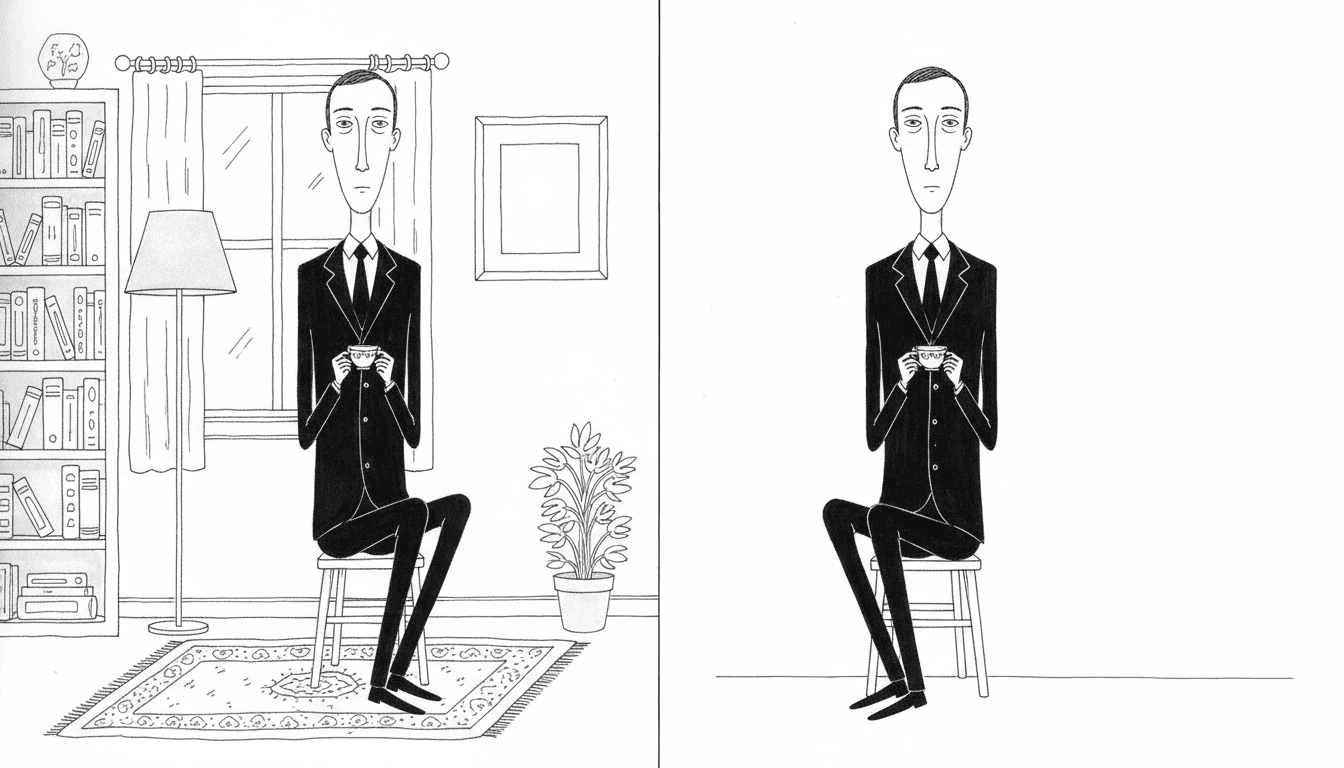
Look at one picture twice. The same tall man, the same black suit, the same teacup, the same straight face. On the left the whole room is drawn around him: a bookshelf, a lamp, a curtained window, a frame on the wall, a plant, a patterned rug. It is a perfectly good drawing, and your eye goes everywhere in it.
On the right the room is gone. There is the man, the stool he is folded onto, and one floor line. Now there is only one thing to look at: how much man there is and how little stool. That is why this ink mascot illustration brief asks for simple settings in a few sparse strokes. The empty paper is not there for calm. It is there so the height can be seen.
Its refusals all protect the same thing: the long, flat black shape against white.
Write the Thing They Don’t Fit
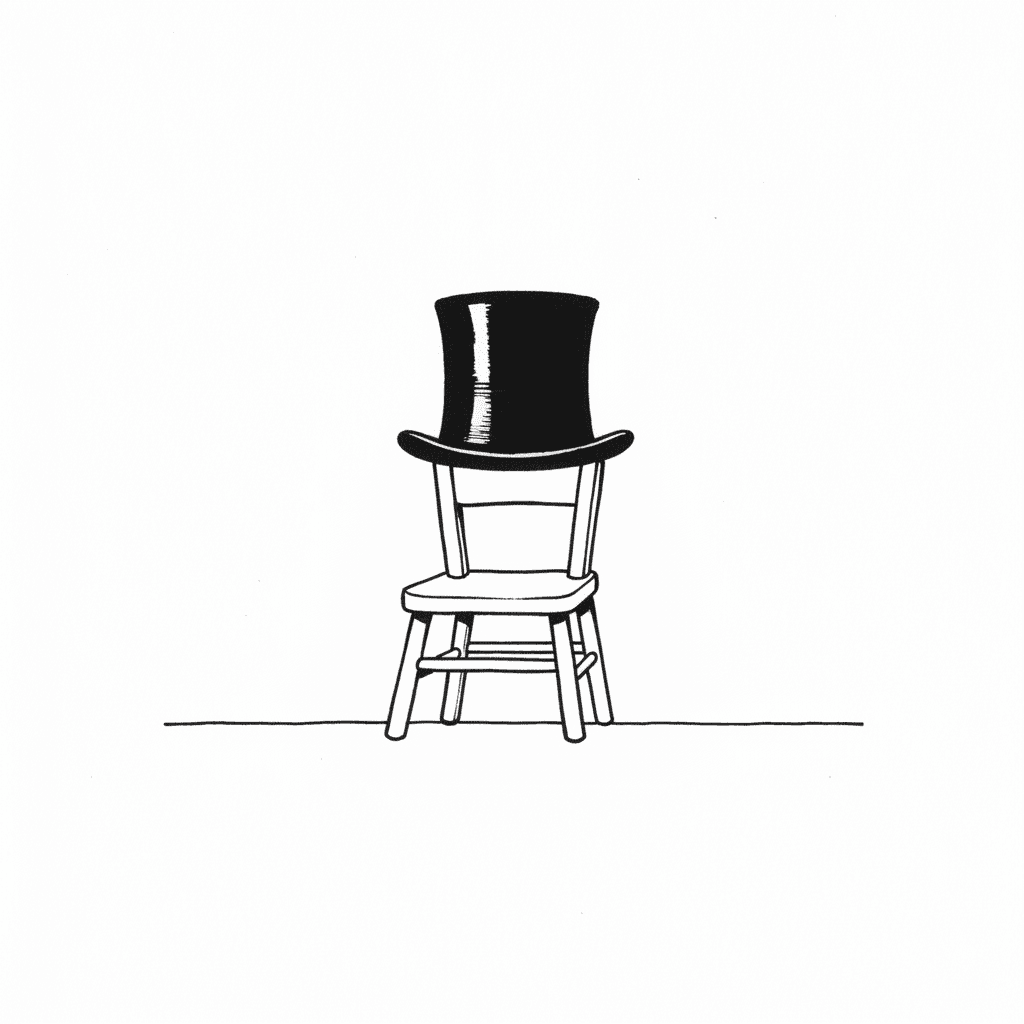
A deadpan face cannot tell the reader where the joke is. It is not allowed to. So the joke has to be something on the page, and with a body this long, the obvious thing is whatever the body does not fit. The square beside this paragraph has nobody in it: a small chair, and a top hat far too big for it. You can already see who is about to sit down.
Write each page around one of those things. The child’s chair at the tea party. The umbrella held so high that the rain only reaches the boy. The bench so long that a pigeon sits in the middle. The lead so long that the dog is in another part of the picture. The balloon just past the end of a very long arm. Name the thing, and this deadpan character design does the rest by not reacting to it.
Then leave the face alone. Do not write that he is embarrassed or that she is cross. The straight face is the punchline, and the reader supplies the reaction for both of you.
From One Sentence to Ink Mascot Picture Books
You pick the look once. The brief is then applied to every page, so the line, the black and white, and each character’s height and face never drift.
Describe the cast and what they don’t fit
Write a sentence or two about who is in the story and what happens. Give your tall character a coat, a hat or no hat, and a straight face, and name the small chair, low door or short bicycle on each page.
Choose Deadpan Ink Mascot
Pick the style from the Styles Library. From then on every page uses the same tapering brush-and-pen line, the same black and white, and the same tall, straight-faced people.
Get a whole book
C2Story writes the story, splits it into pages and illustrates each one. Regenerate any page you want to change without touching the rest, read it online, share it, or buy the PDF download to hand to a printer.
This Style and Its Three Nearest Neighbours
One shares its deadpan, one shares its straight faces and black pen, and one shares its height. Here is what each actually asks for.
Deadpan Ink Mascot
The style on this page
A mid-century black-and-white ink illustration with tall slender elongated characters in adult clothing, deadpan straight faces, clean confident brush-and-pen lines, strong use of empty white space, a restrained editorial mood and simple settings drawn with sparse elegant strokes. It refuses colour, heavy shading, chibi proportions and busy backgrounds.
Deadpan Cartoon
Equally straight-faced, but short and in colour
Simple round-headed characters with blank faces, small blocks of grey-blue and beige, and the joke built from tiny relationships. It is the only brief that refuses exaggerated expressions outright. Its people are small and round, so its comedy is about who is standing next to whom. Here the people are long, so the comedy is about the room they are in.
Single-Panel Editorial
Straight faces too — with the whole room drawn
The only other brief that says straight-faced. It uses black pen with a light grey wash and asks for the adult everyday scene to be rendered fully, with its setting and props, because the room is where its joke comes from. This brief draws the setting in a few sparse strokes and leaves only what the tall body has to deal with.
New-Chinese Minimal
The other tall brief — with no face at all
Tall, elongated figures in flowing classical robes, a calligraphic line and faceless or barely suggested features, in a muted refined palette. It shares the height and the empty paper. It does not share the face: there the posture carries everything, and here a face is drawn and held perfectly still.
Story Ideas for Ink Mascot Picture Books
Each idea has one tall, unbothered grown-up and one ordinary thing per page that is the wrong size, which is what this brief draws best.
Mr Long Comes to Tea
A very tall neighbour is invited to a child’s tea party. Every page is another piece of small furniture he folds himself onto without complaint.
The Umbrella Problem
A tall aunt and a short nephew share one umbrella across town. It rains on exactly one of them on every page, and neither says a word about it.
The New Doorways
A tall man moves into a very old cottage. Each room has a lower door than the last, and he never once changes his expression.
The Small Dog Walks the Tall Lady
Every morning the same lead, the same lamp posts and the same very small dog, who is in charge. A quiet book with one walk per page.
The Bicycle That Was Too Short
A tall woman borrows a child’s bicycle to fetch the bread. Her knees go up to her ears, and the whole town watches without comment.
The Pigeon in the Middle
Two strangers sit at either end of the same park bench every day. A pigeon sits between them, then a cat, then a picnic, until one day they say hello.
What Ink Mascot Illustration Looks Like Across a Book
Pages generated to this one brief, with nothing retouched afterwards. One honest note: the doorway was asked for at shoulder height, and the model drew it tall enough to walk through. He ducks anyway, which we kept, because it is the most deadpan picture on the page.
The whole room, and none of it
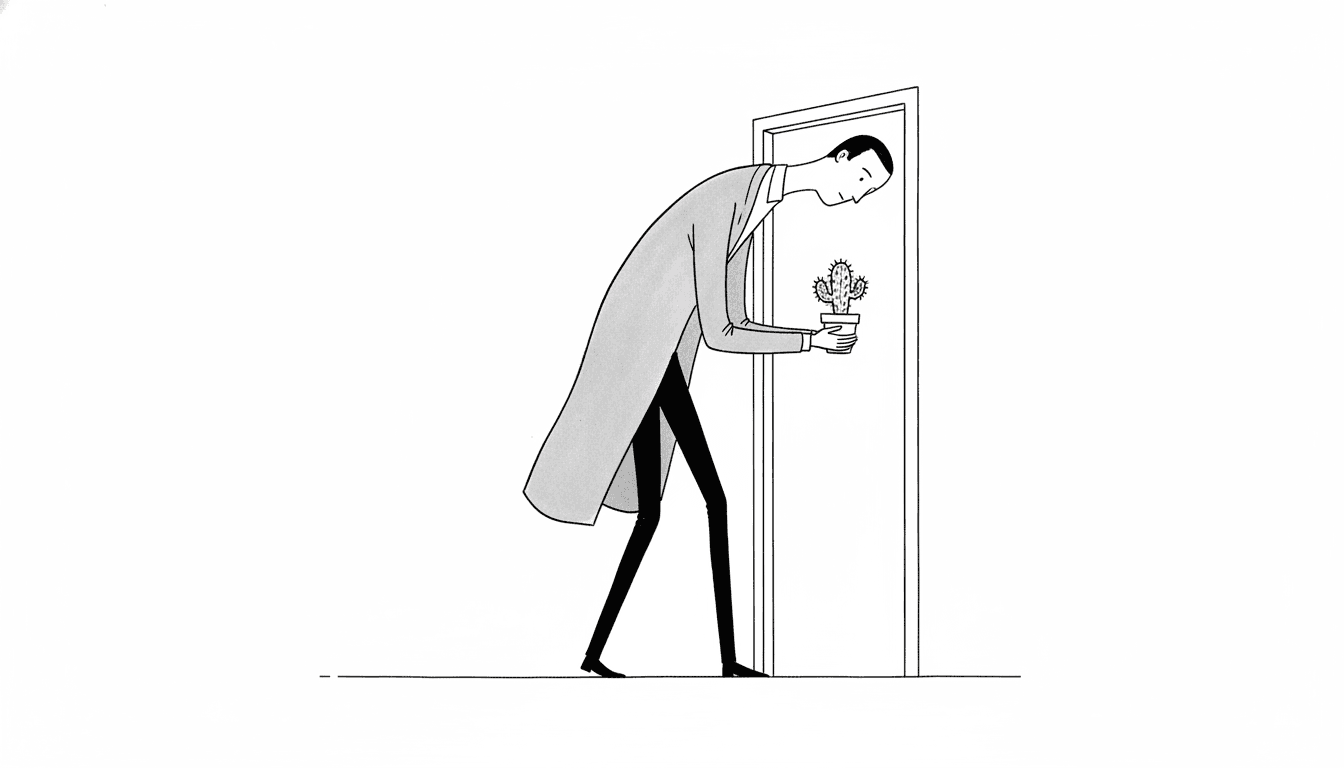
He ducks anyway
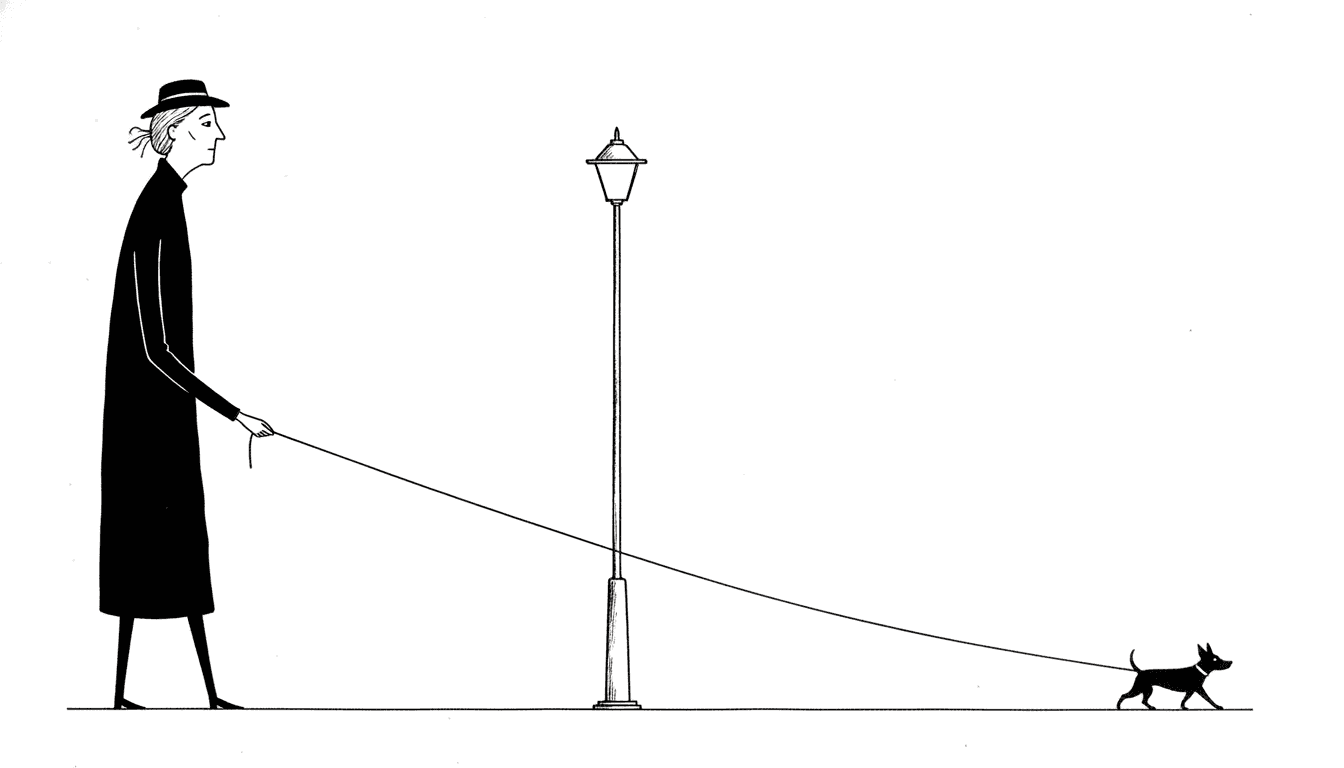
A very long lead
A Cast You Recognise by Their Outline
Without colour, a character is a silhouette, a haircut and a hat. The same man keeps the same suit and tie in three poses, and the same woman keeps the same bob and black dress across four props. The butterfly lands on his nose and nothing on his face moves.
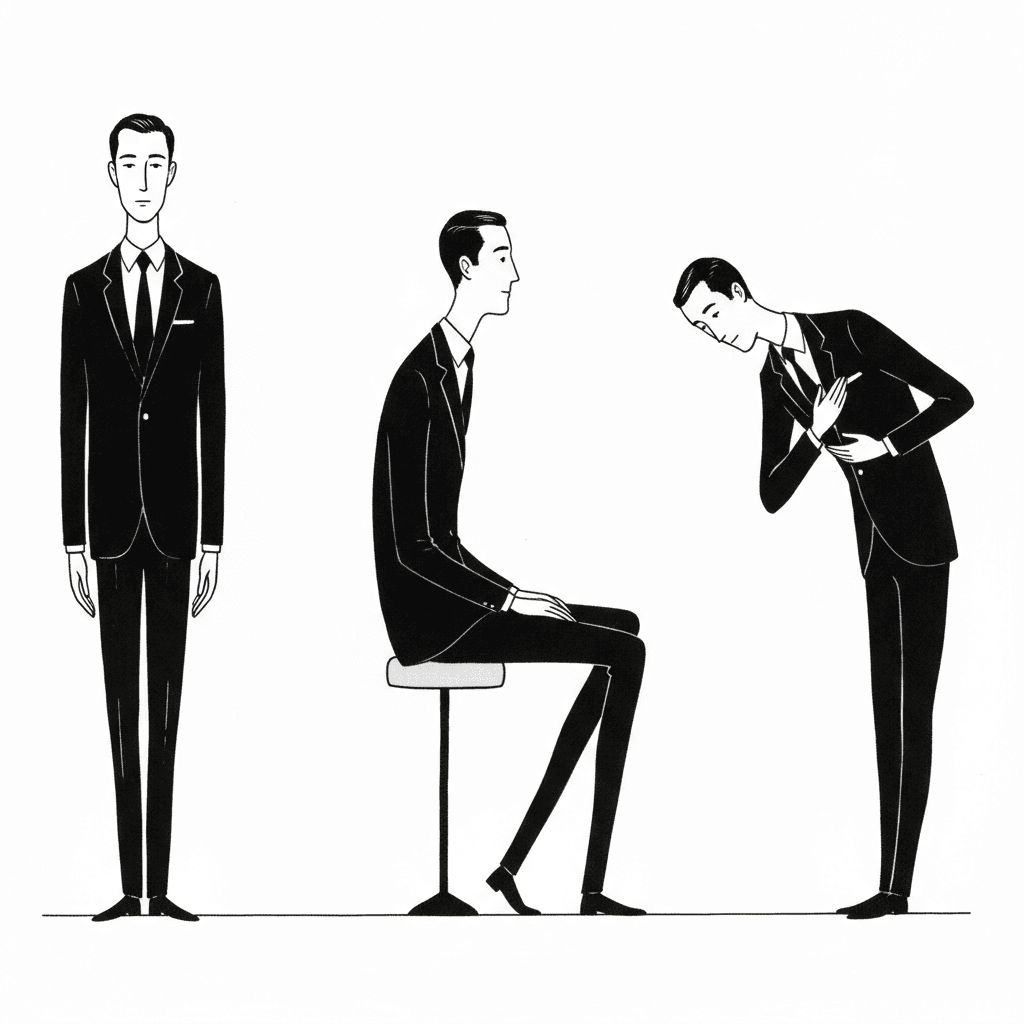
One man, three poses
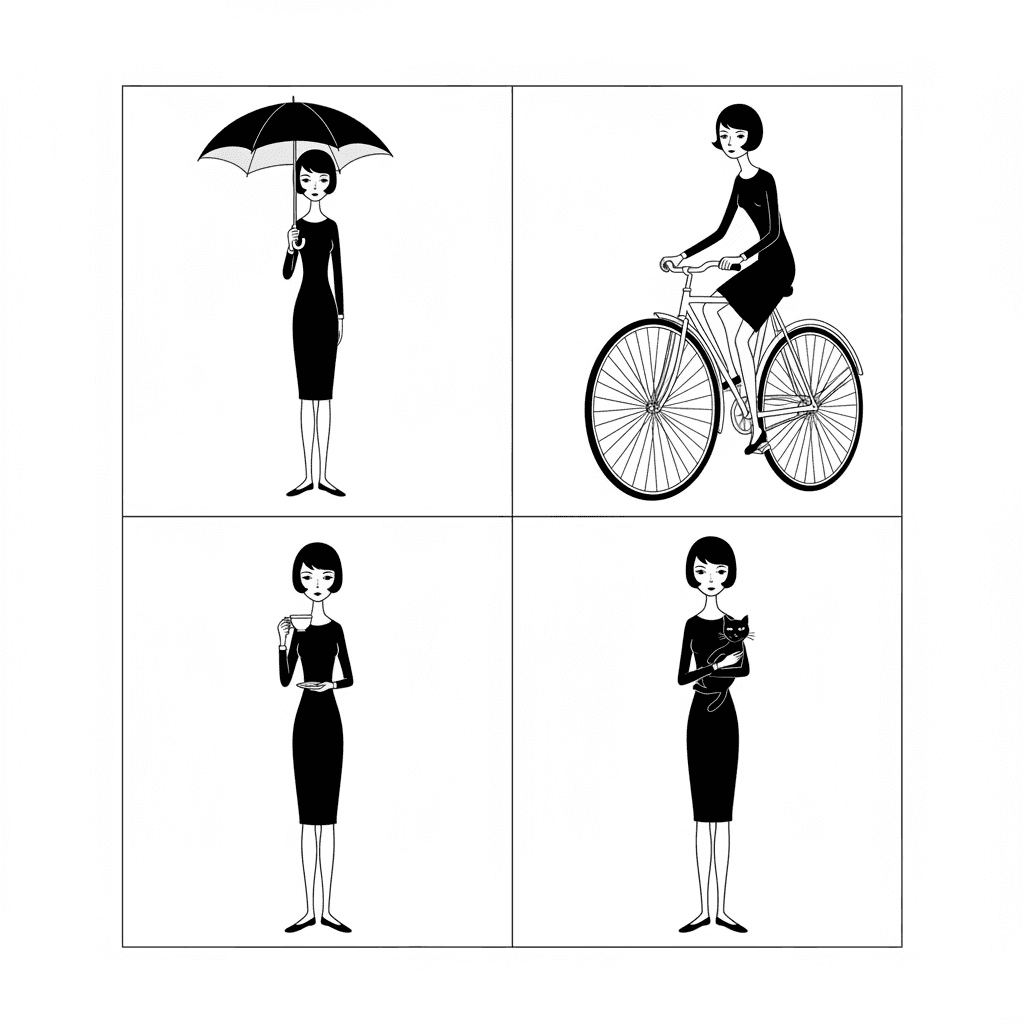
Same woman, four props
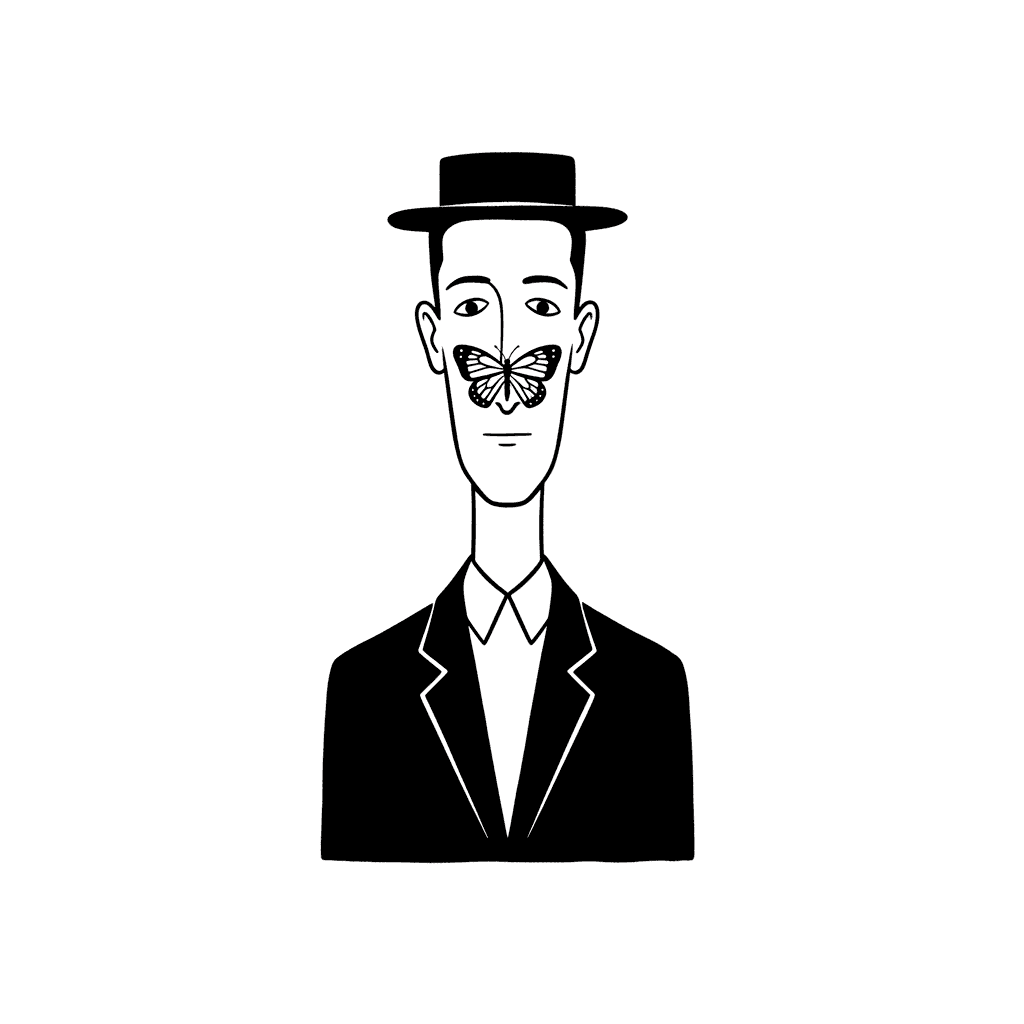
Not reacting
The thing that does not fit
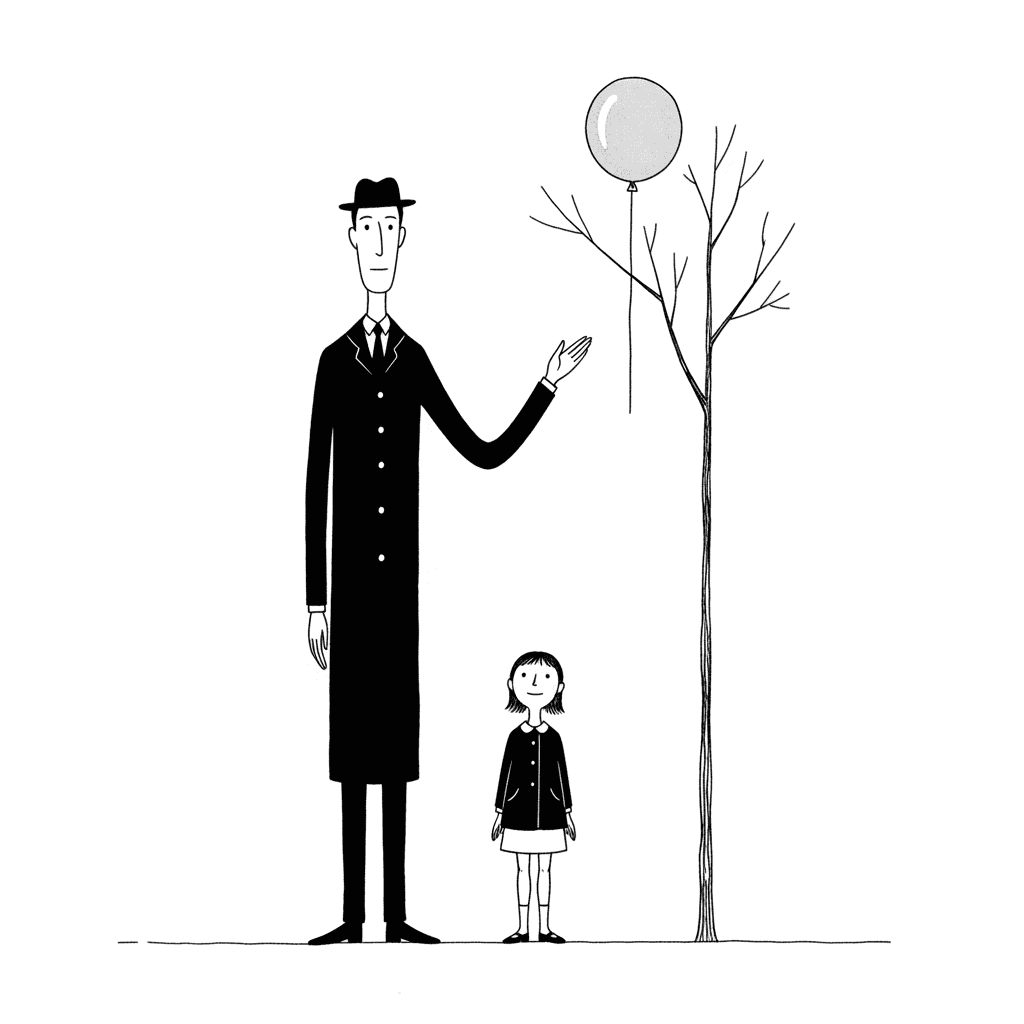
Nearly tall enough
Making Whole Ink Mascot Picture Books
What is useful in a book drawn this way and where the limits are, in the order you are likely to meet them.
One character, kept on model
Save each character in the Character Library with up to fourteen reference images, and describe them in plain words, such as “very tall, black suit, thin tie, slicked black hair”. In black and white, clothing and silhouette are all the reader has to recognise someone, so name the hat, the coat and the haircut. Characters made from an uploaded photo stay private to your account.
Write “straight face” in the description
The brief asks for deadpan faces and most pages keep them. When a figure turns sideways, though, the image model sometimes lets him smile, as he does in two of the three poses on the character sheet here. If the unmoving face is the point of your character, say so in their description, and regenerate the odd page that grins.
Children are drawn short, not small-headed
The brief asks for tall adults in adult clothing, and children still come out as children, as the boy at the bus stop and the girl under the balloon show. That contrast is most of the comedy. A cast of only children loses the one thing this style is for, so give every book at least one tall grown-up.
Hats arrive uninvited
Mid-century men in suits tend to come with a hat, and the image model added one to several pages here that never asked for it. If your character is bare-headed, write that into their description. If they wear a hat, give it a name, because the hat is one of the few things that tells two tall men in black suits apart.
Sparse, not empty
The brief asks for simple settings drawn with sparse elegant strokes and refuses busy backgrounds. You still get a bench, a lamp post, a bus stop or a bare tree, just one or two of them. A page that needs a crowd, a market or a whole cluttered kitchen to land is better drawn in the single-panel editorial style.
A whole book from a sentence
Describe the story in a sentence and C2Story writes it, splits it into pages and draws every page to the same brief, in English, Chinese, Japanese, Spanish, French and more. Story text sits beside the picture, not inside it. Read online, share a link, or buy the PDF download as the handoff to your printer. Pages are licensed for commercial use under the terms of service.
Other dry, inky styles, each built on a different idea: for small round blank faces in muted colour, deadpan cartoon picture books; for the whole room drawn in pen and grey wash, single panel cartoon books; for the couple on the sofa, relationship satire picture books; for tall figures with no face at all, new Chinese minimal picture books; and for long bodies that feel everything, angular line picture books.
Questions About Ink Mascot Picture Books
Explore More Story Ideas
Discover more styles, tools, and story types

Knight Stories
Brave knights and castle quests
Explore
Visual Development Art Picture Books
Animation concept-art characters in flat colour, each designed to look unlike anyone else
Explore
AI Story Generator
Generate complete stories with AI
Explore
Storybee Alternative
More styles & features
ExploreInk Mascot Picture Books: Tall Bodies, Straight Faces, Black Ink
Ink mascot picture books rest on a brief that is deadpan in an unusual way. C2Story runs seventy-eight hand-drawn style briefs, each a short written record of a palette, a light, a line weight and a few refusals. Seven of them ask for deadpan, and four keep the face straight on every page. The Deadpan Ink Mascot brief is the only one of those whose characters are tall, slender and elongated, and the only brief in the library with a tapering line or a brush-and-pen line.
The look is mid-century ink mascot illustration: grown-ups in adult clothing drawn with clean confident lines that swell and taper, solid black for coats and hats, bright white paper, an occasional grey, and flat minimal light that casts no shadow. Settings are simple and drawn in a few sparse strokes, a bench or a lamp post rather than a whole street. It refuses colour, heavy shading, chibi proportions and busy backgrounds.
This deadpan character design suits quiet, dry stories built on one recurring tall character in a world a size too small: a tea party on child’s chairs, a shared umbrella, a long dog lead, an old cottage with low doors. It is a poor fit for bright colour, big faces, crowds or detailed scenery. Characters stay on model through the Character Library, and in black and white their silhouette, haircut and hat are what the reader follows.
The choice between neighbours is clear. Take deadpan cartoon for small round blank faces in muted colour, single-panel editorial for a straight face in a fully drawn room, and new Chinese minimal for tall figures with no face at all. Take this simple ink character style when the face should stay still and the height should do the work. Describe the story in a sentence and C2Story writes it, splits it into pages and draws every page to the same brief, with the paid PDF download as the handoff to your printer.