
Action Comedy Picture BooksSomething Is About to Fall
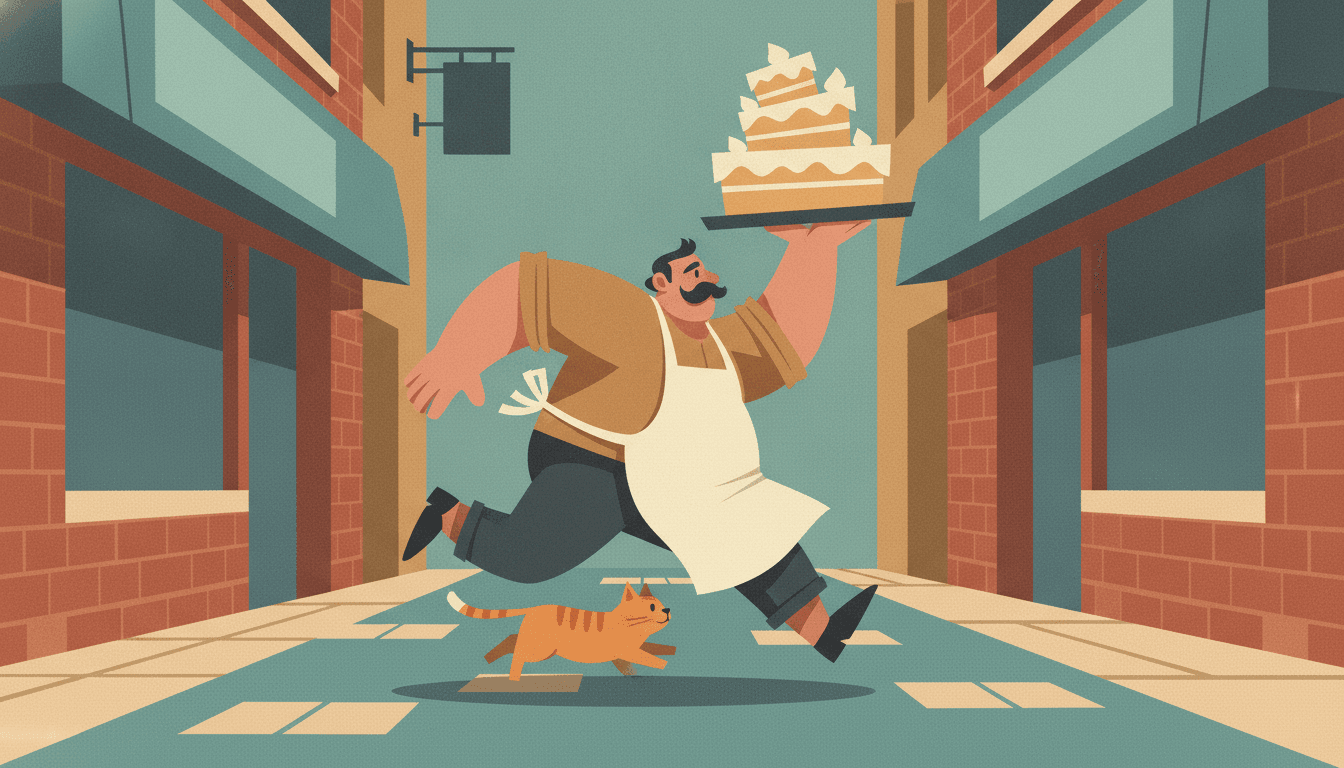
A baker the size of a wardrobe, running flat out down a brick alley with a tall layered cake held high on one hand and a cat under his feet. Nobody is in danger. The cake is. Action comedy picture books are built from big chunky planes of brick red, dusty teal and warm tan, lit by hard slabs of light, and on every page something is about to wobble, drop or tip over.
- Bold planar shapes, no thin outlines
- Hard block light from one side
- Brick red, dusty teal and warm tan
- Free credits by request, no card
50,000+
Stories Created
10,000+
Active Creators
50+
Art Styles
4.9/5
User Rating
What Makes Action Comedy Illustration Look This Way
Every style here is a written brief: a palette, a light, a line weight and a short list of refusals. Four things in this one decide the look, and three of them are found in no other brief in the library.
The comedy has stakes
Every style in C2Story is a short written brief. Three briefs in the library ask for comic timing. This one asks for comic tension instead, and it is the only one of the seventy-eight that uses the word tension, or suspense, or danger, or anything like it. Timing is about when the joke lands. Tension is about what might be lost if it does.
Built from chunky planes
Bold chunky planar silhouettes and crisp geometric block fills with bold blocky edges, as if the figures were cut from card. Only one other brief builds its forms from geometric blocks, and it wants clashing high-chroma colour. This one keeps a punchy grounded palette: brick red, dusty teal and warm tan, under a subtle grain.
Light in slabs
Three briefs ask for hard directional light. This is the only one that calls it block light: the light is cut into the same flat planes as the shapes, so every surface is either lit or not, with a straight edge between. It reads like a stage light on a set, not like sunshine.
An ordinary hero who is never still
The brief’s sample is a burly, mustachioed everyman caught mid-action in a scrappy alley, and it is the only brief that asks for an everyman at all. Its refusals include flat, lifeless poses. Only two of the 312 refusals in the library are about a pose, and this is one of them.
Why an Action Comedy Character Can’t Stand Still
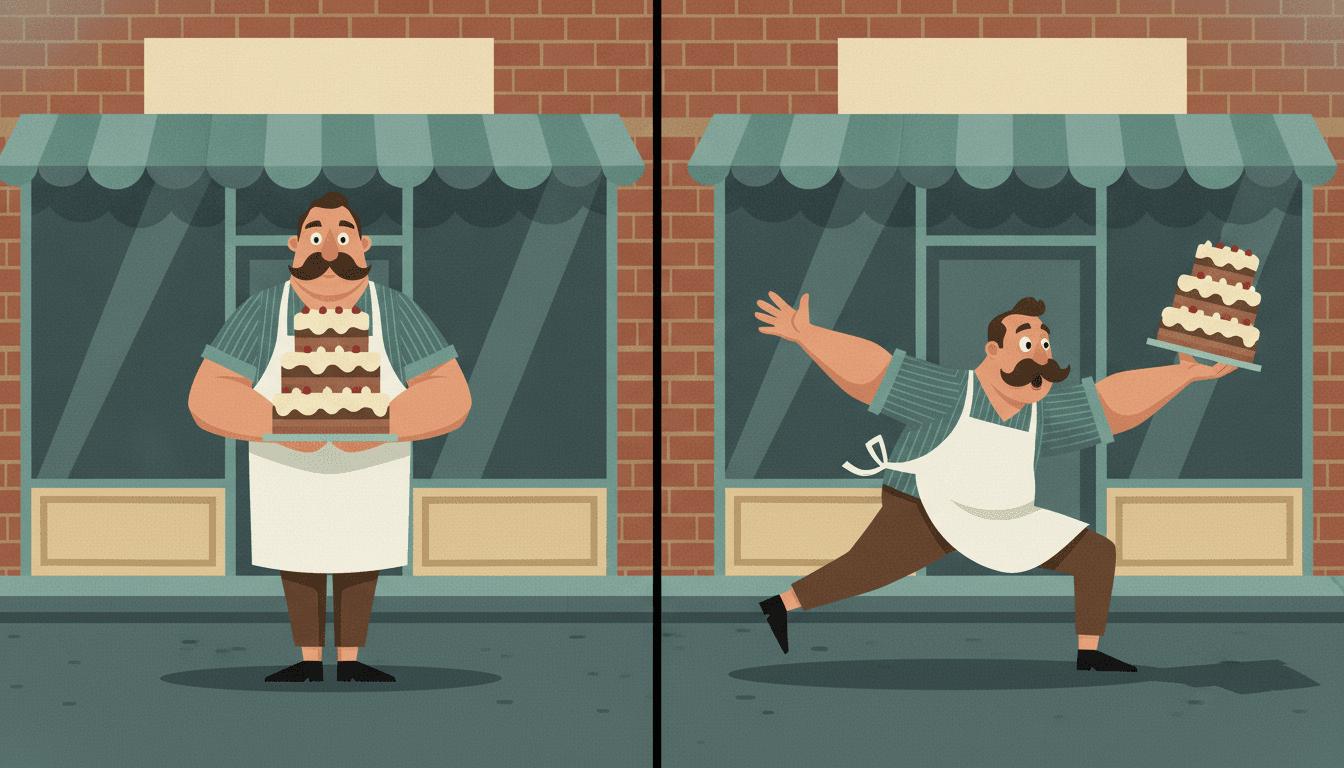
Look at one baker twice. On the left he stands in front of his shop with his feet together, holding the cake level against his chest. Same shapes, same colours, same light, and nothing to look at: the cake is safe, so there is no story.
On the right the same baker has one leg out and one arm flung wide, and the cake is up on a plate at the end of the other arm. Every block of him points the same way. You can feel the weight going over. That is the brief’s refusal of a flat, lifeless pose, and it is what turns a portrait into a page you turn quickly to see what happens.
Its four refusals keep the shapes heavy, the colour grounded and the people moving.
Write What Could Go Wrong
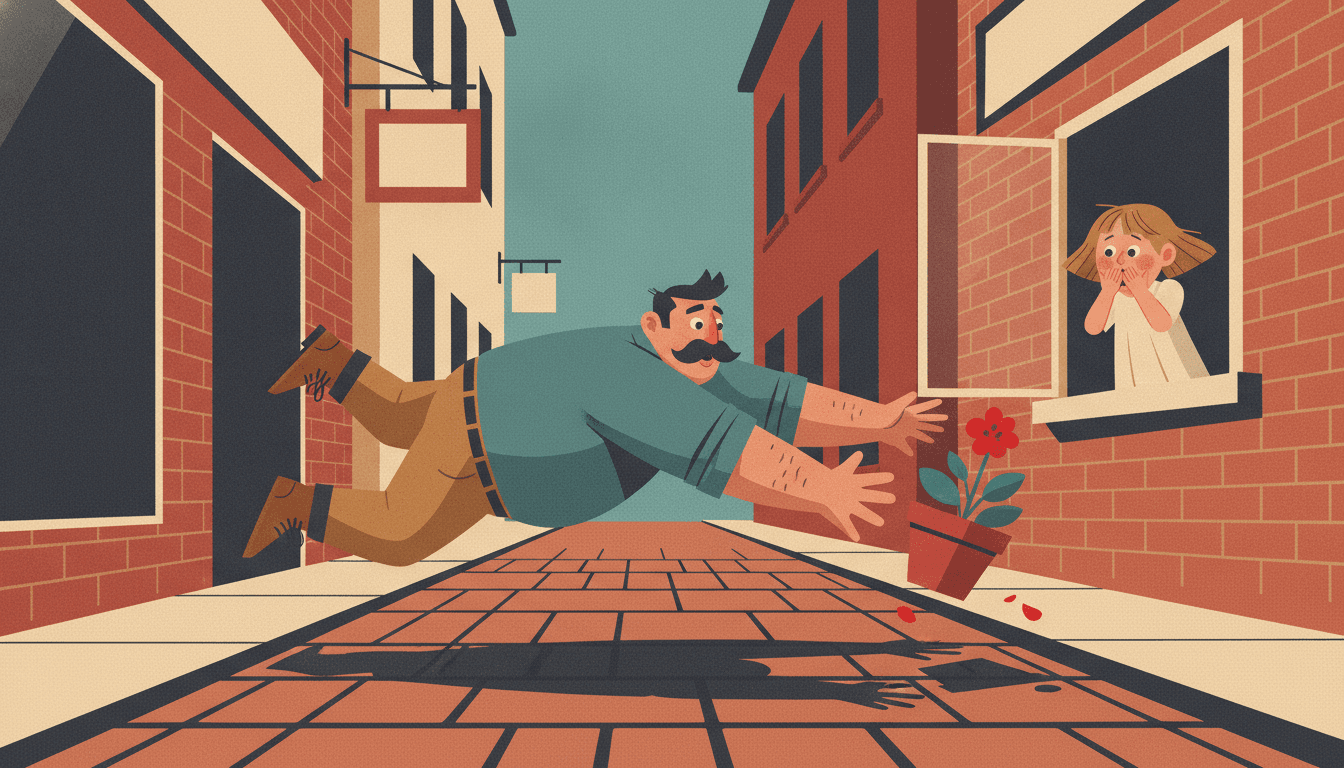
A flowerpot goes over a windowsill. A man in the street below throws himself sideways through the air with both hands out, and a girl at the window covers her mouth. The pot has not landed yet. That half-second is the whole page, and it is funny because nobody knows how it ends.
Other comic styles in the library put the joke somewhere else: in a verdict, in a reaction, in nobody noticing. This brief is the only one that asks for tension, so the joke lives in the stakes, in the gap between what is about to happen and whether it does. The reader is laughing because they are worried, and the worry is about a flowerpot.
In a book you do not write image prompts; C2Story writes them from your story. A page that says “Sam walks to the party” gets a man on a street. A page that says “Sam runs to the party with the cake sliding off the plate” gets a lean, a stride and something to catch.
From One Sentence to Action Comedy Picture Books
You pick the look once. The brief is then applied to every page, so the chunky planes, the block light and the brick-and-teal palette never drift.
Describe the job and the risk
Write a sentence or two about who has to get what, where, and what is in the way. Give the hero one body shape and one colour so they read instantly in every pose.
Choose Cinematic Action-Comedy
Pick the style from the Styles Library. From then on every page uses the same planar shapes, the same hard block light and the same brick red, dusty teal and warm tan.
Get a whole book
C2Story writes the story, splits it into pages and illustrates each one. Regenerate any page you want to change without touching the rest, read it online, share it, or buy the PDF download to hand to a printer.
This Style and Its Three Nearest Neighbours
One shares the big shapes and the comedy, one shares the comedy and nothing else, and one shares the grain and the hard light. Here is what each actually asks for.
Cinematic Action-Comedy Character
The style on this page
A stylised cinematic action-comedy look: bold chunky planar silhouettes, an exaggerated burly mustachioed everyman with a streetwise flavour, crisp geometric block fills with subtle grainy shading, and a punchy sense of movement and comic tension. Punchy directional block light. It refuses delicate thin linework, flat lifeless poses, pastel softness and photorealistic detail.
Bold Flat
Big shapes and comic timing, under a black line
Thick heavy black contours around flat colour blocks, modern everyday characters and deadpan or suddenly exaggerated faces with clear comic timing. The joke there is a verdict on the situation. Here there is no black outline, the edges are blocky planes, and the joke is whether the cake makes it.
Gag Manga
The joke lands on a face
Rough, sketchy manga lines built on big reactions. The comedy sits in somebody’s response after the thing has happened. Choose gag manga for the face somebody pulls; choose action comedy for the second before, when it could still go either way.
Grainy Cinematic
Same grain and hard light, no jokes
Flat colour shapes under film grain with strong dramatic directional light, in dusk blue and burnt orange. The light there sets a mood. Here the light is cut into blocks to make the pose read, and the mood is a near-miss rather than a drama.
Story Ideas for Action Comedy Picture Books
Each idea starts with an ordinary job and one thing that could go badly wrong.
The Cake Has to Get There
The wedding is at noon, the bakery is six streets away and the van has a flat tyre. Mr Rossi will carry the cake himself. The cat has other ideas.
Uncle Bruno and the Tower of Boxes
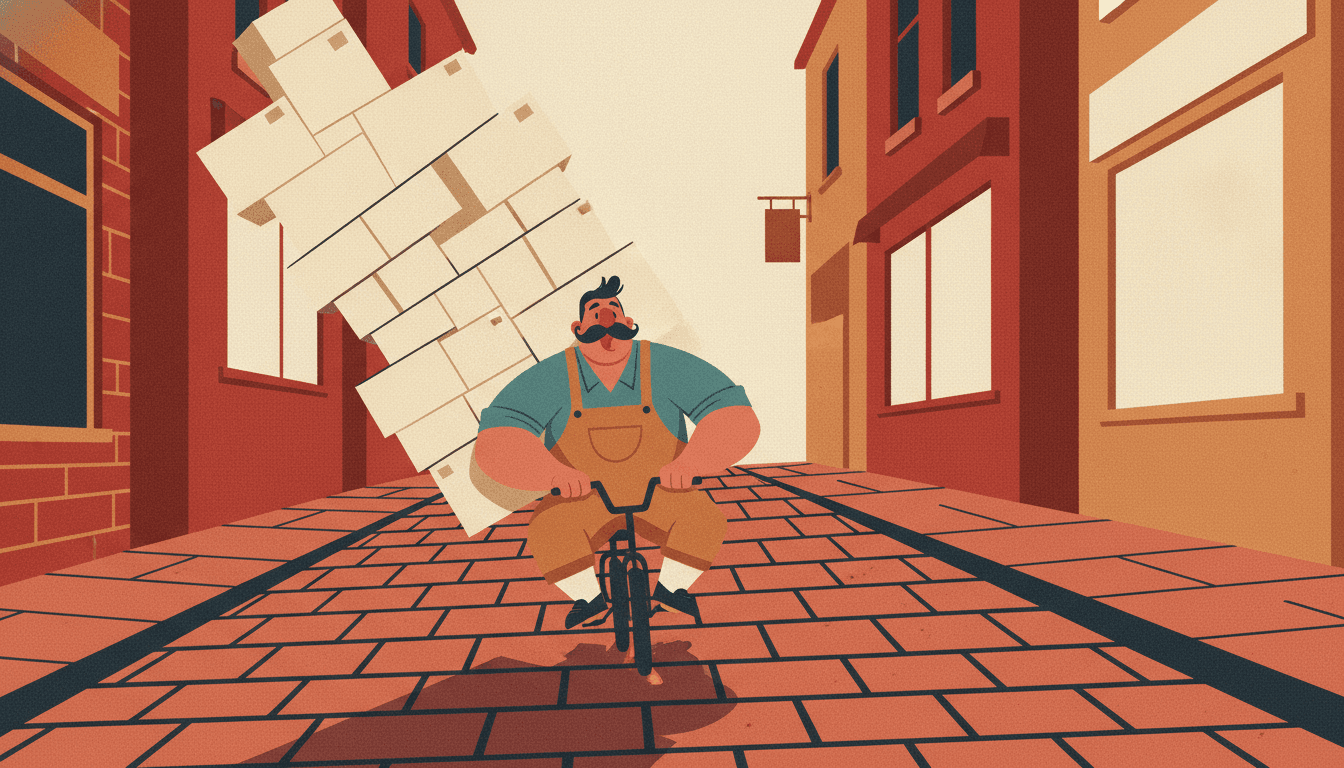
Every parcel in town has to be delivered today, and Uncle Bruno only has a very small bicycle. Each page, one more box.
The Flowerpot Catch
Mia knocks Grandma’s geranium off the windowsill. Down in the street, the man from the corner shop has about one second to decide.
Tiptoe Past Biscuit
The pie is for the neighbours. The neighbours are at the far end of the street. Biscuit the enormous dog is asleep exactly in the middle of it.
The Kite in the Lamp Post
The ladder is too short, the wind is getting up, and the only person holding the bottom of it is seven years old.
Push!
The little red van stops halfway up the steepest street in town. Dad pushes. Lily pushes. The van rolls back a little. Everyone pushes harder.
Dynamic Character Art Across a Book
Pages generated to this one brief and not retouched. Two honest notes: the kite came back flying free beside the man rather than tangled in the lamp post we asked for, and one square came back as a card on a white page, so we cropped it to the picture. Expect the occasional frame you need to regenerate.
Standing still, then about to fall
One box too many
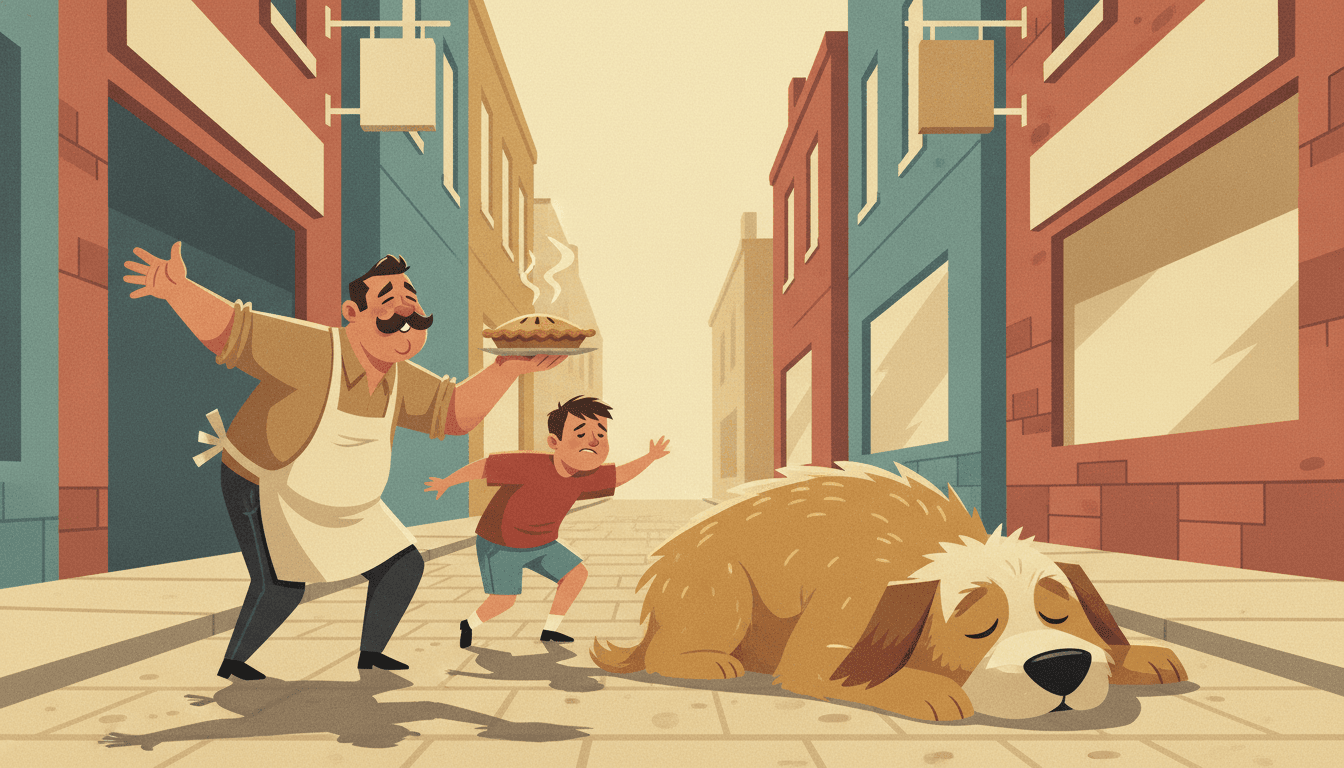
Do not wake the dog
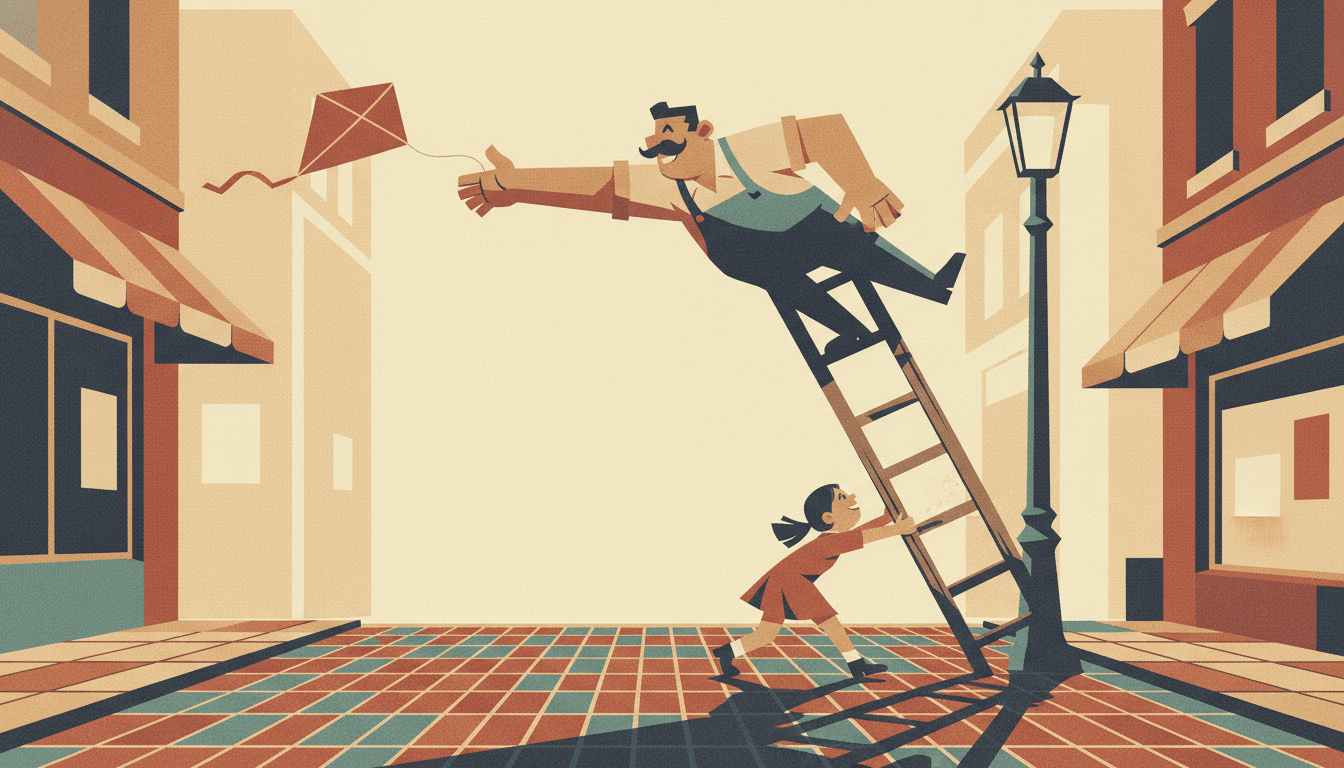
The kite was meant to be stuck in the lamp post. It had other ideas.
Big Poses, Held on Model
The character sheet is plain on purpose, so you can see the design: flat cap, big moustache, teal shirt, brown trousers, the same build in every move. The stakes pages swap the hero for a baker, a dad, a fruit seller and a man with a cat, but the shapes, the light and the palette hold across all of them.
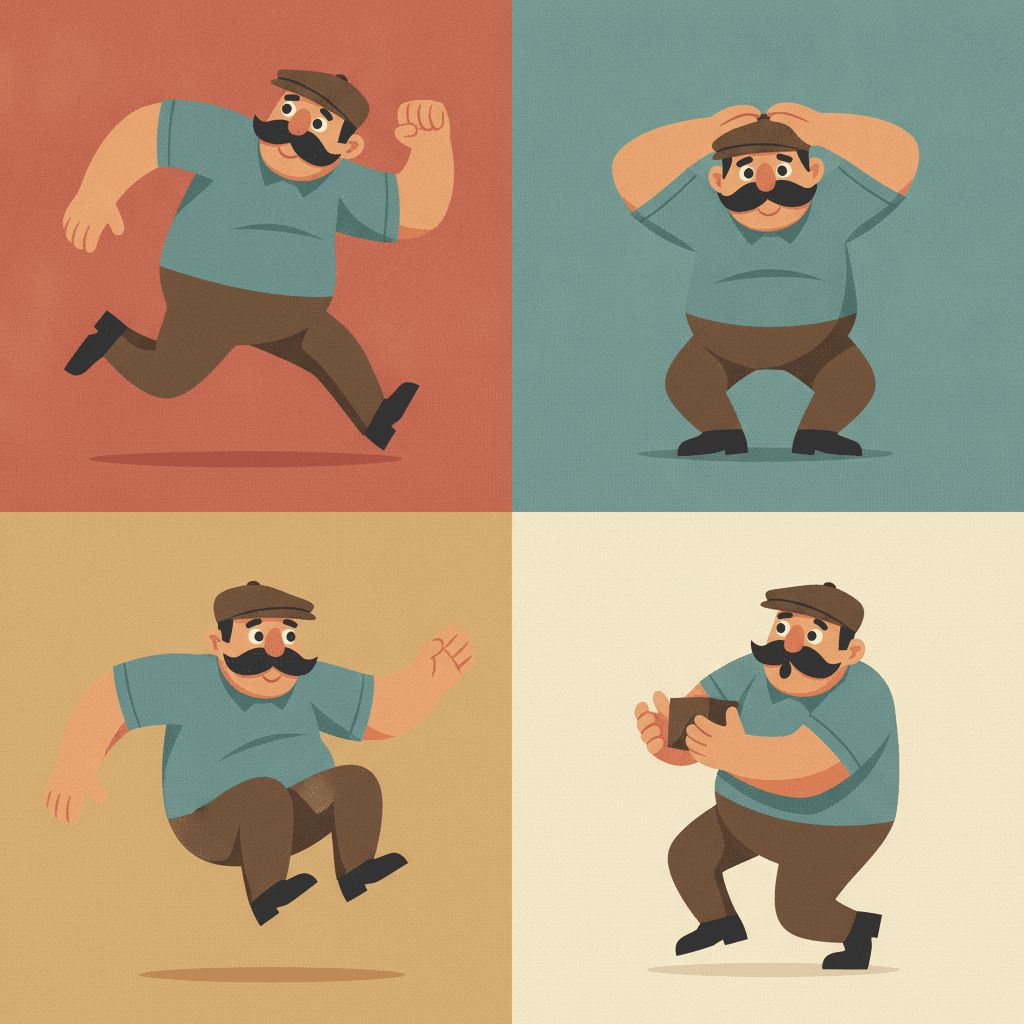
One hero, four moves
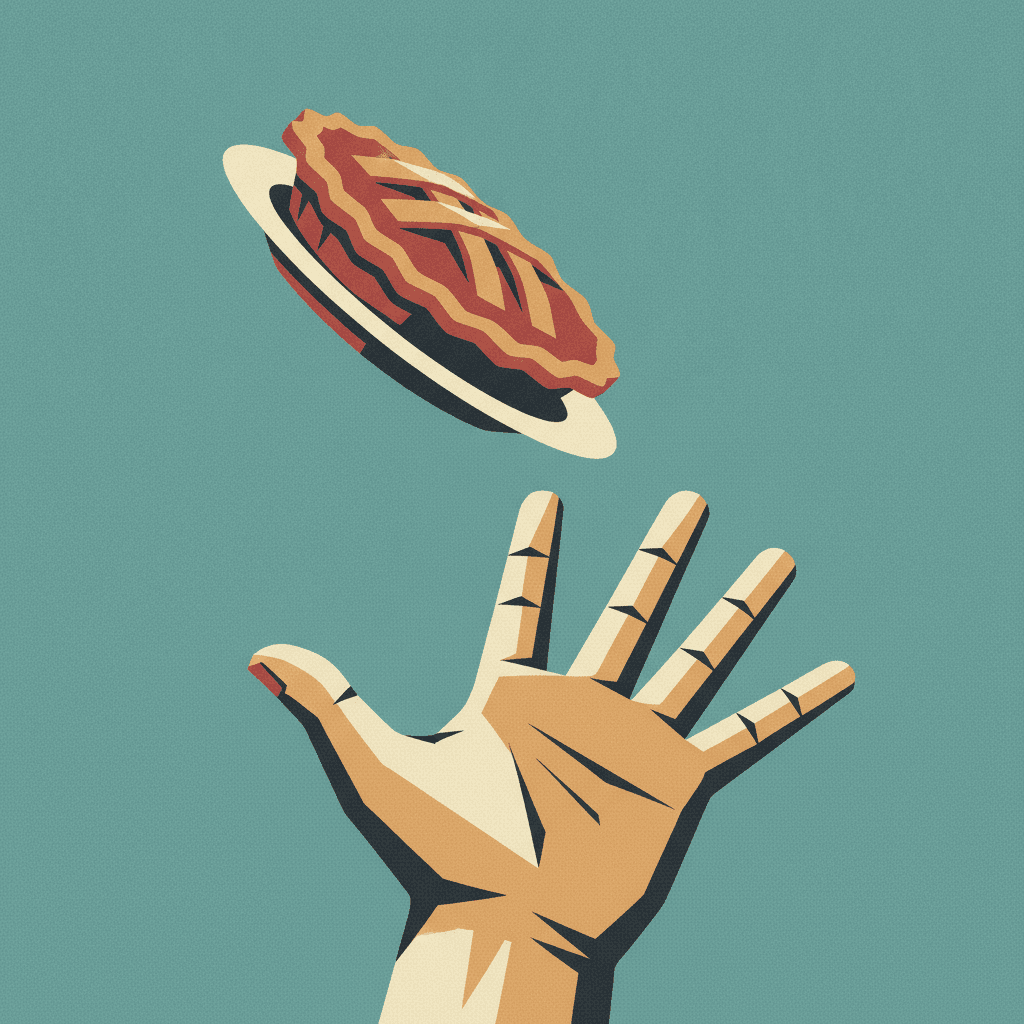
Not caught yet
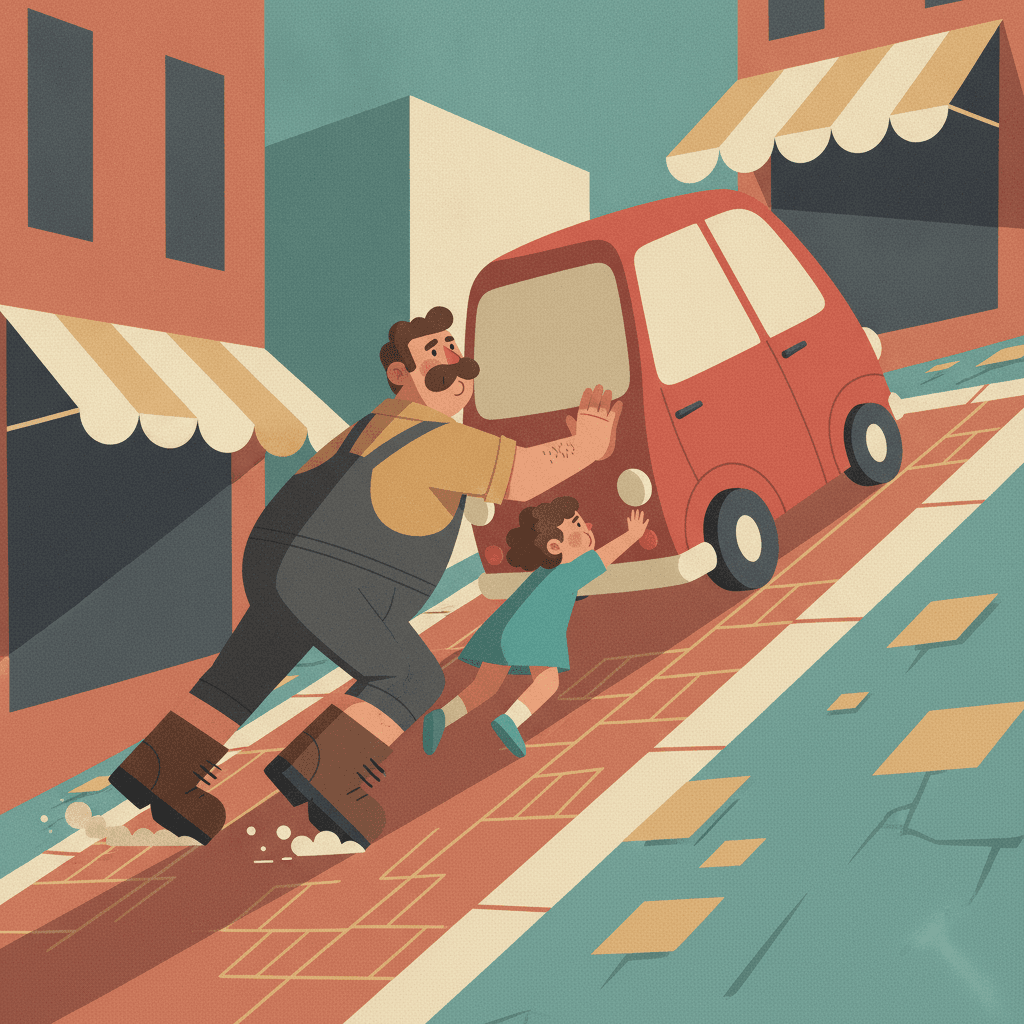
Halfway up the hill
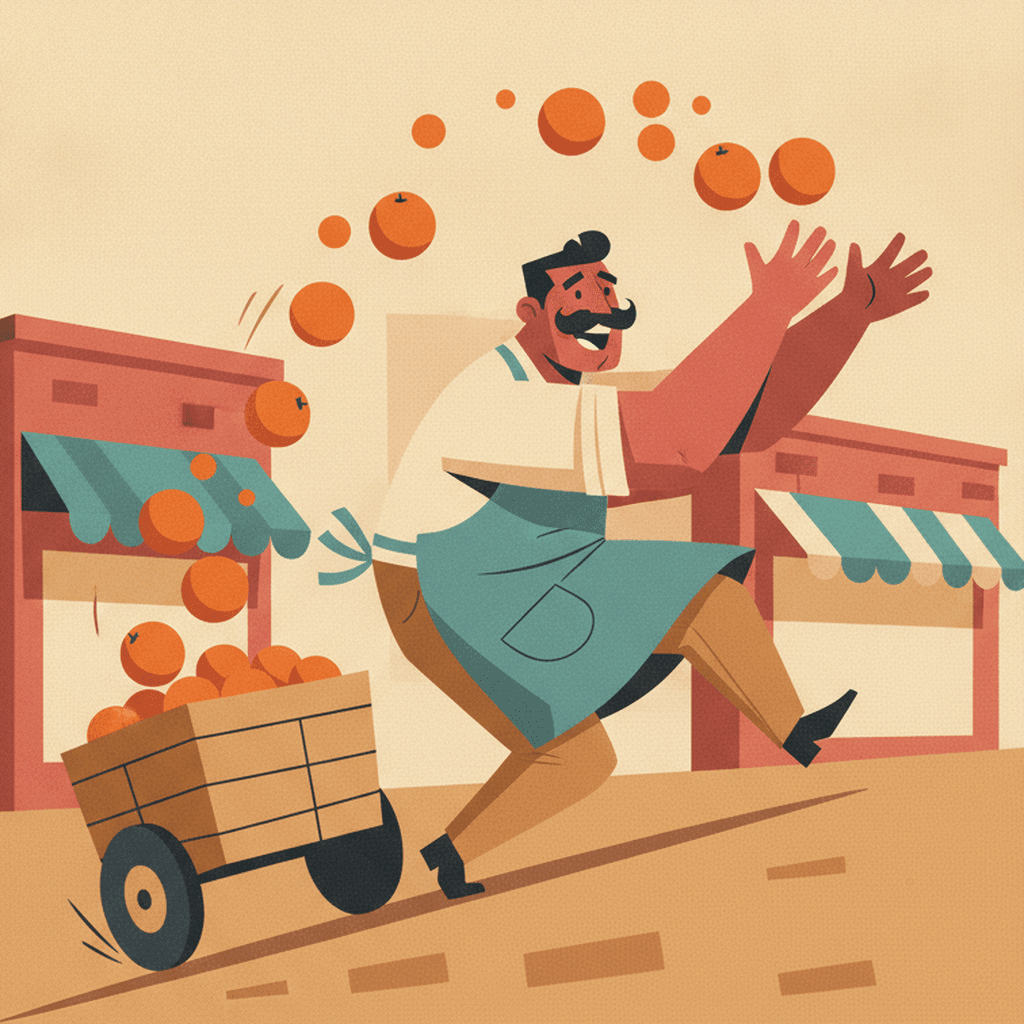
There go the oranges
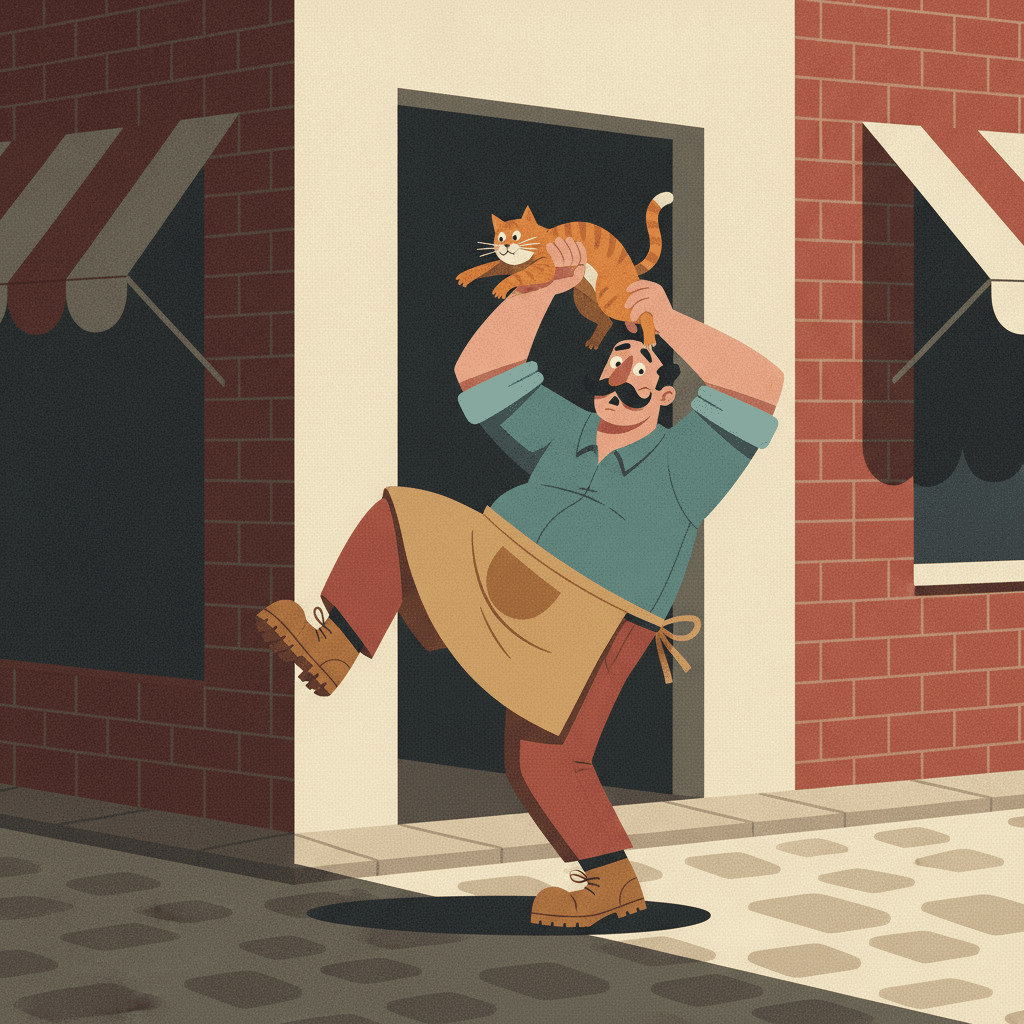
The cat has other plans
Making Whole Action Comedy Picture Books
What is useful in a book drawn this way and where the limits are, in the order you are likely to meet them.
The same hero in every pose
A style made of big shapes needs a hero you know by shape: one body type, one moustache or hairstyle, one shirt colour. Save the character in the Character Library with up to fourteen reference images and a short description. Characters made from an uploaded photo stay private.
Write what could go wrong
The brief asks for comic tension, so give every page something at risk: a cake on one hand, a ladder that wobbles, a dog that might wake. Say what it is and how close it is to falling, and the picture has a reason to lean.
Use verbs with a direction
The brief refuses flat, lifeless poses. A page where someone “stands in the kitchen” gives it nothing to push against. A page where someone “dives across the street” gives it a direction for every arm and leg.
Everybody comes out sturdy
The sample hero is a burly grown-up, and the style draws everyone in chunky blocks, children included. If you want a slender or delicate cast, or a soft pastel bedtime book, a different style will serve you better.
Funny, not violent
The brief’s own words are “gritty street scene” and “streetwise”, but nothing in it asks for fights. Every page on this one was generated with the action kept to falling cakes, wobbling ladders and runaway oranges. Write the stakes as things, not as people getting hurt.
A whole book from a sentence
Describe the story in a sentence and C2Story writes it, splits it into pages and draws every page to the same brief, in English, Chinese, Japanese, Spanish, French and more. Read online, share a link, or buy the PDF download as the handoff to your printer. Pages are licensed for commercial use under the terms of service.
Other styles where the joke sits somewhere else: for big flat shapes under a heavy black line, bold flat picture books; for the face somebody pulls afterwards, gag manga picture books; for the joke nobody in the picture notices, deadpan cartoon picture books; for geometric blocks in clashing bright colour, geometric picture books; for flat shapes under film grain and dramatic light, grainy cinematic picture books; and for every style side by side, the children’s book illustration styles gallery.
Questions About Action Comedy Picture Books
Explore More Story Ideas
Discover more styles, tools, and story types
Ninja Stories
Dojo training, stealth missions and the secret scroll
Explore
Single Panel Cartoon Books
One ordinary room, drawn in full, and one thing in it that should not be
Explore
Bedtime Story Generator
Cozy goodnight stories for kids
Explore
Storybee Alternative
More styles & features
ExploreGive Somebody a Cake to Carry, Then Put a Cat in the Way
A tower of boxes, a falling flowerpot, a ladder that wobbles. Describe your story once and every page keeps the same chunky planes, the same hard block light and the same brick red and dusty teal.
Free credits by request · No credit card required
Action Comedy Picture Books: Big Shapes, Hard Light and Something at Stake
Action comedy picture books rest on a brief that asks for comic tension. C2Story runs seventy-eight hand-drawn style briefs, each a short written record of a palette, a light, a line weight and a few refusals. Three of them ask for comic timing; only this one asks for tension, and only this one asks for an everyman hero. It is also the only brief that calls its light block light: hard, from one side, cut into flat planes.
The look is action comedy illustration built from bold chunky planar silhouettes and crisp geometric block fills, with bold blocky edges and a subtle grain over the flat colour. The palette is punchy and grounded, brick red, dusty teal and warm tan. Its sample action comedy character is a burly mustachioed everyman caught mid-action in a scrappy alley. It refuses delicate thin linework, flat lifeless poses, pastel softness and photorealistic detail, so the shapes stay heavy and the people keep moving.
This cinematic action illustration suits stories about ordinary jobs going nearly wrong: a cake that has to reach a wedding, a tower of parcels on a tiny bicycle, a kite stuck in a lamp post, a van that will not go up the hill. Write what could go wrong on every page, and give every page a verb with a direction. Save your hero in the Character Library with up to fourteen reference images and they stay on model through every pose. It is weaker for quiet bedtime books, delicate pastel worlds and casts that should look slender.
The choice between neighbours is clear. Take bold flat for big shapes under a heavy black line and a joke that is a verdict, gag manga for the reaction after the fact, and grainy cinematic for grain and hard light without the comedy. Take this style for dynamic character art with something at stake. Describe the story in a sentence and C2Story writes it, splits it into pages and draws every page to the same brief, with the paid PDF download as the handoff to your printer.