
Mythic Bestiary Picture BooksThe Old Beasts, Drawn as Animals
Of the seventy-eight style briefs here, only one is about beasts — and it does not ask you to invent them. A mythic bestiary picture book takes creatures that were written down long ago and redesigns them as animals: real weight, real joints, a temper you can read from their ears, drawn in pressured brush and drifting ink mist.
- Legendary beasts redesigned as believable animals
- Visible brush pressure and layered ink washes
- Ink black, smoky grey, aged beige, a little vermillion
- Free credits by request — no card
50,000+
Stories Created
10,000+
Active Creators
50+
Art Styles
4.9/5
User Rating
What Makes Mythic Bestiary Illustration Different From Every Other Creature Style
Every style here is a written brief — a palette, a light, a line weight, a short list of refusals. Four lines in this one decide everything, and the most revealing is the very first: where the creatures come from.
The only brief whose subject arrives already described
Every style in C2Story runs on a short written brief — a palette, a light, a line weight and four things to avoid. Most of them describe a way of drawing and leave the subject to you. This one names where its subject comes from: ancient legendary beasts, reimagined as modern creature design. Read all seventy-eight briefs and the word beast appears in exactly one. So does reimagined. So does creature design. The brief is not asking you to invent a monster. It is asking you to take a creature that somebody wrote down a very long time ago and work out, properly, what it would look like if it had to stand up and walk.
Real character — meant for an animal, for once
Seven briefs in the library ask for expression driven by real character or personality rather than a generic cute default. Six of them are talking about people: their sentences go on to face shapes, head-to-body ratios and hand-and-foot forms. This is the only one that says the creature's real character. That changes what the instruction means. A person shows temperament in the face; a large animal shows it in the ears, the set of the head, the weight on one hoof, the tail. So the beasts in a mythic bestiary book are wary, proud, sulky or curious in the way a horse or an ox is — with the whole body — and never with a mascot's big glossy smile.
A moody light that comes from the air, not a lamp
Only three briefs put the word moody in their light. Two of them mean chiaroscuro — moody hatched chiaroscuro for crosshatch gothic, dramatic moody chiaroscuro for dark fantasy — a source of light and the hard shadow it throws. This brief records moody atmospheric ink lighting. There is no lamp in that phrase and no direction. The mood is made by the ink itself: washes that thicken into grey haze and thin out again, far hills fading layer behind layer, a beast half there in the weather. Nothing is hidden by shadow. It is hidden by distance, which is a gentler and far older kind of mystery.
A brush you can see working, and colour kept on a short leash
The line carries the visible-pressure sentence shared by just three briefs in the library: hand-drawn brush pressure, pauses and slight irregularity that give outlines a real on-paper rhythm. The botanical ink brief holds a fine pen; the wild ink brief and this one hold a brush, with ink washes and textured strokes. The palette is written down as deep ink black, aged paper beige, smoky grey and muted vermillion, under the instruction muted ink tones with restrained colour accents — a phrase that appears in no other brief. In practice the vermillion is a stripe on a flank or a mark on a mane, never a whole sky.
A Mythic Bestiary Beast Is an Animal First
The old creature lists are wonderfully short. An entry in the Shan Hai Jing might give a mountain, a beast, what it resembles, the sound of its cry and what follows when you see one — a handful of lines, and then the next mountain. Generations of artists have filled the gap between those lines and a drawable animal, and they have mostly filled it in one of two ways: a decorative emblem, or a monster.
This brief asks for a third thing. Its creatures are reimagined as modern creature design — the discipline of working out how an invented animal would really be built — and their expression and body language come from the creature's real character rather than a generic cute default. Put those together and the job is clear: decide what this beast is like as an animal, and let its body say it.
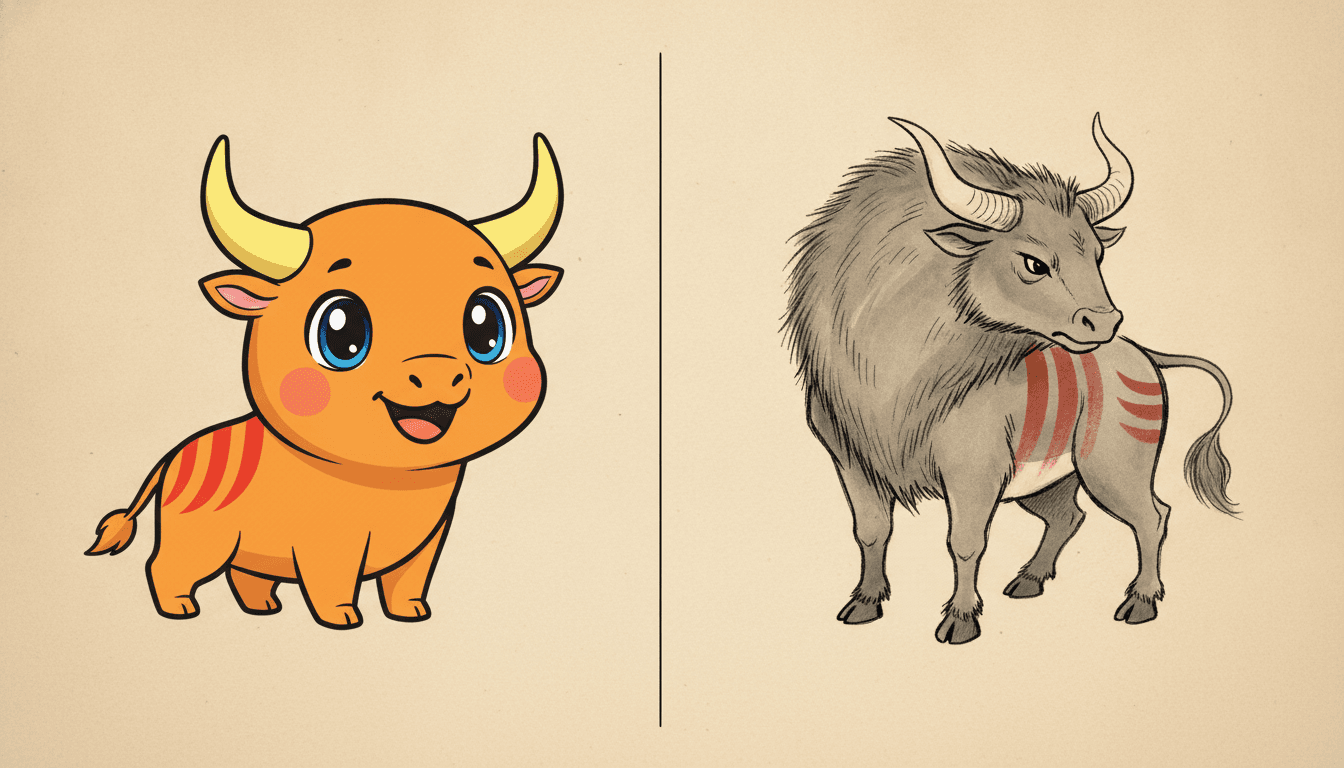
The picture beside this shows the difference at a glance. The same horned beast, drawn twice: once as the friendly default every image model reaches for, and once as the brief asks — heavier, shaggier, mouth shut, watching you out of the corner of its eye. Only one of them looks like it could walk off the page.
Write the Entry, Not the Monster
Here is what that means for the person writing the story, and it is the reason to choose this style over a darker one. Most creature stories describe their beast by its effect: huge, terrifying, majestic, mysterious. Those are adjectives a brief built on body language cannot draw. It has nothing to do with them.
What it can draw is behaviour. So write your creature the way the old lists did — as an entry. Where does it live? What does it eat? What does it do when a child comes too close, and what does it do when it is ignored? Does it steal persimmons and look guilty about it, or steal them and look you in the eye? Every one of those answers turns into a posture, and a posture is what this brief renders best.
The test of a page is simple: cover the text, and ask whether you can still tell what kind of animal this is today. If you can, the mythic bestiary style is doing its job.
From One Sentence to a Book of Beasts
You pick the look once. The brief is then applied to every page of the story, so the beast a child meets on page one is the same beast on page thirty.
Describe the creature like an entry
A sentence is enough, and one habit in it goes a long way. Not a majestic mythical beast appeared — a one-horned deer with red stripes comes to the stream at dawn and will not drink while anyone is watching. Temperament is what this style draws.
Choose Mythic Bestiary Ink
Picking it fixes the whole brief at once: legendary beasts reimagined as creature design, visible brush pressure and pauses, textured strokes and ink washes, ink black and smoky grey on aged beige with restrained vermillion, moody atmospheric ink light, and the four refusals.
Get a book, not one striking beast
C2Story writes the story, splits it into pages and builds each page to the brief according to what that page says. Your words are set as type rather than brushed into the art. Read it on the web, share it, or buy the PDF to hand to a printer.
This Style and Its Three Nearest Neighbours
Three other briefs sit closest to this one — one shares its hand, two share its interest in animals. Here is what each actually asks for, so you can take the right one rather than the first one.
Mythic Bestiary Ink
The style on this page
A mythic bestiary ink illustration: ancient legendary beasts reimagined as modern creature design with traditional brush spirit. Visible hand-drawn brush pressure, pauses and slight irregularity give outlines a genuine on-paper rhythm, with ink washes and textured strokes, and expression and body language driven by the creature's real character rather than a generic cute default. Muted ink tones with restrained colour accents. Its palette is deep ink black, aged paper beige, muted vermillion and smoky grey, its line is variable pressured brush lines, and its light is moody atmospheric ink lighting. It refuses clean vector lines, photorealism, generic chibi faces and flat digital fills.
Wild Ink Weirdness
The same hand — a different creature and the opposite light
The comparison to make first, because the two share almost everything about the brush: the pressure sentence, the ink washes, the muted vermillion, the refusal of a stock cute face. They split on subject and on light. Wild ink draws eerie spirits that are closer to people — robed, long-haired, standing upright — on bare paper under flat ink-on-paper light, so its strangeness is in the shape. This brief draws beasts, animal in body, inside weather. Take wild ink for something uncanny standing quietly at noon; take the bestiary for a creature with mist around its legs and a temper you can read from across a valley.
Naturalist Watercolour
Real animals, carefully observed
The brief that draws animals the way a naturalist would: carefully observed realistic animals, soft translucent washes, delicate detail in fur and foliage, under soft natural diffused light. It shares this brief's respect for how an animal actually stands and moves, and none of its subject. Every creature there exists; every creature here is legendary. If your story is about a real hare in a real meadow, take the watercolour. If it is about a beast with one horn and three red stripes that only the grandmothers have seen, take this.
Bendy Absurd Storybook
Invented creatures, built for laughter instead of weight
The other brief with creatures as its subject, and the clearest way to see what this one is not. The absurd brief invents its creatures from nothing — wobbly, bendy, towering over crooked houses — in bright inventive colour and playful even light, and its job is delight. This brief inherits its creatures from old lore and gives them mass, joints and a temperament. One is a toy that has come alive; the other is an animal that happens to be legendary. If the creature in your story is a joke, take the absurd brief. If it is something you would not walk up to without asking, take this one.
Mythic Bestiary Story Ideas That Suit the Brief
Each of these plays to the same strength: a creature with a habit, a temper and a place it belongs, and a child with a reason to learn all three.
The Beast That Comes Down for Persimmons
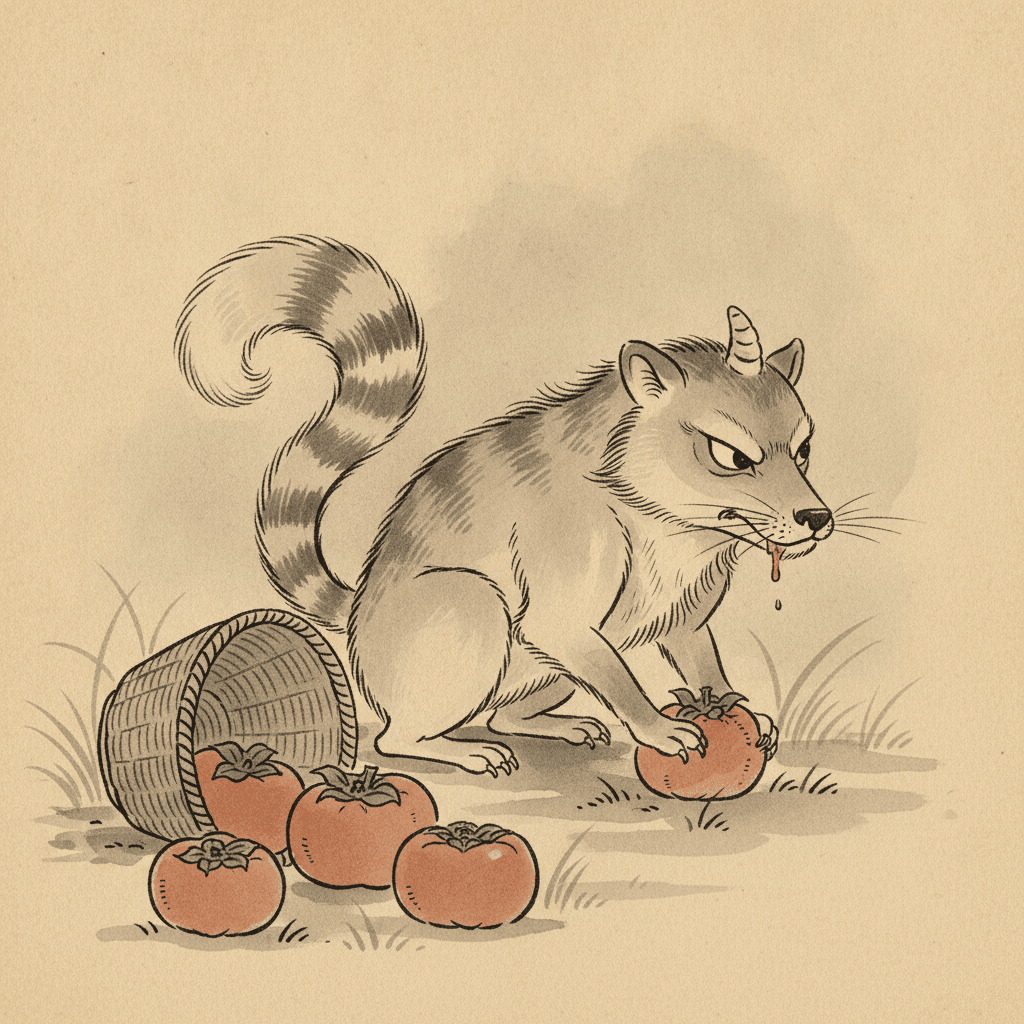
Every autumn something takes the fruit from Grandmother's basket and leaves hoofprints. A habit is the fastest way into a creature's character, and this brief draws the guilty look as clearly as the horn.
You Must Not Wake the Fox in the Bamboo
Everybody in the village knows the rule; nobody remembers why. Atmospheric ink light suits a creature half seen through stalks and mist, and a sleeping one with one ear still turned towards you.
Riding the Mountain Ox Across the River
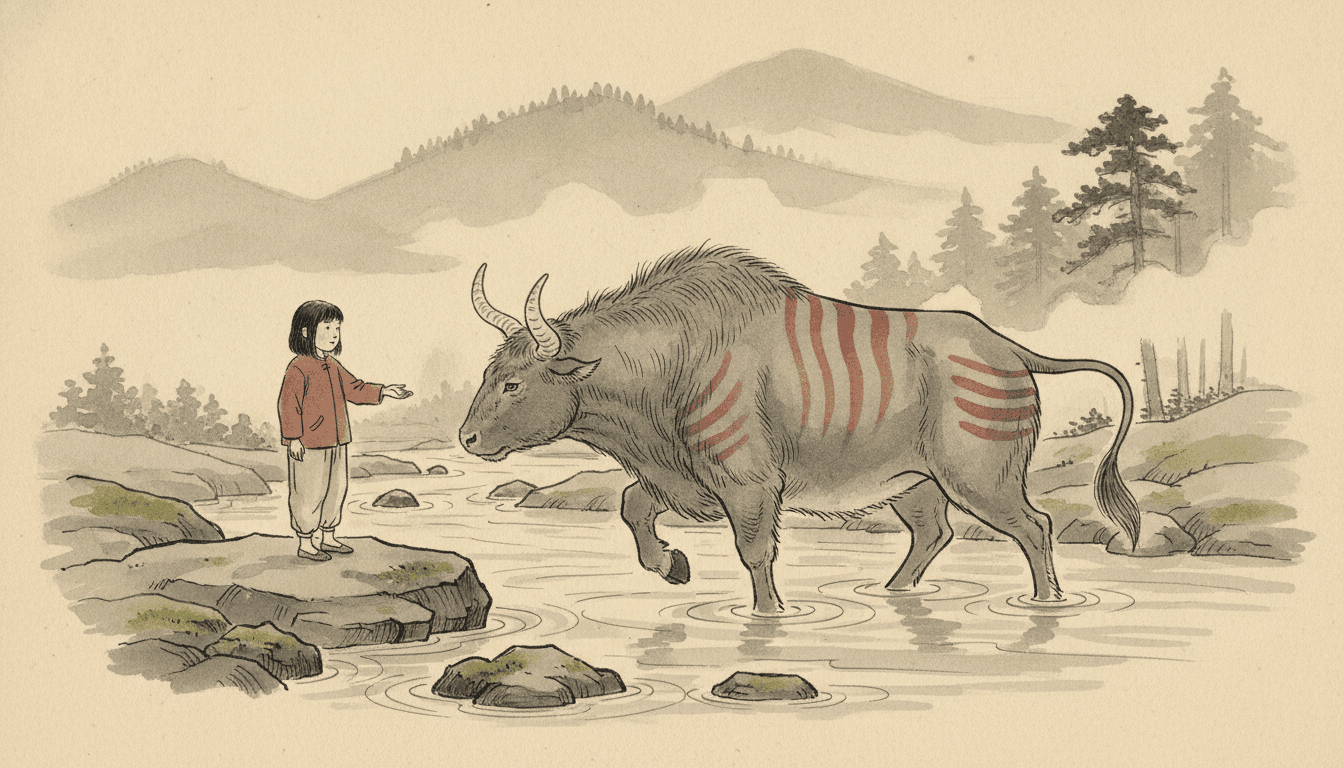
The ferry is gone, the water is high, and the oldest animal on the mountain is willing — this time. A creature with real weight makes a crossing feel like a crossing.
The Herd That Only Comes Out in Fog
A boy sits on the same rock every misty morning to count them, and the number is never the same. Layered washes let a crowd of beasts recede into the weather one by one.
Under the Beast When It Rains
A lost child, a cold hillside and something enormous that lies down and makes room. Body language does the reassuring here — the half-closed eye, the folded legs — without a single smile.
My Grandfather's Book of Beasts
A child finds an old list of creatures, each with three lines of description, and goes looking. The story is literally what this brief does: read an entry, then meet the animal.
What Pressured Brush and Atmospheric Ink Light Actually Look Like
Three images generated to this one brief, with nothing retouched afterwards.
The Same Beast, Drawn Two Ways
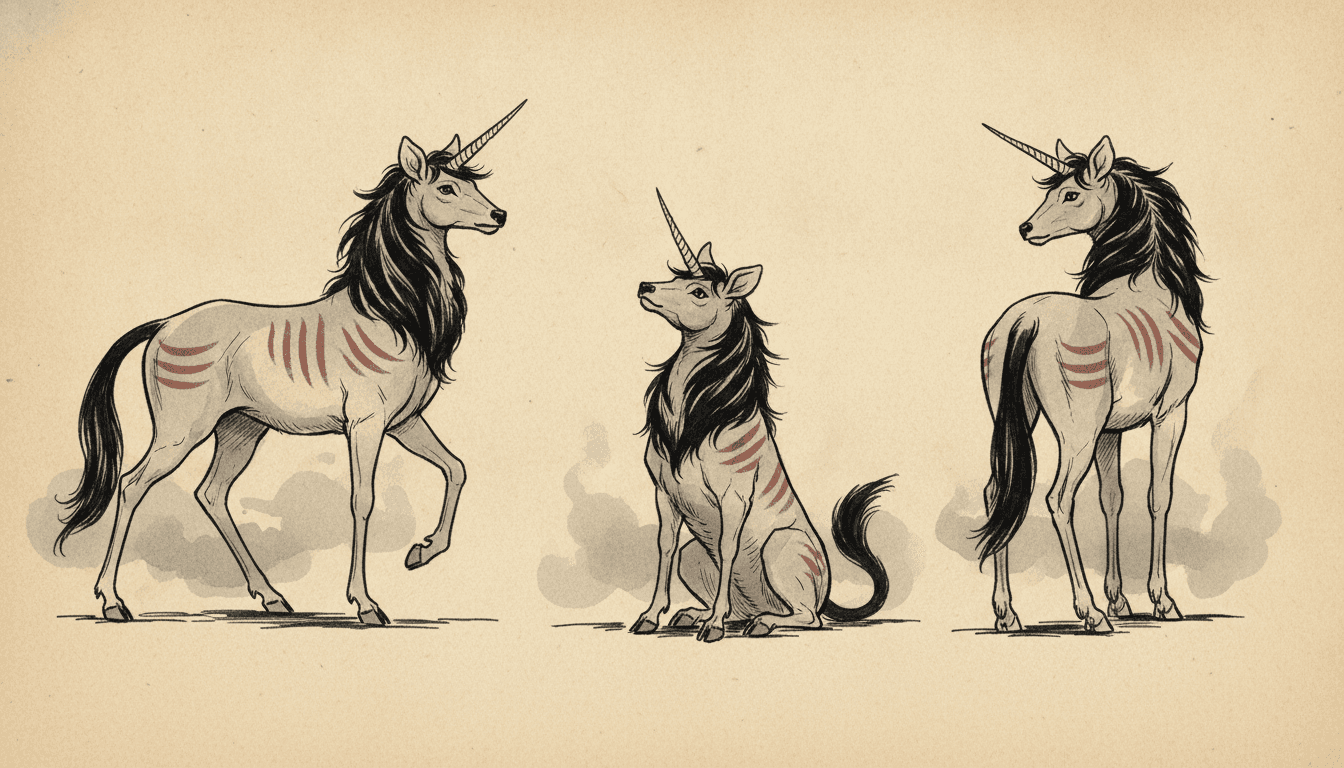
One Beast, Three Poses
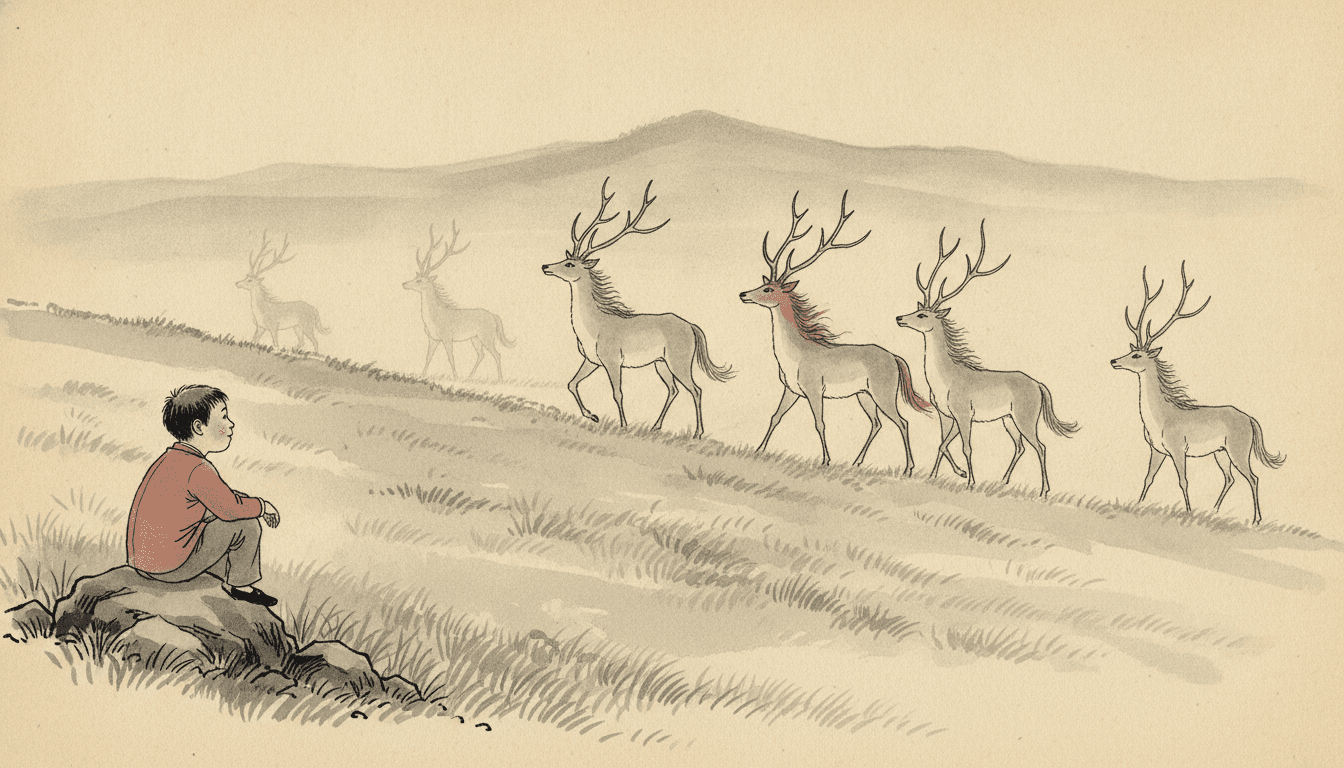
The Herd That Comes Out in Fog
Five Pages Where the Beast Tells You How It Feels
Same brief, same four colours, same misty light — and in every one, the mood is in the ears, the head and the weight, not in a smile.
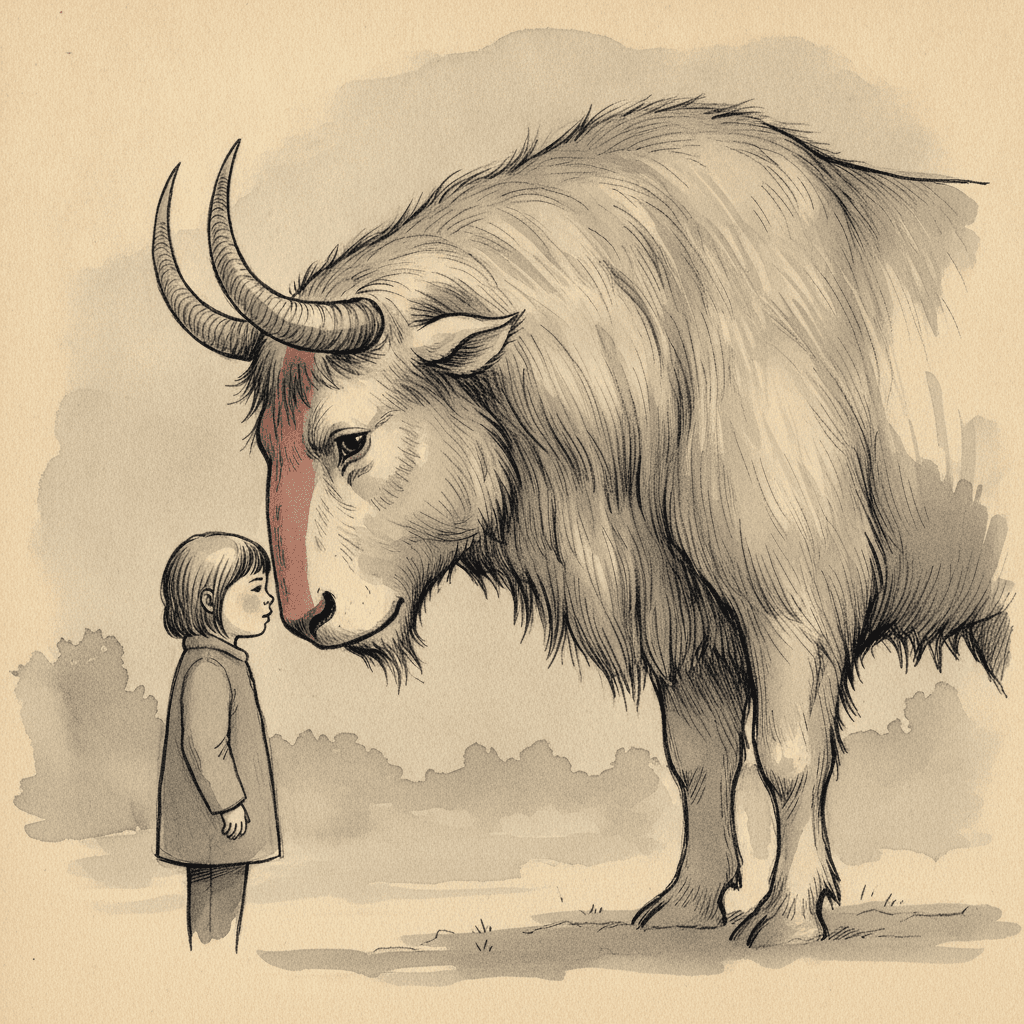
Nose to Nose
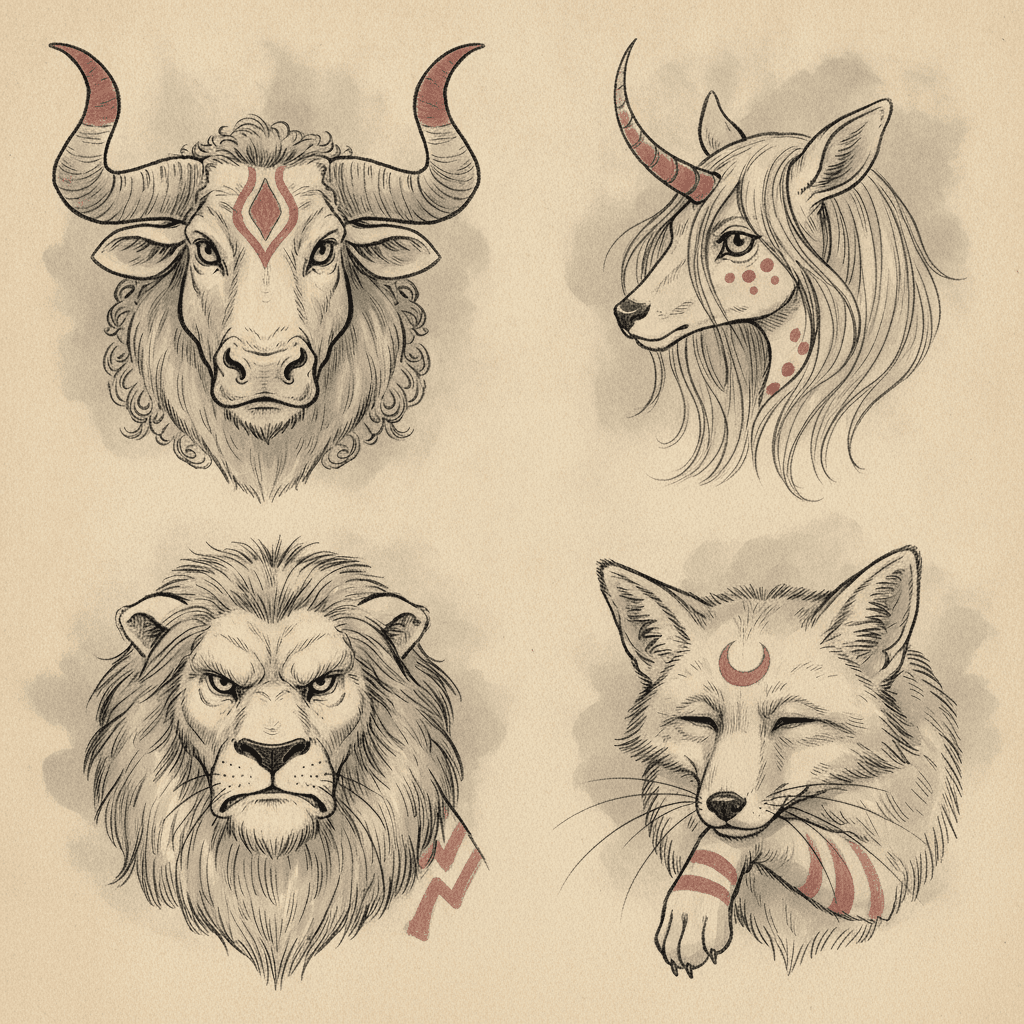
Four Beasts, Four Tempers
Caught With the Persimmons
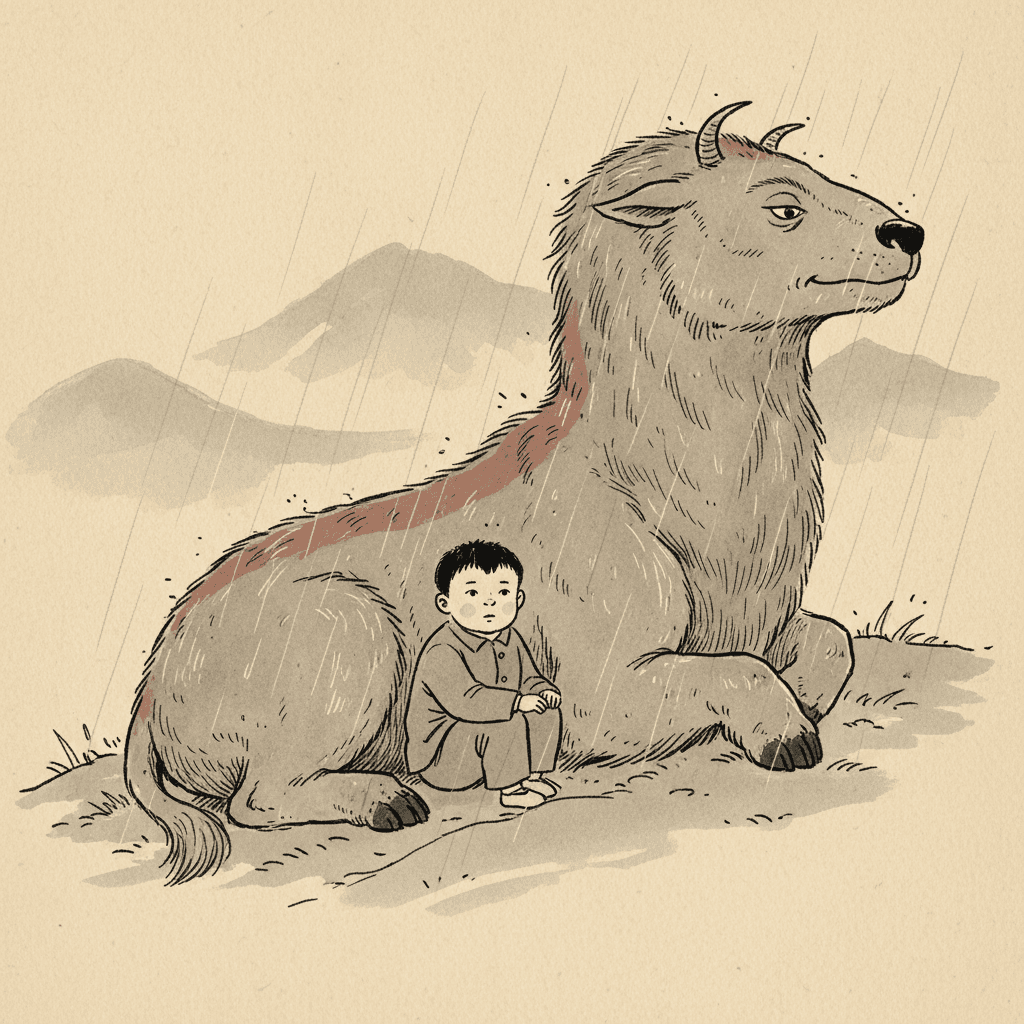
Room Under the Beast
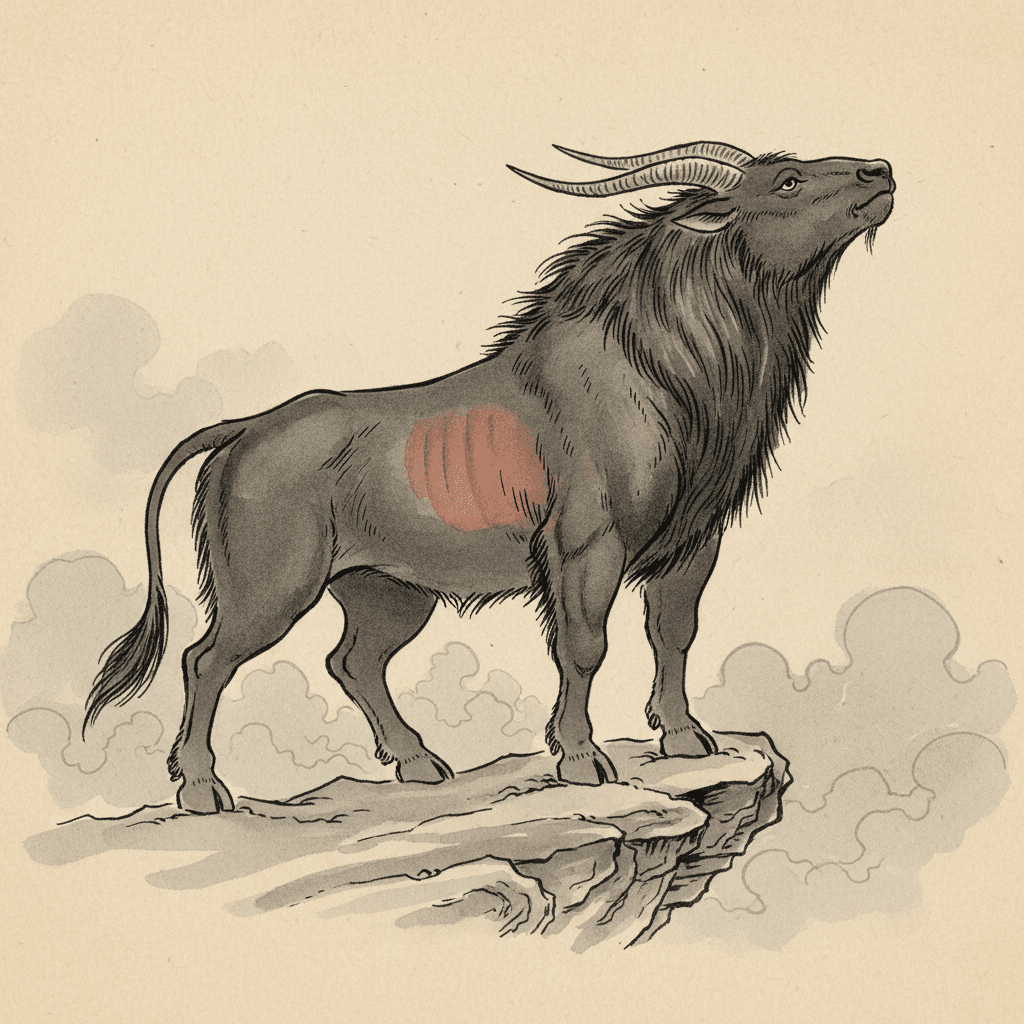
Something on the Wind
Making a Whole Mythic Bestiary Picture Book, Not One Image
The useful things and the honest limits, in the order they are likely to matter to you.
One horn on page one, one horn on page forty
A designed creature is only useful if it stays designed. Generate images one at a time and the beast grows a second horn, loses its stripes and changes species by the fourth spread. C2Story carries one fixed brief into every page, so the line, the palette and the misty light hold, and each character — beast or child — can be saved in the Character Library with up to fourteen reference images. That is what keeps a one-horned deer-beast with three vermillion stripes exactly that across a whole book. Characters built from an uploaded photo stay private to your account.
Four colours, one of them used sparingly
Deep ink black, aged paper beige, smoky grey and muted vermillion — and the brief's own phrase, restrained colour accents, governs that last one. Expect the red on a stripe, a mane or a child's jacket rather than across a page. One honest note: there is no global greyscale switch in C2Story, so if you want ink with no colour at all, pick a brief that is monochrome by design rather than trying to strip the vermillion out of this one.
What you are giving up, said plainly
You are giving up brightness and crispness. The light is moody and atmospheric by instruction, so a sunny primary-coloured world will fight the brief. The line is a pressured brush line by instruction, so a clean graphic outline will too. And you are giving up the cute default: if your story needs a cuddly round creature with big eyes for the very youngest readers, this brief will keep drawing it as an animal with opinions. That is the point of it, but it is not for every book.
Why the mist makes it gentler, not scarier
A legendary beast in a children's book raises a fair worry. The brief helps in two ways. Its mystery comes from distance and weather rather than from black shadow, so nothing leaps out of a dark corner — far things simply fade. And its insistence on real animal character means the beasts behave like animals: they sniff, they hesitate, they sulk, they lie down. A child who has met a large dog or a farm horse already knows how to read them. They are impressive, and often a little proud, but they are not monsters.
A whole book, not one admired creature
A horned beast in drifting ink mist is exactly the kind of image that looks finished on its own and tells you nothing about forty pages. You are not prompting for one picture. Describe the story and C2Story writes it, splits it into pages and builds each page to this brief according to what that page says. Your words are set as type rather than painted into the art, so no fake brush-written characters appear in the picture. Write in English, Chinese, Japanese, Spanish, French and more. The paid PDF download is the handoff to your printer, and everything you make is licensed for commercial use.
Honest about the age this one suits
This is not a toddler style. Very young children want one big friendly shape on a clear ground, and a muted, misty page with an animal that refuses to smile will not give them that. It comes into its own from around five, when children enjoy a creature that is a little bigger and older than they are, and it keeps working well into the teens and for adult readers who grew up on the old stories. For younger readers who want a creature book, the friendly monster stories and the bendy absurd brief are the better choice.
A note on where this one sits in the wider map. For the same brush turned on robed, near-human spirits in flat daylight, see wild ink picture books; for the same visible hand pressure held in a fine pen and spent on plants, botanical ink picture books. For real animals painted from observation, animal watercolour picture books, and for invented creatures played for laughs, whimsical absurd picture books. For the calmer ink traditions where the brush is there to breathe, sumi-e picture books; and if you want a gentle monster story in any style, start with friendly monster stories.
Questions About Mythic Bestiary Picture Books
Explore More Story Ideas
Discover more styles, tools, and story types
Bear Stories
A new bear friend, woodland picnics, honey treats and great bear hunts
Explore
Essay Manga Picture Books
Quiet diary vignettes of an ordinary day
Explore
Picture Book Maker
Create illustrated picture books
Explore
Midjourney vs C2Story
Stories, not just images
ExploreMythic Bestiary Picture Books — Legendary Beasts, Brush and Ink, and a Temper You Can Read
A mythic bestiary picture book starts from an unusual instruction. C2Story runs seventy-eight hand-drawn style briefs, each a short written record of a palette, a light, a line weight and four things to avoid, and almost all of them describe a way of drawing while leaving the subject open. This one names its subject and where it comes from: ancient legendary beasts, reimagined as modern creature design with traditional brush spirit. The words beast, reimagined and creature design each appear in exactly one brief, and it is this one. That makes it the library's only real piece of bestiary illustration — a style whose job is to take a creature somebody described long ago and draw it as though it could stand up and walk.
The second instruction decides how those beasts behave. Seven briefs ask for expression driven by real character rather than a generic cute default, and six of them are about people, going on to face shapes and hand-and-foot forms. Only this one says the creature's real character. So the temperament of each beast lives in its body — the ears, the angle of the head, the weight on one hoof, the tail — the way a horse or an ox shows a mood. That is what turns this mythical creature art into something closer to natural history than to a mascot or a monster, and it is why the beasts are impressive without being frightening.
The light and the line finish the look. Three briefs use the word moody in their light, and two of them mean chiaroscuro. This one records moody atmospheric ink lighting — no lamp, no direction, just ink washes thickening into mist and far hills fading into grey — so mystery comes from distance rather than shadow. The line carries visible brush pressure, pauses and slight irregularity, a sentence it shares with only the wild ink and botanical ink briefs, and the palette is deep ink black, aged paper beige, smoky grey and muted vermillion under the instruction restrained colour accents. Its internal Chinese name points straight at the mountain-and-sea beasts, which is why it is the natural home for a Shan Hai Jing style story. It refuses clean vector lines, photorealism, generic chibi faces and flat digital fills.
The practical payoff is a change in what you write. A brief built on body language cannot draw majestic or terrifying, but it can draw a habit, so describe your creature the way an old entry would: where it lives, what it eats, what it does when a child comes too close. The honest limits are the mirror of that strength — no bright sunny palette, no crisp graphic outline, no cute default — and it suits roughly five and up. Describe your story in a sentence and C2Story writes it, splits it into pages and builds every page to the same brief, holding each beast and child steady with up to fourteen reference images, in English, Chinese, Japanese, Spanish, French and more, with the paid PDF download as the handoff to your printer and everything you make licensed for commercial use.