
Fashion Illustration Picture BooksThe Coat Is the Character
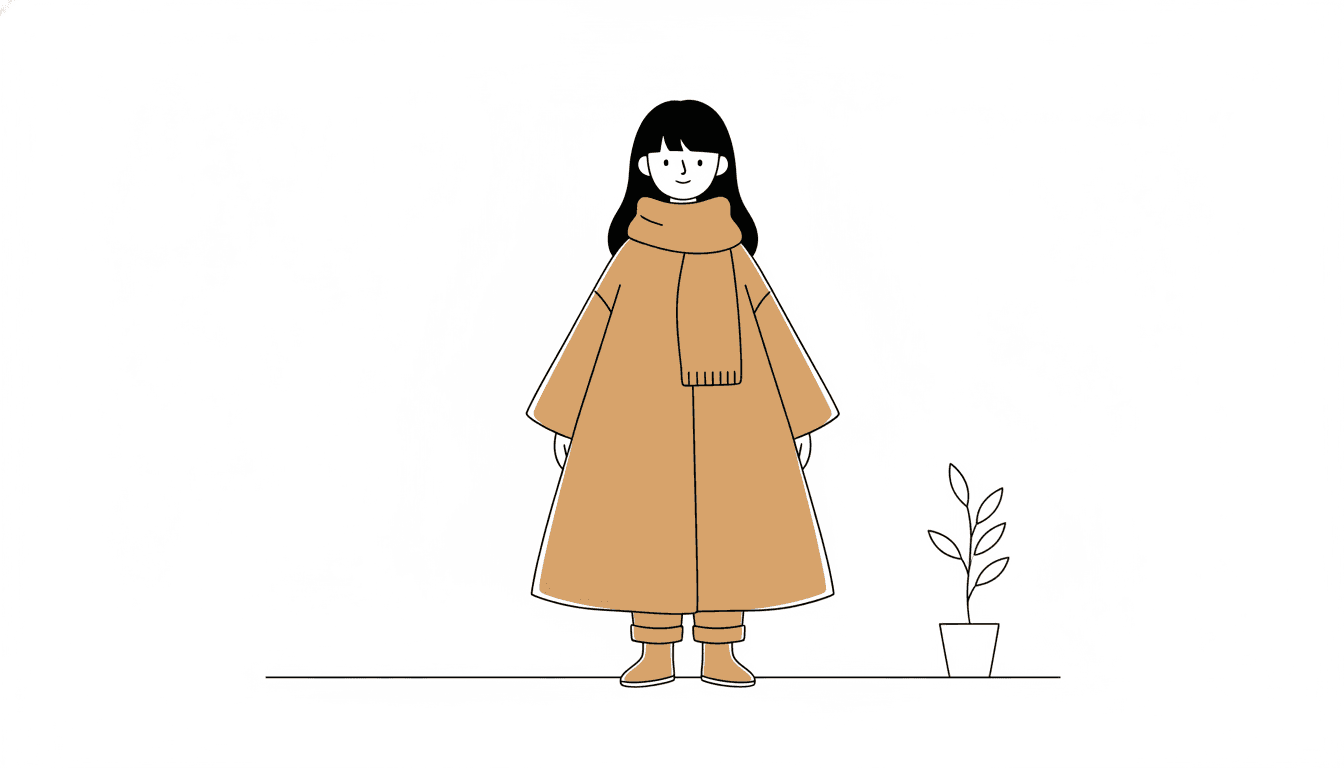
One of the seventy-eight style briefs here names a garment as something to draw. A fashion illustration picture book is built from that one — which then takes away the shading, the line weight and the colour you would normally draw cloth with, and leaves you the outline.
- One confident black line, the same weight from end to end
- No shading anywhere — nothing modelled, nothing casting a shadow
- Clothes drawn with more care than faces, on a clean white ground
- Free credits by request — no card
50,000+
Stories Created
10,000+
Active Creators
50+
Art Styles
4.9/5
User Rating
What Makes Fashion Illustration Different From Simply Drawing Thinly
Plenty of styles here use a thin line and a lot of white paper. This is the only one that spends them on what somebody is wearing.
One brief in seventy-eight names a garment as something to draw
Every style in C2Story runs on a short written brief that records a palette, a lighting note, a line weight and four things to avoid. Read all seventy-eight of the hand-drawn briefs and the word garment appears exactly once, in this one: chic garment shapes over rendered detail. Eight briefs mention clothing at all, and the way they mention it is the giveaway. Two treat it as a colour slot — flat colours keeping silhouettes and clothing in strong graphic contrast. One names it only to refuse it, avoid modern clothing. One uses it as a costume label, characters in adult clothing. One gives it motion, the flowing drape of clothing. In none of them is a garment a thing you sit down and draw. Here it is the thing.
Three briefs throw the clothes away with the face. Only this one says which to keep
Three of the seventy-eight contain the same instruction — faces and clothing reduced to essentials — and on its own that is a subtraction, not a direction. It tells you to stop drawing detail; it does not tell you what survives. This brief is the only one that adds the ranking clause immediately afterwards: chic garment shapes over rendered detail. That word over is doing the work. Having cut the face and the clothes down to essentials, it then says the clothes are the half worth keeping. Nowhere else in the library does a brief hand the character over to what they are wearing. Its second refusal of four is an over-detailed face, which is the same instruction said from the other side.
Then it confiscates every tool you would normally draw cloth with
This is where the style stops being a taste and becomes a problem to solve. Four of its fields are each the only one of their kind in seventy-eight briefs, and all four remove something. Its lighting reads flat shadeless light — the only brief to use the word shadeless — so there is no tone to model a fold with, and shading is the first of its four refusals. Its line weight is a clean confident single-weight line: five other briefs ask for an even or uniform line, but this is the only one that fixes it as one weight, so the stroke cannot thicken to imply heft or shadow. Its palette opens black and white, the only one here that does. And its ground is a large clean white background, so there is no setting to lean on either. No tone, no weight, no colour, no backdrop.
Which leaves the outline, and that is why fashion drawing looks like this
Put those two halves together and the look stops being arbitrary. You have been told the clothes are the subject, and then every instrument for describing cloth has been taken off the table except one: the shape of the line around the outside. So the swing of a coat, the slouch of an oversized scarf, the bell of a gathered skirt and the square of a wide collar all have to be carried by the contour alone, drawn once, at one weight, with nothing inside it. That is not a shortcut, it is the whole discipline, and it is why a fashion drawing can be four strokes and still tell you exactly what somebody is wearing. It is also why this style is unforgiving: there is no shading to hide a shape that was not observed properly in the first place.
Where the Drawing Spends Its Effort
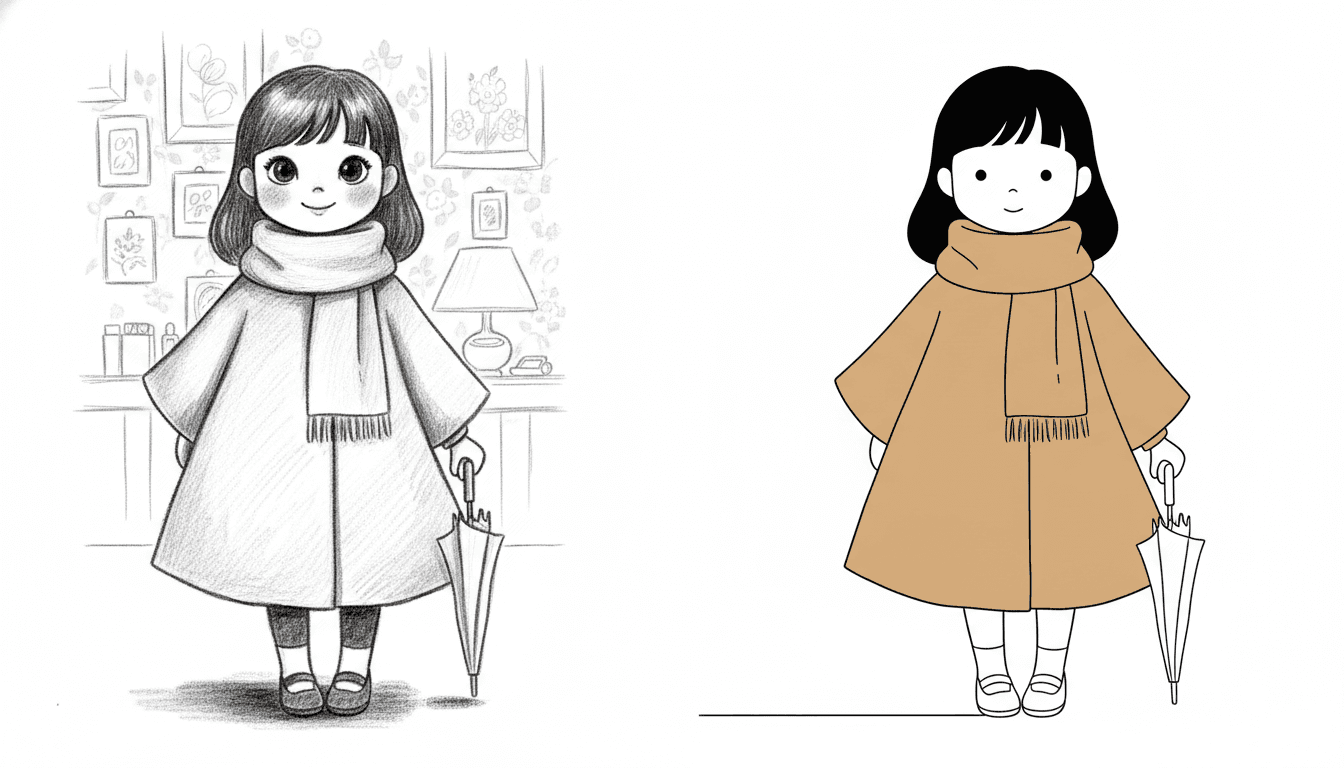
The same girl, the same pose, the same coat, the same scarf, the same closed umbrella in the same hand — and what changes between the two halves is only which part of her got the attention. On the left the effort has gone almost entirely into her face. It is modelled in soft pencil, with big glossy eyes, drawn eyelashes, a shaded nose, pink cheeks and individual strands in her hair, and the room behind her has been filled in to match: patterned wallpaper, five framed pictures, a lamp, a shelf of small objects, a shadow smudged under her feet. Look at what happened to her clothes while all that was going on. The coat is a vague shaded mass. The scarf is barely a shape. You could not say what either garment is cut like.
On the right nothing about her has changed except where the drawing decided to look. Her face is now two dots, a tiny nose line and a small smile, and her hair is one flat black shape with no strands in it at all. The room is gone. And the coat has become the most deliberate object in the picture — a clear swinging outline from the collar down to the hem, drawn once, at one weight, with the scarf's ribbed fringe described just as plainly. The drawing did not get simpler. It got reallocated. That is the actual content of the phrase chic garment shapes over rendered detail, and the reason this brief pairs it with over-detailed face on the refusal list: those are one decision stated from both ends.
Three briefs cut the face and the clothes down together. Only this one then says which half survives the cut — and it is not the face.
Garment appears once in seventy-eight briefs. Eight mention clothing; the rest use it as a colour slot, a costume label, a period refusal or a bit of motion.
Its four refusals, in the order the brief states them:
Write the Wardrobe, Not the Expression
Most picture-book advice tells you to write the feeling: she was nervous, he felt left out, they were secretly delighted. For almost every other style here that is good advice, because a face can be drawn doing it and a light can be dimmed around it. This style has neither. The face is cut to two dots and a mouth by instruction, sweet templated cuteness is refused outright so there is not even a default cute expression to fall back on, and with flat shadeless light there is no atmosphere to carry a mood either. Write "she felt shy" and you have handed this brief nothing it can draw.
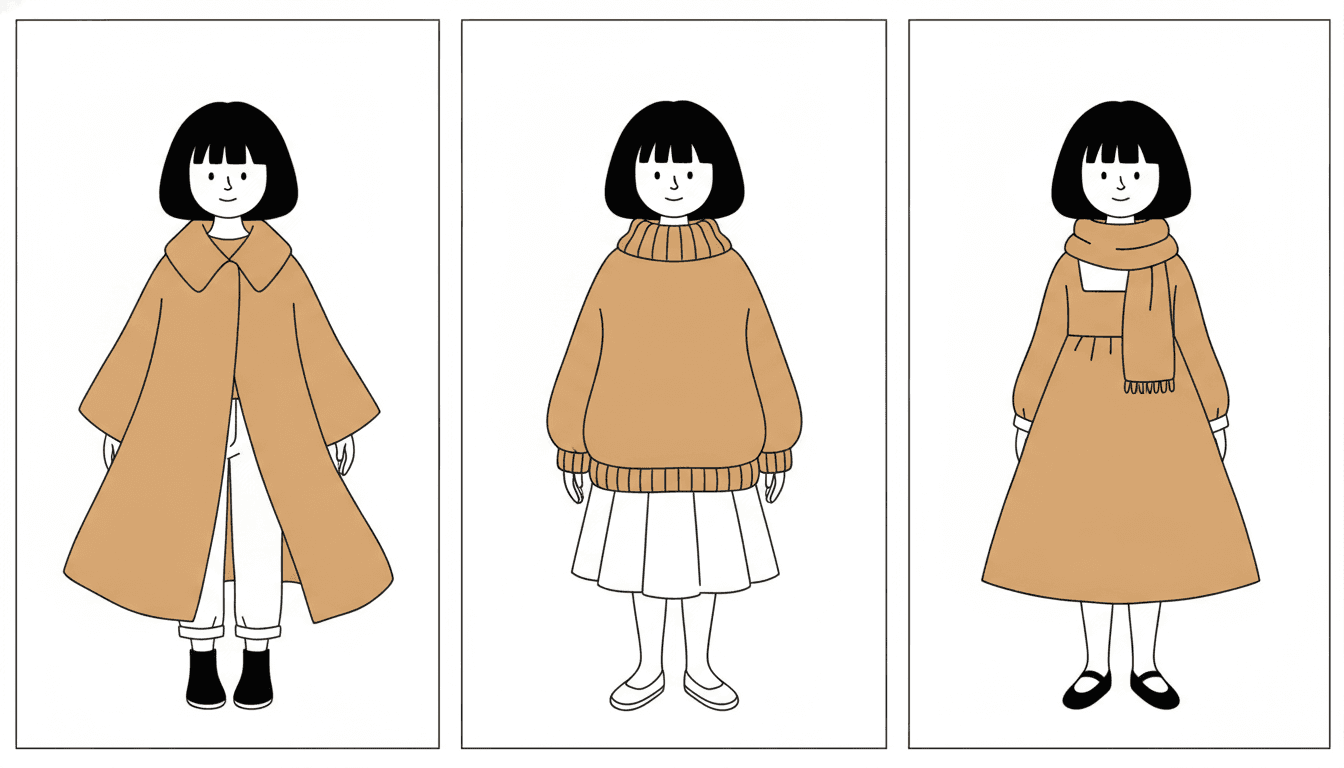
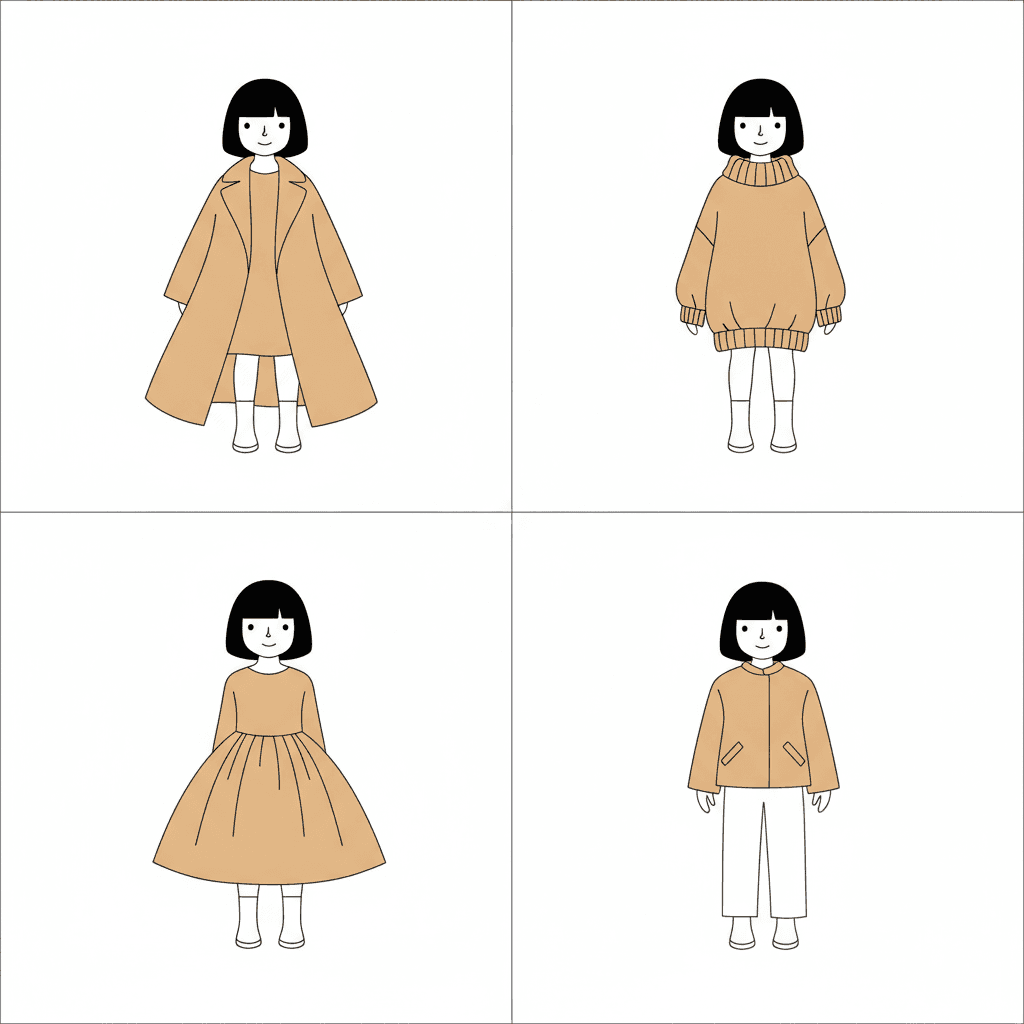
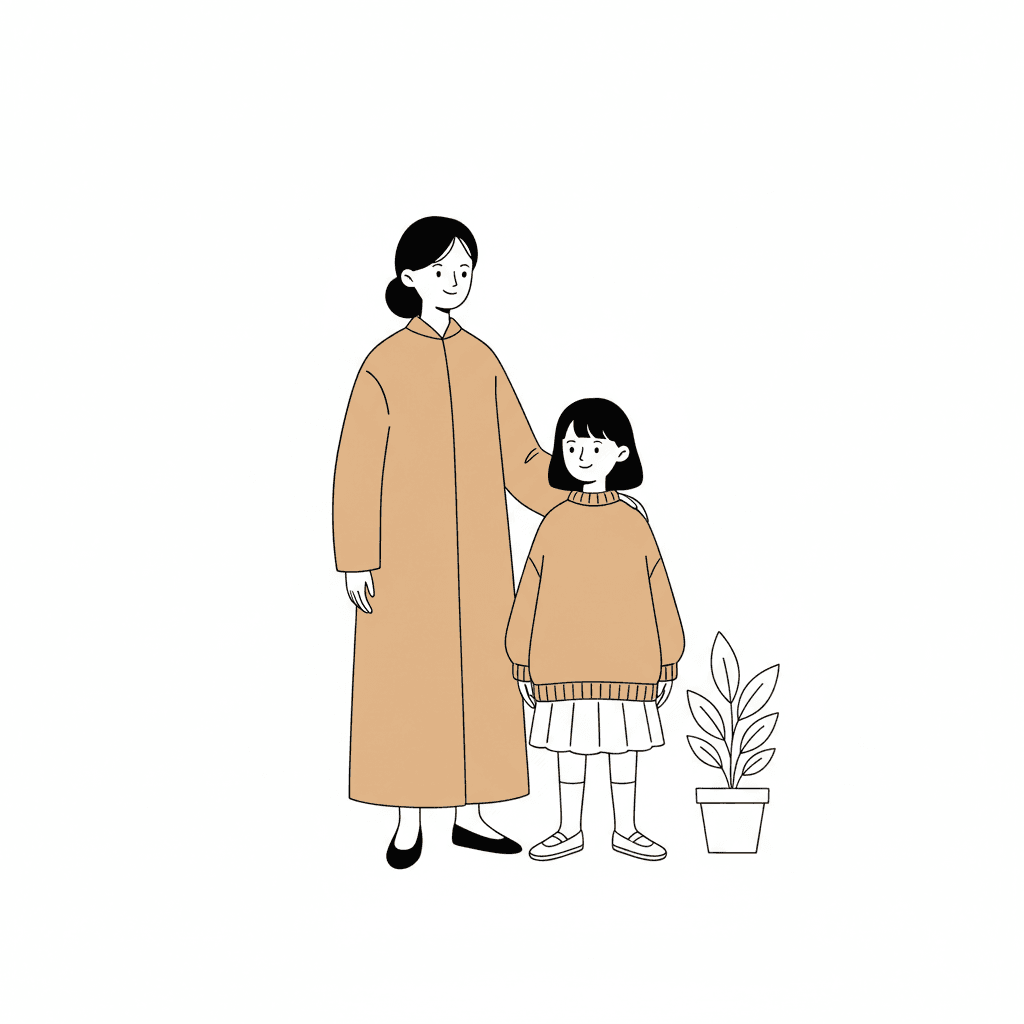
Write what she is wearing and you have handed it everything. Look at the three panels: the same girl three times over, and she is genuinely identical in all three — the same flat black bob with the same straight fringe, the same two dot eyes, the same small smile, the same stance. Nothing in her face is doing any work at all. What changes is a long coat swinging open, then an oversized rollneck jumper swamping her over a pleated skirt, then a dress with a square collar and a scarf down the front. Three completely different pages, and the only thing that moved was the clothes. That is the lever this style gives you, and it is a writing lever rather than an art one: put the coat, the hat, the too-long scarf into the sentence, and the drawing has something to be about.
Give each character a garment, not a mood. The one in the long coat, the one in the enormous jumper, the one who always has the scarf. That is how the reader will tell them apart.
Let the clothes do the emotion. A coat that swamps her says more here than a worried face can, because the outline is the only thing being drawn properly.
Worth seeing side by side before you commit: the ligne claire style, which points the same even line at everything instead, the fine-line ink style, whose white space is distance rather than room for a contour, and the angular line style, whose line is deliberately unsure where this one is decided.
Create a Fashion Illustration Picture Book in 3 Steps
From a one-line idea to a finished book drawn end to end in a single unvarying black stroke, in under two minutes.
Describe the story
A sentence is enough. Say what people are wearing rather than what they are feeling — this style has no shading and almost no face to put a mood in, but it will draw the shape of a coat beautifully.
"A boy in a coat three sizes too big waits for the bus"
Pick Minimal Fashion Line
Choose it for a single-weight black contour, no shading at all and clothes drawn with more care than faces. Choose ligne claire instead if you want that even line pointed at the whole world, fine-line ink if you want the white space to mean distance, or angular line if you want a contour that looks unsure.
Black line, white ground, one warm accent
Generate and export
C2Story writes the story, breaks it into pages and builds every one to the same brief. Read it on screen, share the link, or export the PDF and take that file to whichever printer or print service you already use.
Whole book built, PDF export, instant sharing
Fashion Line Drawing and Its Nearest Neighbours
Four real styles, sorted by the question that actually separates them: what is this line being pointed at?
Minimal Fashion Line
A spare confident black contour on a large clean white ground, with an elegant relaxed figure, no shading anywhere and chic garment shapes placed over rendered detail. Its palette is black and white with a single accent hue and a sparse spot colour, its line weight a clean confident single-weight line, its light flat shadeless light, and its four refusals in order are shading, a busy background, an over-detailed face and sweet templated cuteness. It is one of the styles featured in the picker rather than buried in the long list.
Ligne Claire
The comparison worth making first, because both styles run on an unvarying line and flat unshaded colour, and they point it at opposite things. Clear line uses its uniform stroke to draw everything with equal care — the background, the furniture, the far distance — so nothing on the page can hide, and the result is an inventory of a world. This brief uses the same even stroke to draw almost nothing except the person and what they have on, and leaves the rest of the page white. Take ligne claire if your story needs places. Take this one if your story needs a figure.
Fine-Line Ink
The other style here built on a thin pen and a great deal of empty paper, and the emptiness means something different in each. In the fine-line style the white is distance: figures are tiny, the environment is vast, and the space between things is what you are being shown. Here the white is not distance at all — the figure is large and close, and the emptiness exists so that a single black outline has nothing whatever to compete with. Same bare page, opposite purpose. Fine-line also varies into hairline detail; this line never varies at all.
Angular Line
The sharpest contrast in the library, because the two briefs disagree about what a line should sound like. That one asks for a broken, searching, nervous contour that doubles back and overshoots — a line that is visibly thinking, and the only one here allowed to be unsure of itself. This brief asks for the exact opposite: confident, black, placed once, the same weight from end to end, no second attempt showing. Both draw an elegant relaxed figure with very little in the background. One looks like a drawing being made; this one looks like a drawing that was already decided.
Three more worth knowing. The minimalist style reaches a similarly bare page by subtraction, where this one gets there by spending everything on one contour. The negative space style is the other look built on a bold silhouette, but it wants the gap around the shape to become a second picture. And the deadpan cartoon style also gives you an almost blank face, though it does that to withhold a reaction rather than to move the attention onto the clothes. Browse everything on the illustration styles hub.
Fashion Line Story Ideas to Get You Started
This style is far better at a person than at a place. These six put the story into something somebody is wearing.
The Coat That Was Too Big
A hand-me-down that swamps her for twenty pages and finally fits on the last one. A story whose whole arc is the shape of one garment is the most natural possible fit for a style where the garment outline is the drawing.
Create this storyThe Dressing-Up Box
One child, one afternoon, and a different silhouette on every spread. The face never changes and does not need to — this look tells you who somebody has become purely by what shape they are now.
Create this storyFirst Day
A new uniform worn for the first time, stiff and unfamiliar. The nerves have to live in the posture and in how the clothes hang, because this style will not give you a worried face to fall back on.
Create this storyA Scarf Long Enough for Two
A knitted scarf that gets passed from one character to the next through the book. Give one object the accent colour and it becomes the thread the reader follows from page to page without being told to.
Create this storyWhat to Pack
Deciding what comes and what stays behind. A story made almost entirely of objects with clear outlines — a boot, a hat, a folded jumper — which is exactly what a single-weight line draws best.
Create this storyThe Lost Hat
It blows off in the first scene and travels through the rest of the book without its owner. A garment drawn on its own keeps its shape in this style, so an empty hat is still unmistakably a character.
Create this storyAI-Generated Fashion Illustration Examples
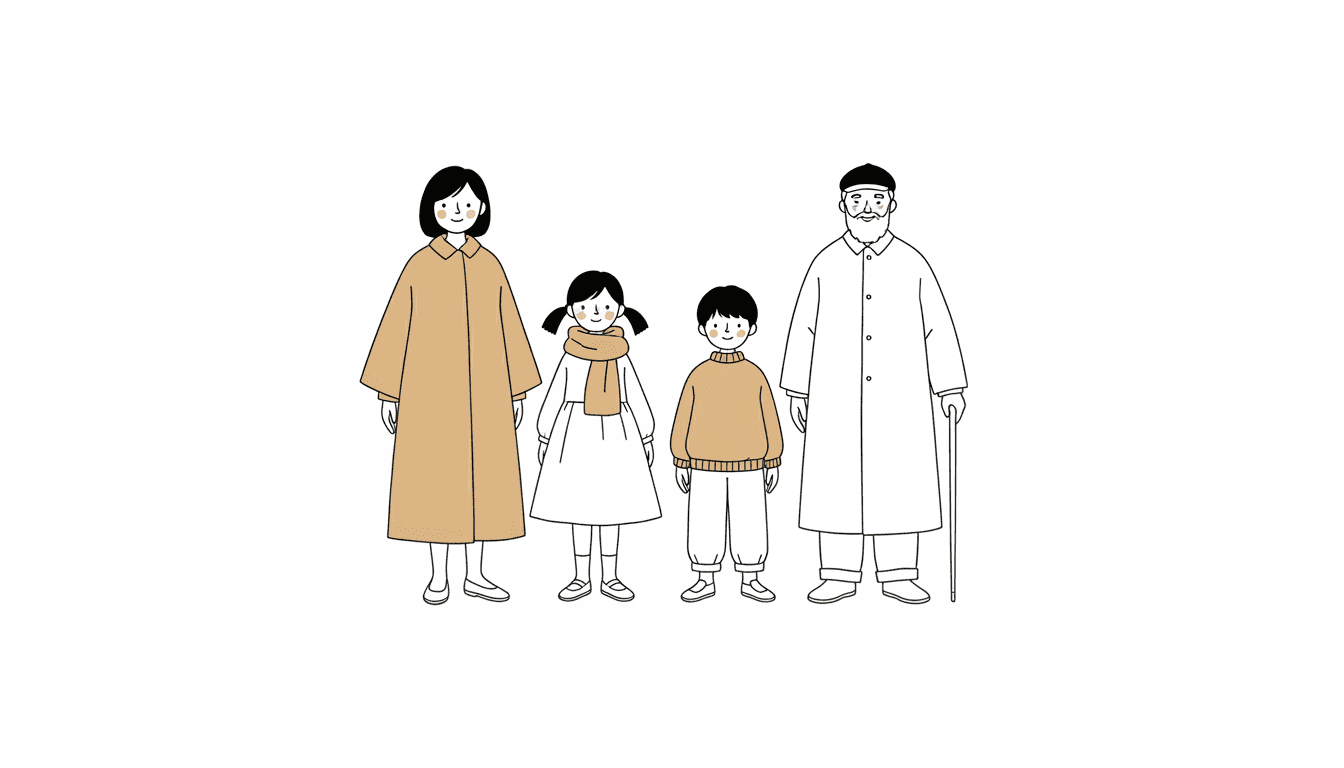
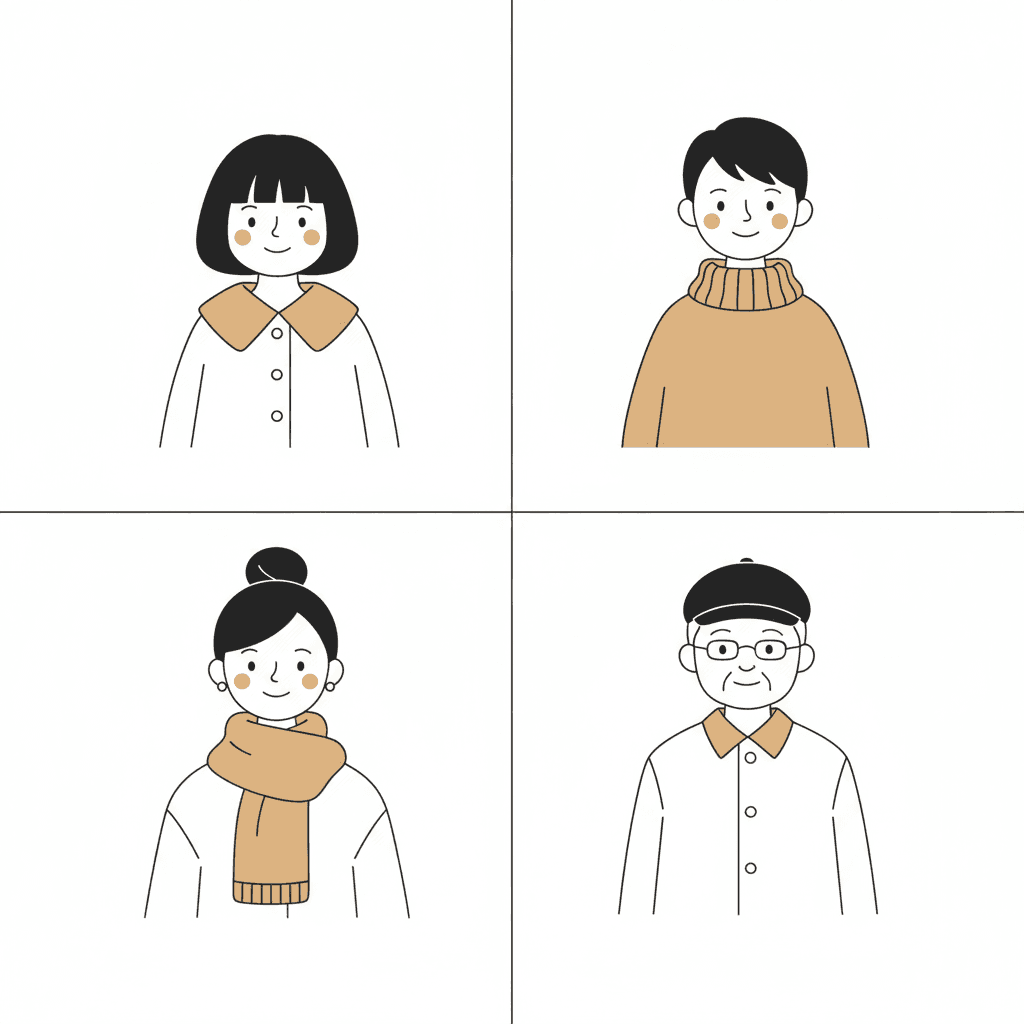
Look at the row of four. There is no outline weight separating anybody, no shadow under anyone and no background at all, and yet nobody merges into their neighbour — because each one has a different garment shape, and a shape is enough. The woman is a long straight coat, the girl is a scarf, the boy is an enormous ribbed jumper, the grandfather is a buttoned coat down to his shins.
Fashion Line Drawing for Every Part of Your Story
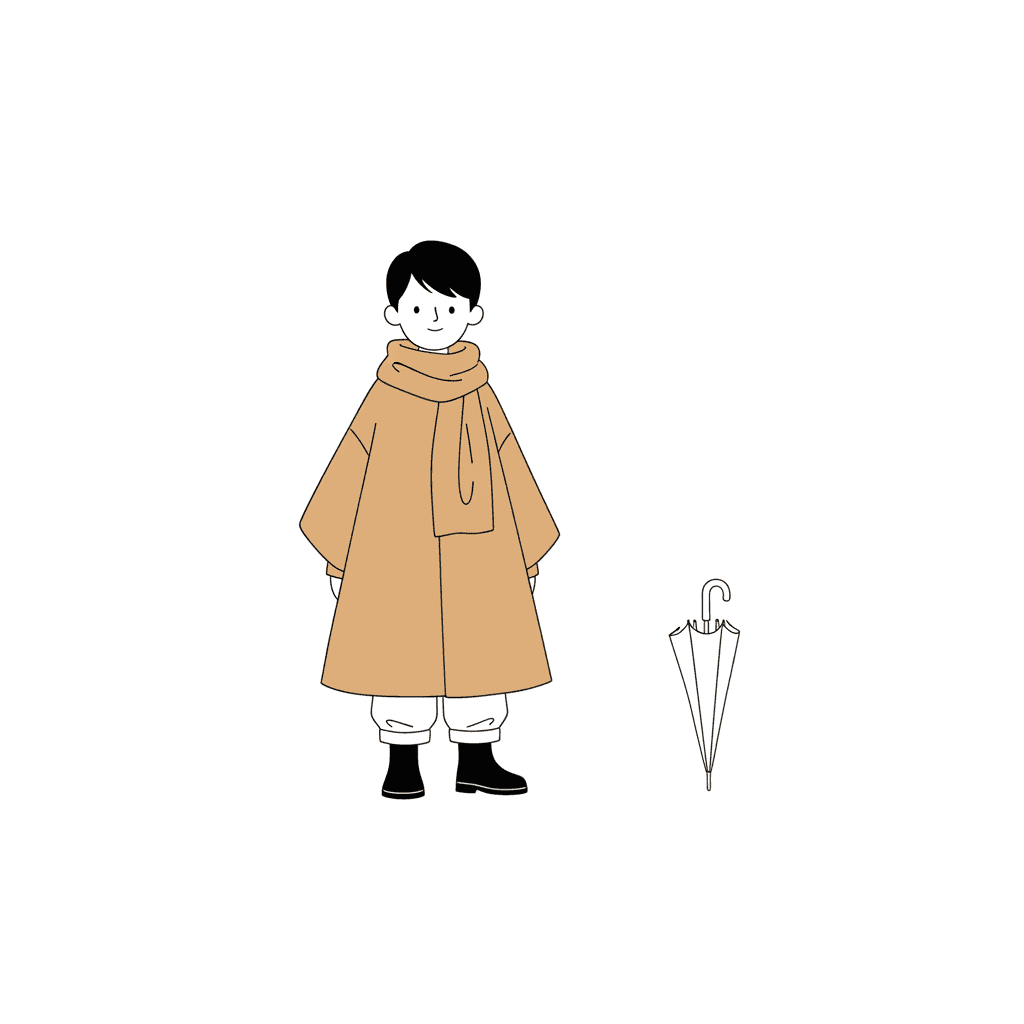
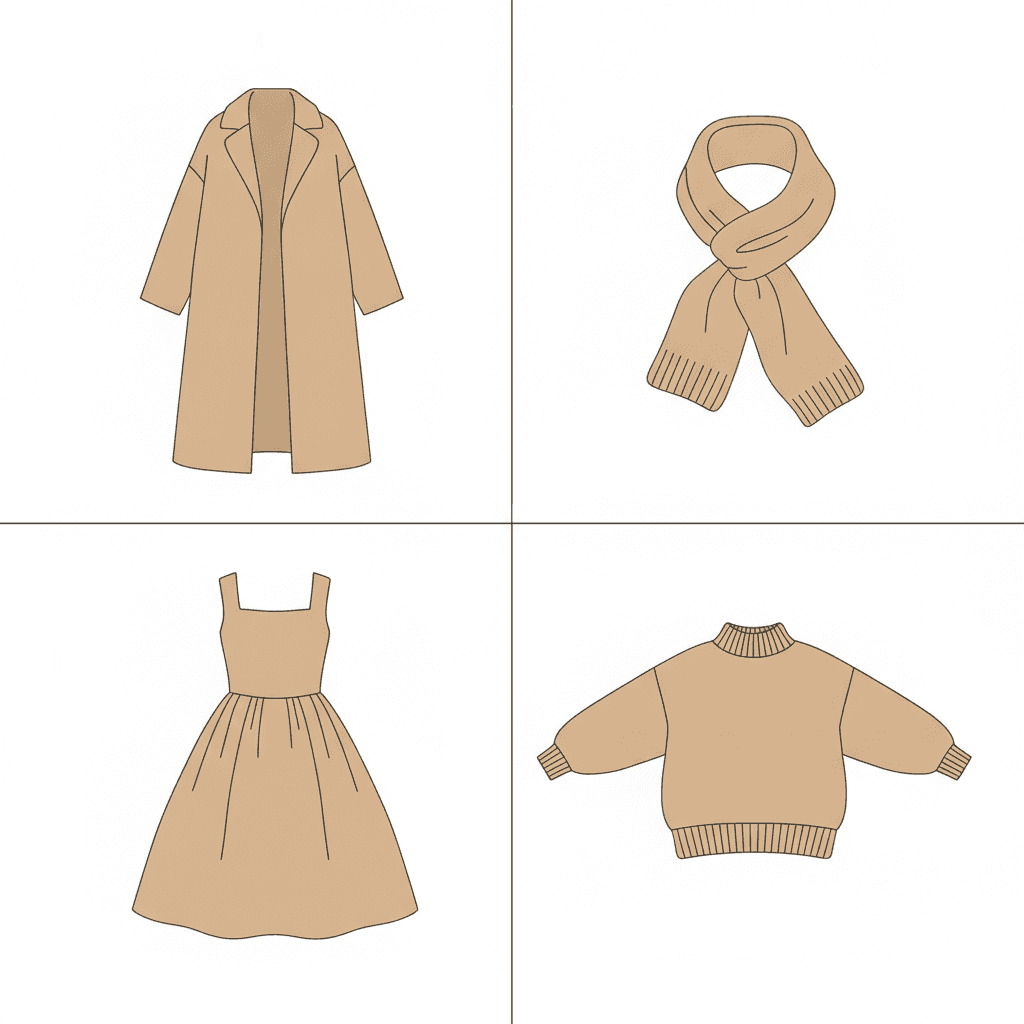
One character under four different garments, a cast told apart by what they wear, a single figure with the page almost empty around him, four garments drawn with nobody inside them, and whole scenes — the same single stroke spent on whatever your story is actually about.
Everything You Need for Fashion Illustration Picture Books
One elegant figure is easy. Twenty-four pages whose line never changes weight, with a cast you recognise by their clothes, is the part that needs building.
One line weight, held for the whole book
This is the thing that breaks first when pages are generated one at a time, and in this style it breaks loudest, because the single weight of the line is the style. If page three is drawn with a hairline, page four with a fat marker and page five with a tapering brush, you no longer have a look — you have three drawings of the same child. One fixed brief is carried into every page instead: spare confident black contour lines, no shading, a large clean white background, chic garment shapes over rendered detail, and the same four refusals of shading, a busy background, an over-detailed face and sweet templated cuteness. Twenty-four pages, one stroke.
A cast you tell apart by what they wear
Worth understanding before you cast your book, because it changes how you write the characters. The brief builds identity from a crisp silhouette, the eyes and mouth and a few key shapes — and with faces cut to two dots and a mouth, the reliable signals left are hair shape, proportion and clothing. In practice that means your characters need wardrobes rather than faces: the one in the long coat, the one in the enormous jumper, the one who always has the scarf. Save each character in the Character Library with up to fourteen reference images and they are reused on every page and into later books. Characters built from an uploaded photo stay private to your account.
Black, white and one accent — and what that costs
The palette is recorded as black and white with a single accent hue and a sparse spot colour, which makes this one of the few styles here that is near-monochrome by design rather than by a toggle. Worth knowing there is no global greyscale switch in C2Story, so if you want a book that is essentially black and white, picking a style that is already built that way is how you get one. Know the trade. There is no second colour to separate two things with, no shading to push anything back, and skin is usually left as unfilled paper — so a page here cannot be carried by colour the way a board book is. What you get instead is a book that looks drawn rather than filled in. If you want a palette that sings, the gouache or pop art styles will serve you better.
Fashion drawing, with its usual defaults turned off
The honest note this style needs, because the tradition it borrows from is an adult one with habits a children's book should not inherit. Fashion figures are conventionally stretched to nine heads tall and drawn very thin; faces are conventionally aloof. Left alone, a brief like this drifts there. Our generation guidance holds the line on purpose: the cast is children and friendly grown-ups in ordinary childlike proportions, every figure whole and well fed rather than gaunt or stretched into a fashion plate, everybody fully and modestly dressed, and no runway, catwalk, camera or shop mannequin anywhere. And although the brief refuses sweet templated cuteness, a blank face is not the same as a cold one — every face is warm and gently happy rather than haughty or sad. We say so in the brief rather than hoping for it.
A whole book, not a single figure on a page
This look lives almost entirely as one-off images — a single elegant figure, a print, a card. You are not prompting for one of those. Describe the story and C2Story writes it, splits it into pages and builds each page to this brief according to what that page actually says, so the line is spent across a narrative with a beginning and an end rather than all at once on one drawing. Worth saying plainly: the fashion reference describes how the drawing is made, not a subject. You are not making a lookbook. You get picture-book pages, with your words set as type rather than drawn into the art.
Readable very young, in whichever language you read aloud in
Easy to doubt, because the reference points are grown-up ones. But a bold clean silhouette on an empty white page is close to ideal for a small child, who reads an overall shape long before they read a face — and there is no clutter, no texture and no busy background anywhere to get in the way. The caveat is subject rather than complexity: a style with almost no colour and almost no setting suits a quiet story about a person far better than a loud one about a place, so this works from roughly three up when the book is about somebody. Write in English, Chinese, Japanese, Spanish, French and more; the look does not change with the language.
Fashion Illustration Picture Books — Questions
What people ask before committing a whole book to one black line and no shading.
Explore More Story Ideas
Discover more styles, tools, and story types

Horse Stories
First pony rides, grooming, horse shows and the stable
Explore
Art Brut Picture Books
Thick wobbly outlines & off-kilter figures
Explore
Picture Book Maker
Create illustrated picture books
Explore
Storybird Alternative
Better AI story creation
ExploreFashion Illustration Picture Books — One Line, No Shading, and the Clothes Drawn First
A fashion illustration picture book is one where every page is a spare black contour drawing on a large clean white ground, with no shading anywhere, and where the clothes are drawn with noticeably more care than the faces. On C2Story this is the Minimal Fashion Line style, and its brief states the ambition plainly: minimal fashion line illustration, spare confident black contour lines, an elegant relaxed figure, no shading, a large clean white background, faces and clothing reduced to essentials, identity built from a crisp silhouette, and chic garment shapes over rendered detail. One brief applied across a whole book, so the twentieth spread is built from the same instruction as the first.
The part worth knowing before you commit a book to it is which of that is genuinely rare, because a thin line and a lot of white paper are not rare here at all. What is rare is the subject. Read all seventy-eight of the hand-drawn style briefs enabled in C2Story and the word garment appears exactly once, in this one. Eight briefs mention clothing at any point, and the way they mention it is the giveaway: two treat it as a colour slot — flat colours keeping silhouettes and clothing in strong graphic contrast — one names it only to refuse it, avoid modern clothing, one uses it as a costume label, characters in adult clothing, and one gives it motion, the flowing drape of clothing. In none of those is a garment a thing you sit down and draw. Three briefs, including this one, carry the same reduction — faces and clothing reduced to essentials — but a reduction only tells you to stop drawing detail; it does not tell you what survives. This is the only brief in the library that adds the ranking clause straight afterwards, and says the clothes are the half worth keeping. Its own refusal list agrees from the other direction, with an over-detailed face sitting third of four.
Follow the rest of the brief and the look stops being a taste and becomes a problem the style is solving. Having made the clothes the subject, it then removes every tool you would normally describe cloth with, and each removal is the only one of its kind in the seventy-eight. The lighting field reads flat shadeless light — the only brief here to use the word shadeless — so nothing is modelled, no fold can be darkened and nothing casts a shadow; shading is also the first of its four refusals. The line weight is a clean confident single-weight line; five other briefs ask for an even or uniform line, but this is the only one that pins it to a single weight, which closes the other obvious route, since a stroke that cannot thicken cannot imply heft either. The palette opens black and white, the only one in the library that does, with a single accent hue and a sparse spot colour, so there is no second colour to separate anything with. And the ground is a large clean white background it explicitly tells you to keep clean, so there is no setting to lean on. No tone, no weight, no colour, no backdrop — which leaves exactly one instrument, the shape of the outline. That is not a shortcut. It is why a fashion drawing can be four strokes and still tell you precisely what somebody has on, and it is also why the style is unforgiving, since there is no shading available to cover a shape that was not properly observed.
Four honest notes before you choose it. First, the writing advice inverts. Most picture-book guidance pushes you to write the feeling, and this brief has almost nowhere to put one: the face is two dots and a mouth, sweet templated cuteness is refused so there is not even a cute default, and a shadeless light gives you no atmosphere. Write the wardrobe instead — a coat three sizes too big, a scarf long enough for two — and the drawing has something to be about. Second, the palette costs you something real: black, white and one accent means a page cannot be carried by colour the way a board book is, and this is also one of the few styles here that is near-monochrome by design rather than by a toggle, which matters because C2Story has no global greyscale switch; if you want a book that sings in colour, the gouache style or the pop art style will serve you better. Third, the tradition this borrows from is an adult one — fashion figures are conventionally stretched to nine heads and drawn very thin, and fashion faces are conventionally aloof — so our generation guidance states the opposite outright: ordinary childlike proportions, every figure whole and well fed, everyone fully and modestly dressed, no runway or camera or shop mannequin anywhere, and every face warm rather than haughty. Fourth, with no shading at all this style cannot give you a night scene, a dark room or weather; for those take the grainy cinematic style or the crosshatch style. Among its nearest neighbours, the ligne claire style runs the same unvarying line but points it at the entire world rather than at a person, and the fine-line ink style shares the bare page while using its emptiness as distance instead. In exchange you get a book that is unusually elegant and unusually easy to keep consistent — characters are carried by silhouette and clothing rather than by fine facial detail, so save each one in the Character Library with up to fourteen reference images and they are reused across every page and into later books, and characters built from an uploaded photo stay private to your account. Write in any language you read aloud in, then export the finished book as a PDF, which is the handoff to whichever printer you already use, and the images you generate are licensed for commercial use. Start free: see our pricing plans, browse every option on the illustration styles hub, or go straight to the AI Story Generator.