
Folk Decorative Picture BooksBuilt for a Whole Village
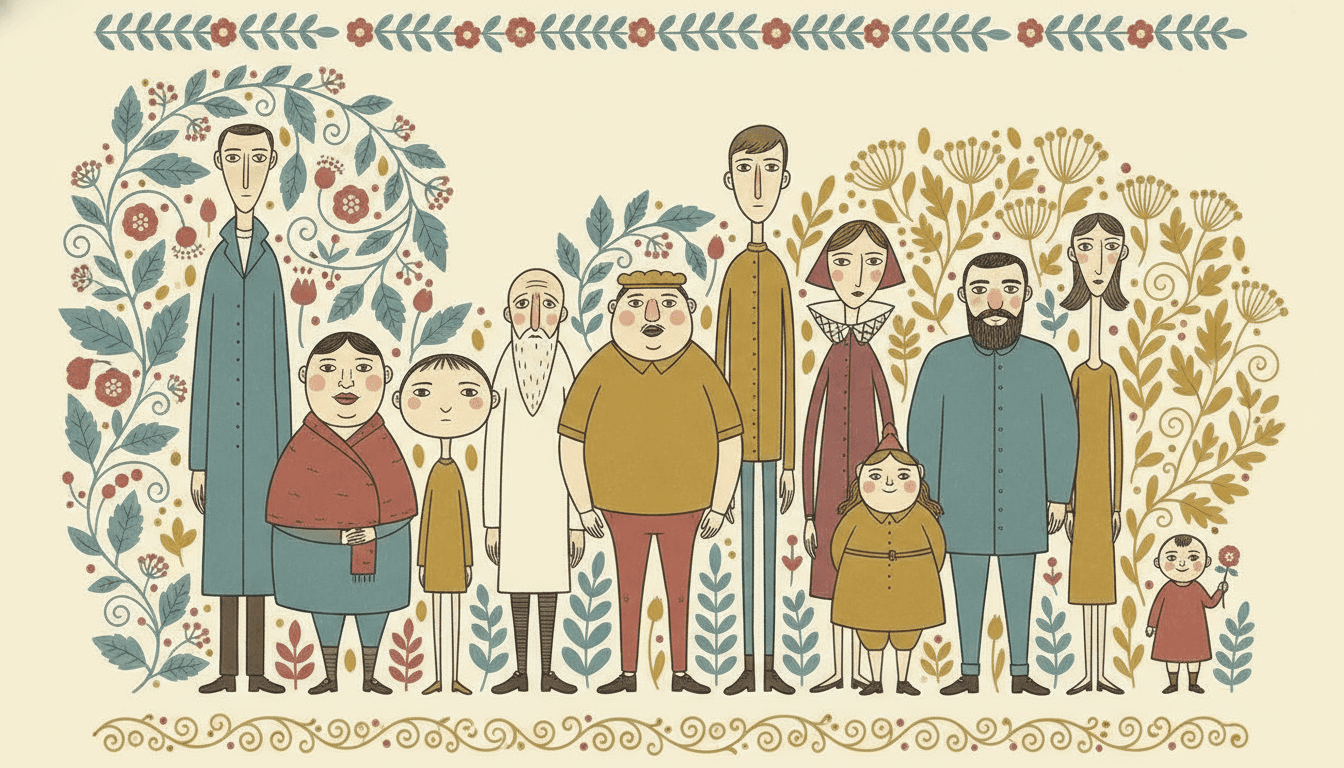
Every other style here hands you a hero. A folk decorative picture book hands you a crowd — pattern-filled, vintage-muted, and written to keep eleven people telling apart on every page of your story.
- A cast built from distinct silhouettes, not from accessories
- Ornamental botanical pattern filling the page, not just the border
- A muted vintage palette so the density stays readable
- Free credits by request — no card
50,000+
Stories Created
10,000+
Active Creators
50+
Art Styles
4.9/5
User Rating
What Makes a Folk Decorative Picture Book More Than Pattern
The ornament is the first thing you notice and the second most important thing about this style. What it is actually built to solve is a harder problem: how to put eleven people on a page and keep them all separate.
Every other brief here hands you a protagonist. This one hands you a village
Of the seventy-nine hand-drawn styles enabled in C2Story, exactly one asks for a quirky ensemble, and this is it. Its brief calls for a quirky crowd of figures and its own preview subject is a small crowd of villagers gathered among ornamental vines. Four styles in the whole library even mention a crowd, and two of those mention it as something to avoid — crowded framing and crowded composition sit in their lists of refusals. This style asks for the thing the others are specified against.
Five styles cast by silhouette. This is the only one casting a crowd
There is a clause that appears in five of the seventy-nine enabled styles: each character built from a clear distinct silhouette with its own face shape, head-to-body ratio and hand-and-foot forms, rather than piled-on detail. The other four aim it at a single figure — one silhouette, one guardian, one dark-clad figure, one big-headed character. This is the only one that aims it at a group, and the only picture book style among the five. That is the whole idea: a rule for making people different from each other, applied to a page with eleven of them on it.
Its first refusal is a face, not a technique
Every style here ends with four refusals. Across the eleven picture book styles enabled in C2Story, forty-four refusals are listed and almost all of them police the medium: vector lines, digital smoothness, glossy CGI, soft gradients, thick outlines, neon colour, photorealism. This brief refuses uniform chibi faces first and a generic cute default last. It is the only picture book style here that spends any of its four refusals on the cast looking interchangeable, and it spends two of them. The thing it is most afraid of is not a rendering style. It is a row of identical people.
No light source, so the pattern does the organising
The lighting is specified as flat decorative even light: no sun, no lamp, no modelling, no cast shadow. That removes the usual way a crowded page is organised, because nothing can be lit as the lead. What takes over is ornament — stylised botanical motifs and decorative pattern filling the ground between the figures, running in bands and borders. Pattern is not decoration added at the end here. It is the structure holding a full page of people in order, which is why the brief names it before it names the crowd.
Why This Style Refuses a Row of Identical Faces
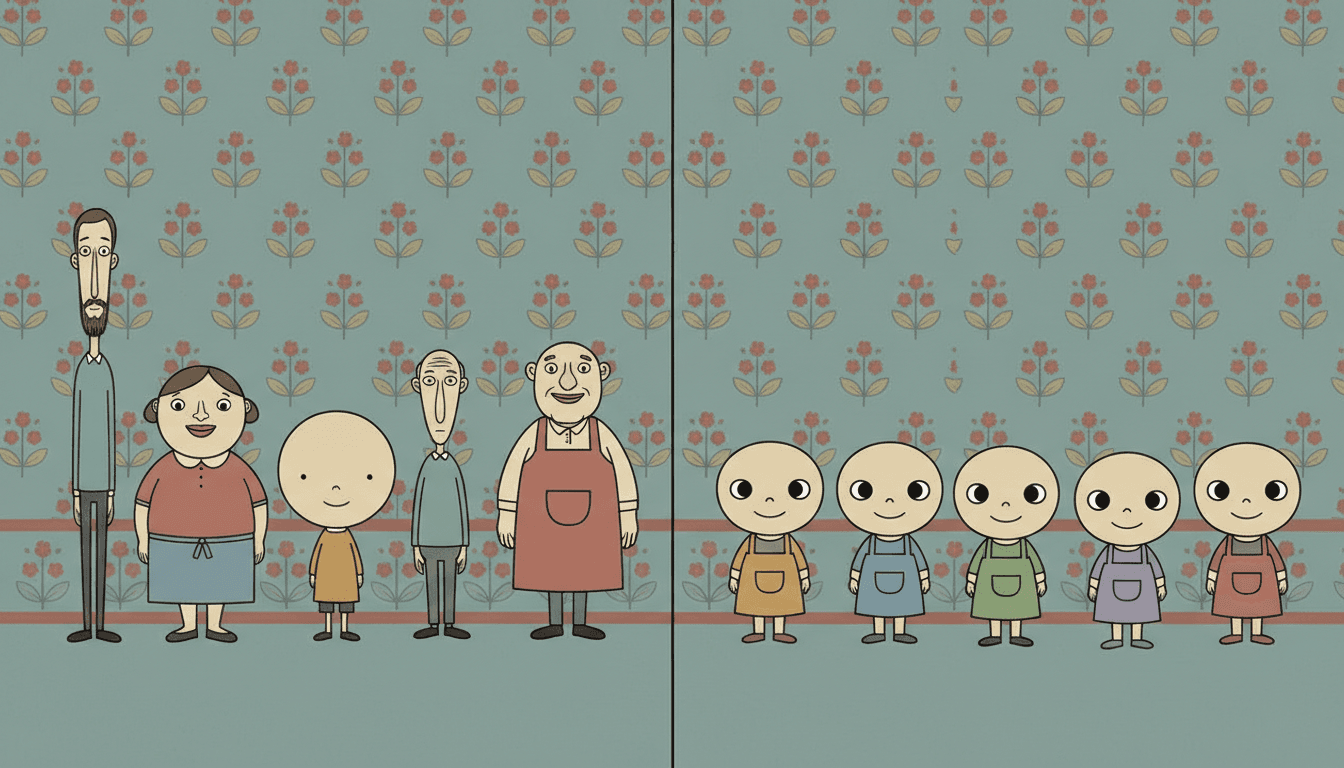
The same wall, the same patterned border, the same number of villagers, twice. On the left each one is built to its own measurements — a tall narrow man, a short round woman, a small child, a stooped elder, a broad baker — and you could cover the colours entirely and still name every one of them from the outline.
On the right they are drawn to the cheerful default that image models fall back on: one round head, one head-to-body ratio, one pair of big eyes, one smile, repeated. Nothing is wrong with any single figure. The problem only appears when there are five of them, which is precisely when this style is meant to be used — and it is why uniform chibi faces is the first of its four refusals and generic cute default is the last.
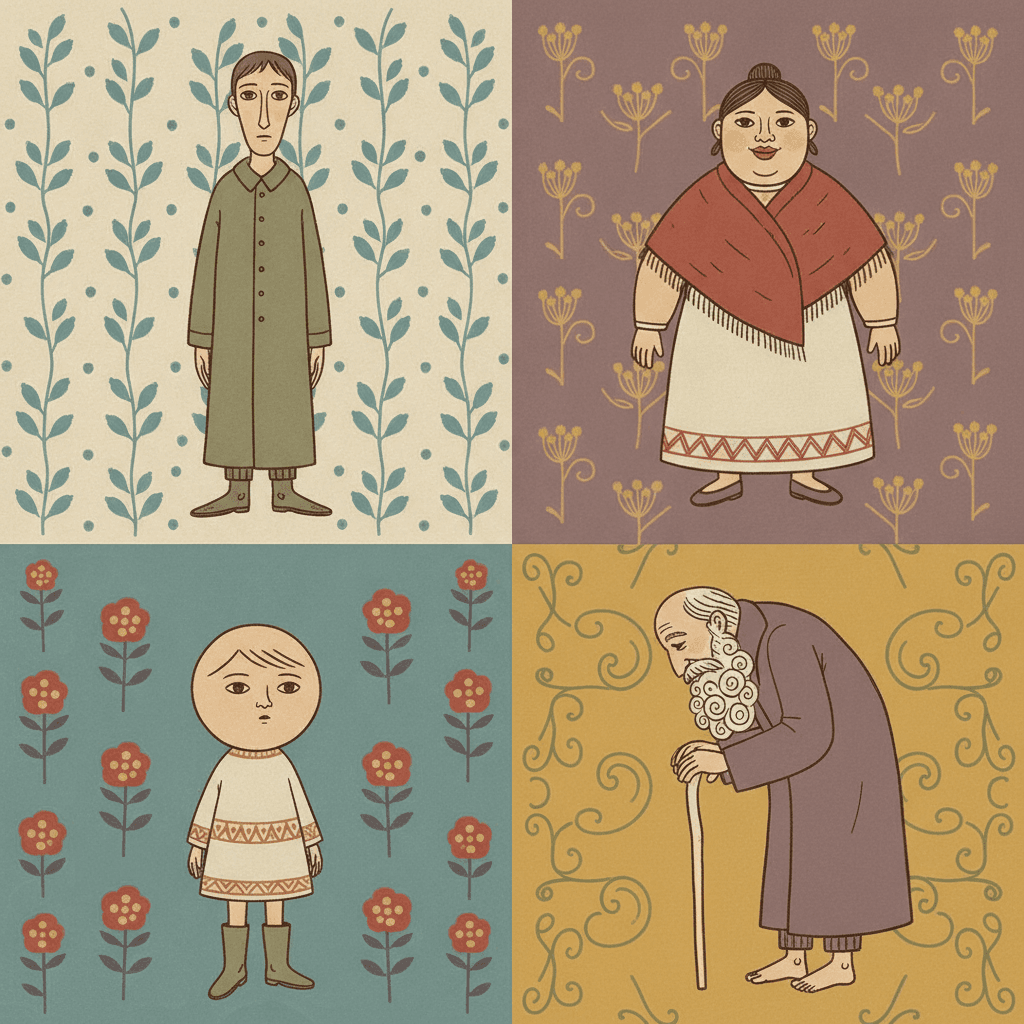
So write bodies. Give each character a height, a width and a head-to-body ratio before you give them a personality. In this style those are the things that survive twenty pages.
And let the cast be large. Most picture book advice says keep it small because most styles cannot hold a crowd apart. This brief is written for exactly that job, so a small cast wastes it.
Its four refusals, in the order the brief states them:
Give Each Character a Body, Not a Hat
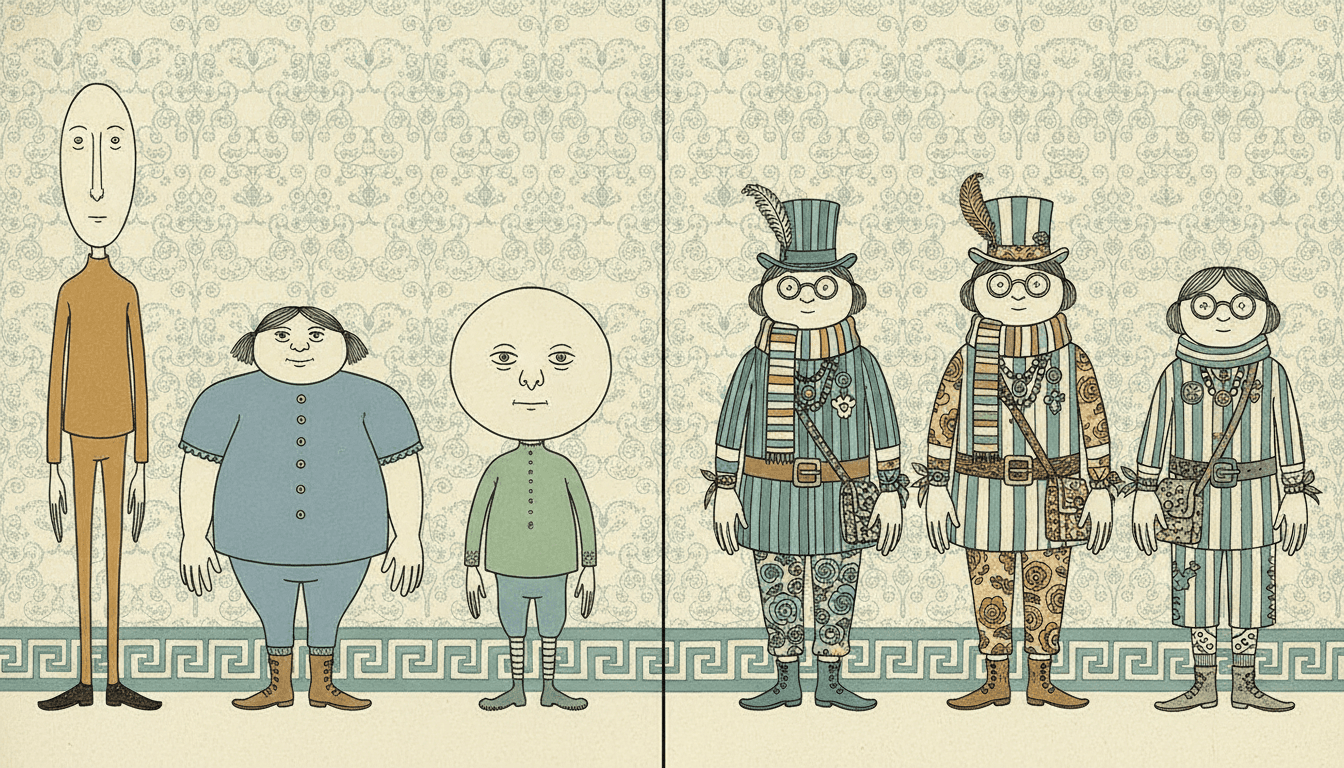
Here is the same problem solved twice. On the left, three figures in plain undecorated clothes who differ only in shape — one very tall and thin with a long oval face, one short and nearly as wide as she is tall, one whose enormous round head sits on a small body. No accessories at all, and they are instantly three people.
On the right, three figures built to the identical body and the same round face, then loaded with everything detail can offer: striped and floral layered clothing, feathered top hats, spectacles, beads, belts and satchels. They still read as the same person three times over, and the busy clothing now competes with the pattern on the wall behind them. That is what the brief means by rather than piled-on detail — and it is a sentence about your writing, not just about the rendering.
The squint test. Imagine your cast as black shapes with the detail removed. If two of them are the same shape, they are the same character, however differently you have dressed them.
Spend the detail on the world. In this style the ornament is already carrying the surface interest. Your characters do not need to compete with it, and they lose when they try.
Worth seeing side by side before you commit: the Scandinavian folk style, which is folk with the page left empty, the anthropomorphic animal style, the only other picture book here built for a crowd, and the bold flat style, which also organises its characters by silhouette but for satire rather than for a village.
Create a Folk Decorative Picture Book in 3 Steps
From a one-line idea to a finished book where every page carries the same ornament and the same cast, in under two minutes.
Describe the story
A sentence is enough. This is the one style here where a large cast is an asset rather than a risk, so name the people — how many, how tall, how wide. It will build from a word about size more reliably than from a word about costume.
"The whole village argues about where to sit"
Pick Folk Decorative Storybook
Choose it for ornament, a muted vintage palette and a page that can hold a crowd. Choose Scandinavian Folk Naive instead for folk with empty space and one small hero, Busy Anthropomorphic Town for a crowd of animals with jobs, or Guochao Decorative for the same ornament at full saturation.
Dusty teal, brick red, ochre, faded cream
Generate and export
C2Story writes the story, breaks it into pages and builds every one to the same brief. Read it on screen, share the link, or export the PDF and take that file to whichever printer or print service you already use.
Whole book built, PDF export, instant sharing
The Folk Art Illustration Style and Its Nearest Neighbours
Four real styles for a decorated story, sorted by the two questions that actually separate them: how many people are on the page, and does the ornament fill it or leave it empty?
Folk Decorative Storybook
Folk line-drawing decorative storybook illustration: a vintage muted palette, ornamental botanical motifs, and a quirky crowd of figures in which each character is built from a clear distinct silhouette with its own face shape, head-to-body ratio and hand-and-foot forms rather than piled-on detail, with expressions and poses driven by real personality. Its palette is muted vintage tones, dusty teal, warm brick red, ochre and faded cream; its light is flat and decorative; its line is a clean confident ink outline. One of eleven picture book styles enabled here.
Scandinavian Folk Naive
Minimalist Scandinavian folk-art storybook illustration: humble naive childlike shapes, a soft matte earth-tone palette, relaxed textured brushwork and restrained empty space. Both are folk and both are picture books, and they disagree about almost everything after that. That one is drawn with soft irregular hand-drawn edges and keeps the page empty; this one is drawn with clean confident ink outlines and fills it. Its preview subject is one round-cheeked child beside a cottage. This one is eleven villagers. If your story has a single small hero and a lot of quiet, that one is the better fit.
Busy Anthropomorphic Town
Warm anthropomorphic-animal picturebook illustration: a busy little society of animals in occupational roles, rounded friendly contours and rich everyday detail, with empty backgrounds refused outright. The closest thing here to a rival, because it is the only other picture book style built for a full page of characters. The difference is what fills the page and who the cast is. That one is animals given jobs, and its density comes from the business of a town. This one is people, and its density comes from botanical pattern.
Guochao Decorative Character
Decorative guochao illustration combining a stylized character with ornate architecture and traditional decorative patterns, in a richly saturated palette with dense ornamental motifs and a flat graphic finish. It carries the identical silhouette-first casting clause and the same flat decorative lighting, so it is the nearest relative in method. Two things separate them: it points that casting rule at one proud figure rather than a crowd, and its palette is saturated where this one is deliberately muted and vintage.
Two more relatives are worth knowing about. Ornate Dark Fantasy carries the same silhouette-first casting clause and the same love of intricate ornament, but spends them on a shadowed, jewel-toned mood rather than on a village. And the mid-century modern style also works in a restricted vintage palette with flat decorative colour, but it is after a decade rather than a craft tradition. Browse everything on the illustration styles hub.
Traditional Folk Story Art Ideas to Get You Started
This look is better at communities, gatherings, counting and inherited things than at solitude, weather or a single dramatic moment. These six lean into that.
The Longest Table
The whole village sits down to one meal and nobody will agree who sits where. A story whose entire cast is on screen at once is exactly what this brief was written for, and a table is the simplest way to get everyone into one frame.
Create this storyTwelve Doors
One house, one neighbour, one page each, and on the last spread all twelve doors open at once. Pattern gives every house a different front without changing the palette, which is the thing this style does more easily than any other here.
Create this storyGrandmother’s Pattern
A border of leaves and berries is copied down four generations, and each one gets it slightly wrong. A story where the ornament itself is the plot suits a style that treats botanical motifs as structure rather than as trim.
Create this storyWho Is Missing?
Every page is the same crowd with one person gone, and the reader has to work out who. A hunting game only works if the cast is genuinely distinguishable by outline, which is the one thing this brief guarantees in writing.
Create this storyMarket Day
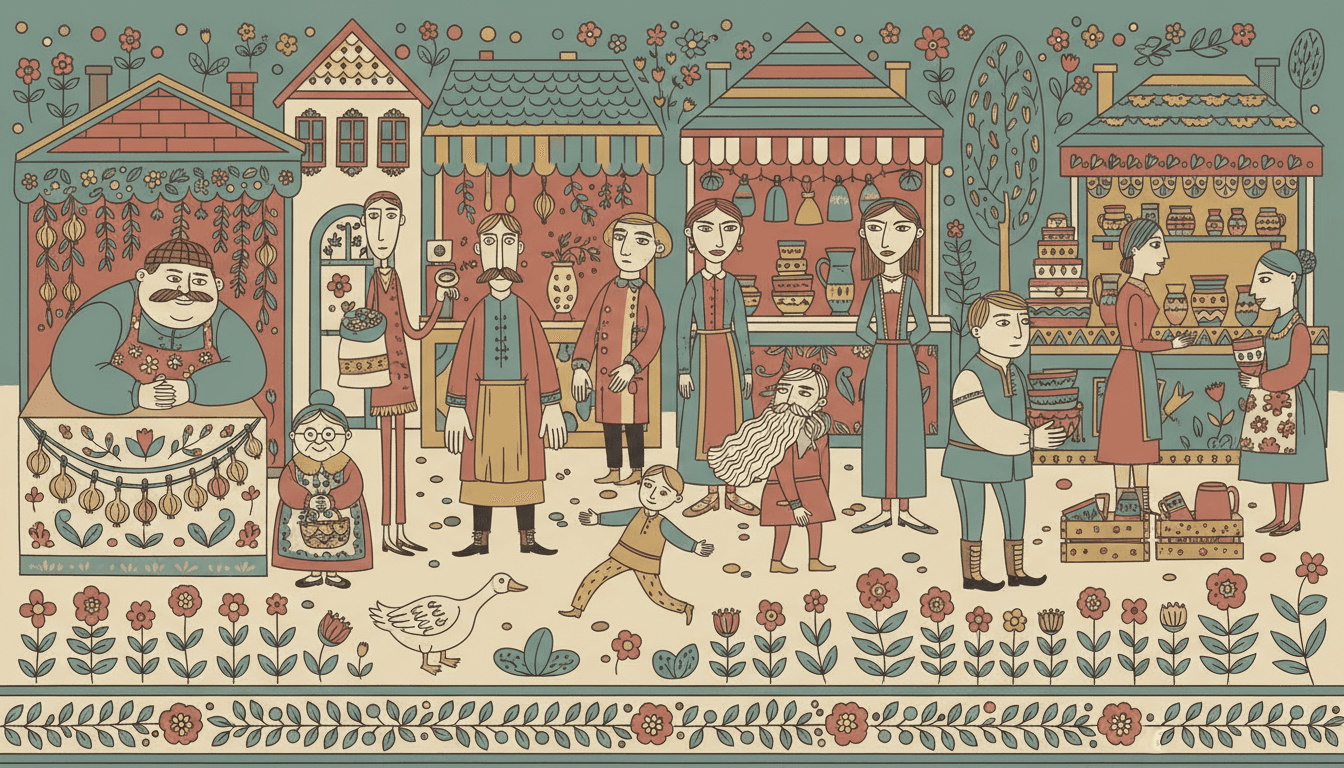
Everything is swapped for something else until a goose ends up owning a house. Stalls, awnings, crates and pottery are all surfaces this look wants to decorate, so a market gives it the most to do per page.
Create this storyThe Festival Nobody Planned
A village argues its way into a party. Scenes built from many people reacting differently to one event are the natural home of a brief that asks for expressions driven by real personality rather than a shared default.
Create this storyAI-Generated Folk Decorative Picture Book Illustrations
Try this on the market below: pick any one villager, then find them again. There are twelve people in that frame and not one of them is built to another one’s measurements.
Decorative Folk Pattern for Every Part of Your Story
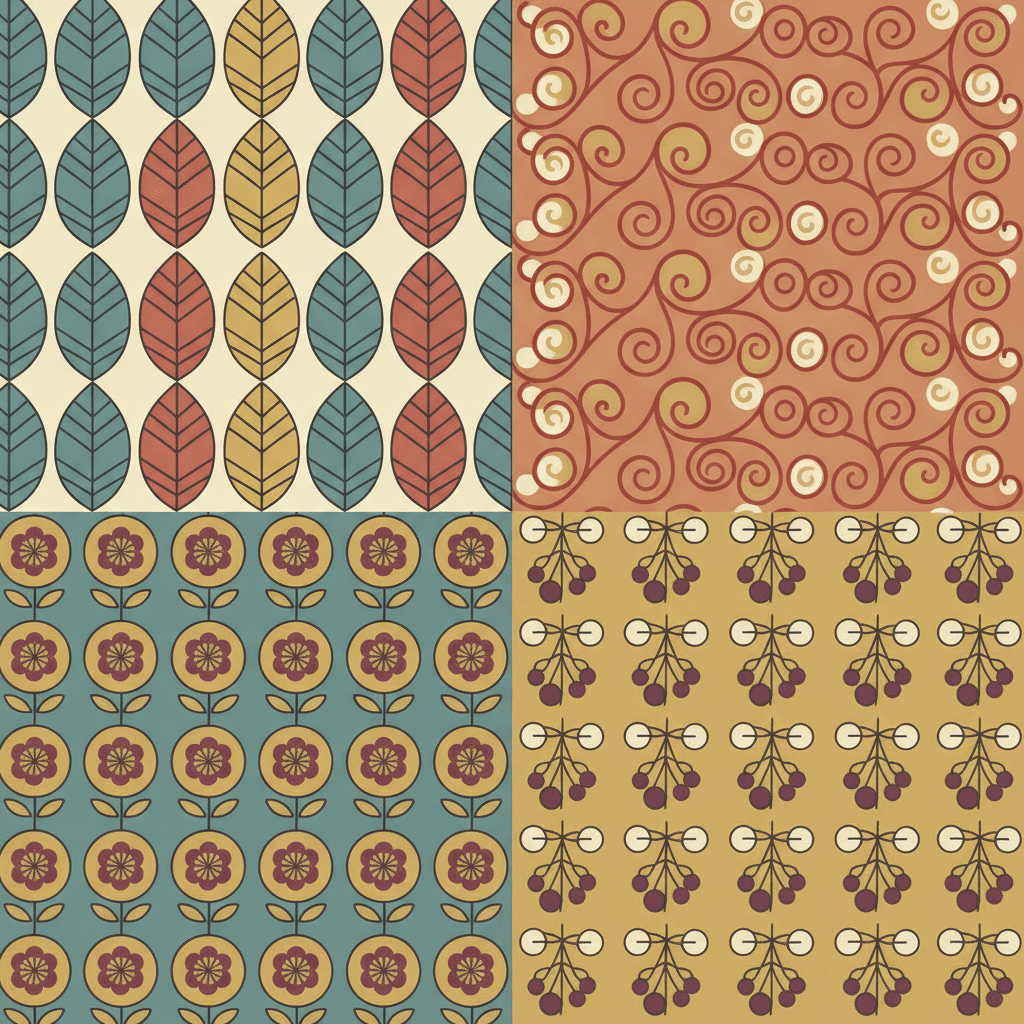
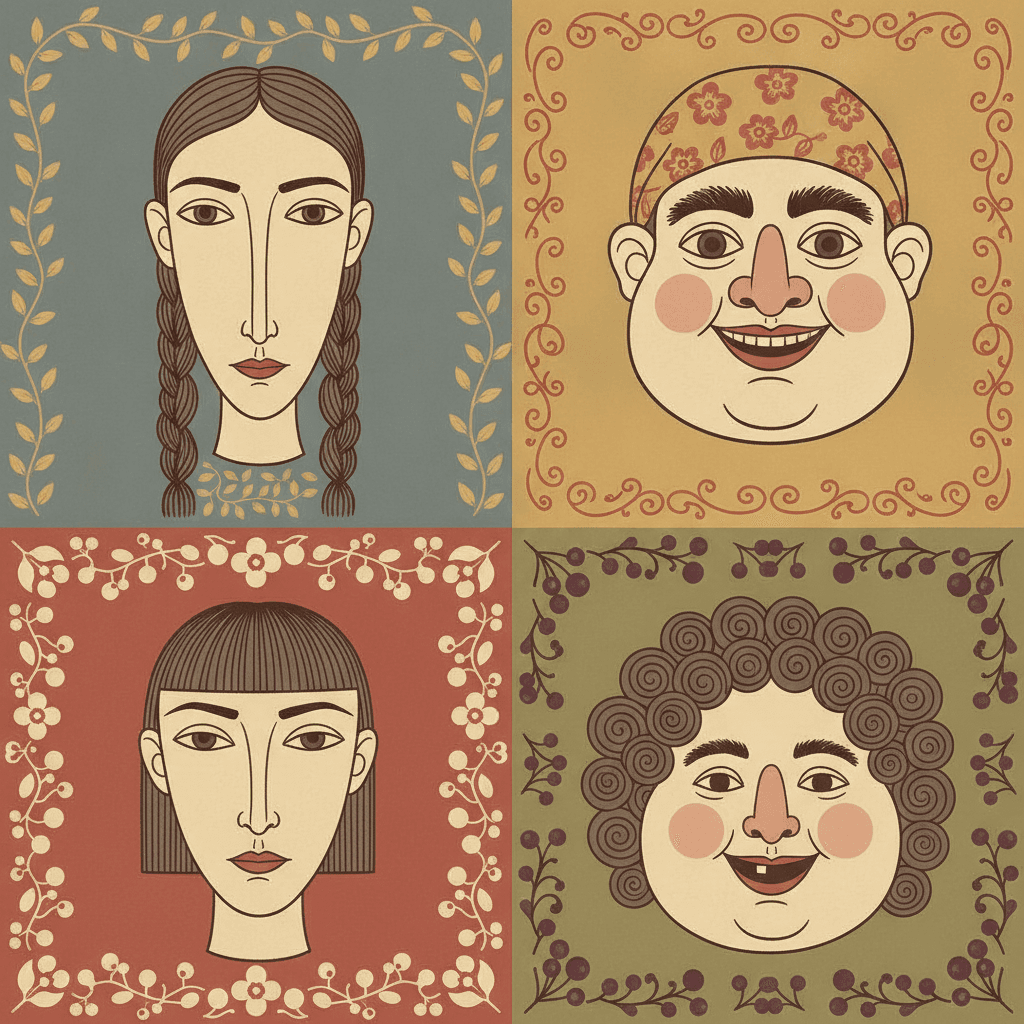
One character held on model, a cast built to four different sets of measurements, the pattern vocabulary itself, four faces that share no shape, and whole places — the same ink line and the same muted palette, spent on whatever your story is actually about.
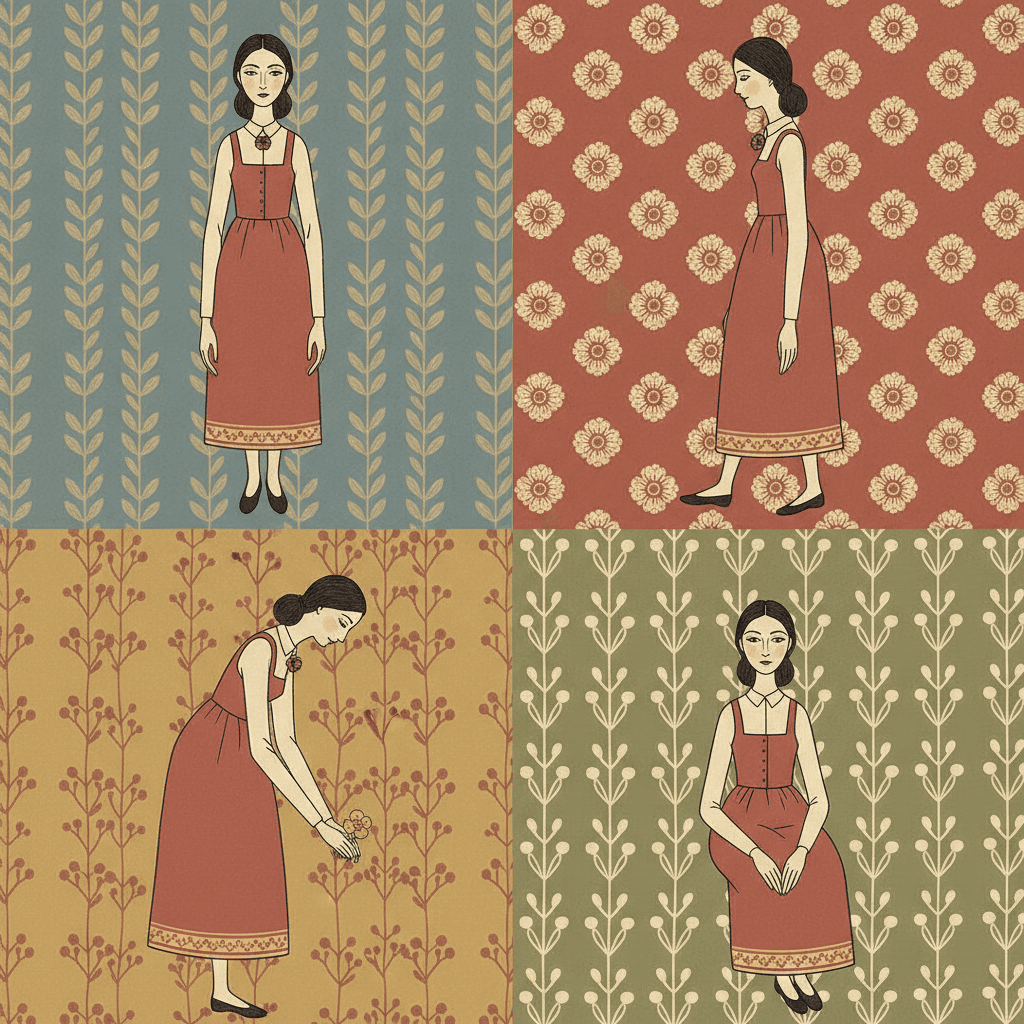
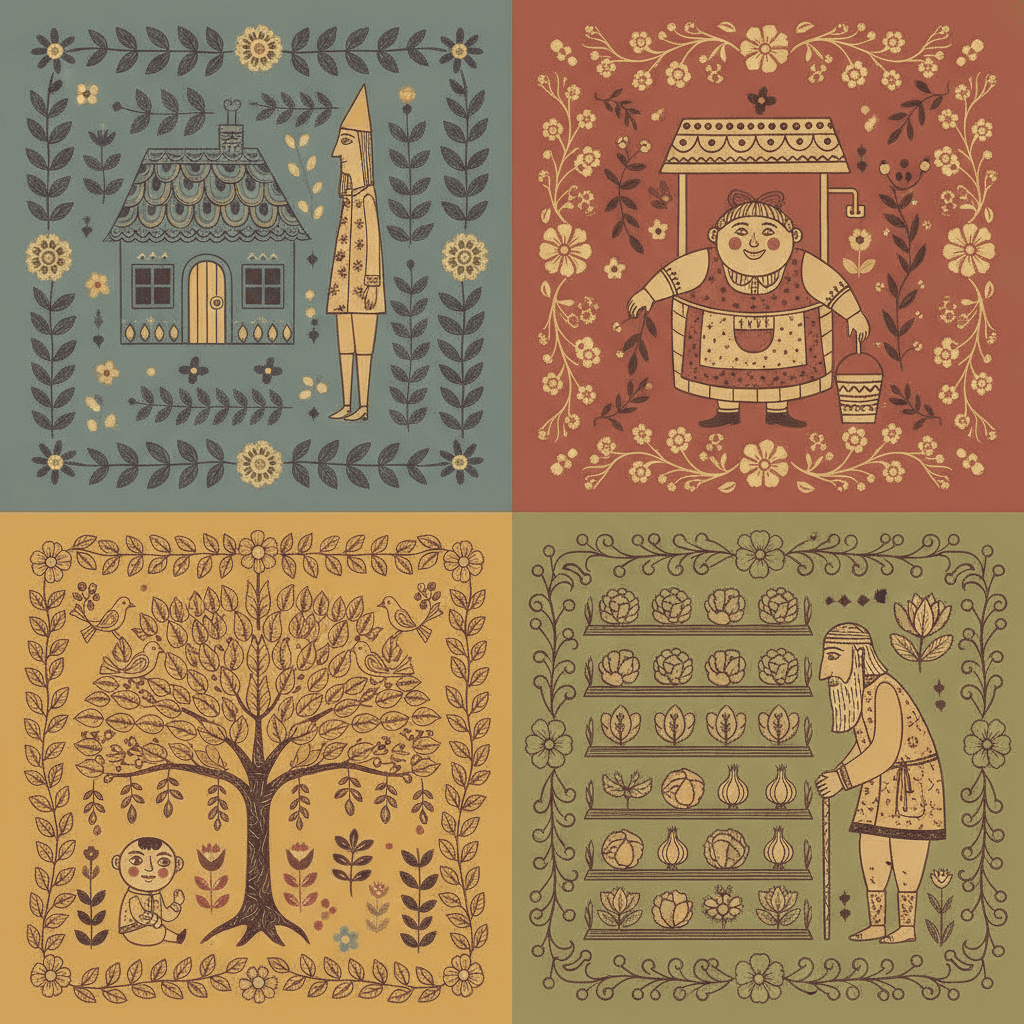
Everything You Need for Folk Decorative Picture Books
One beautiful ornamented image is easy. Twenty-four of them, with the same twelve villagers recognisable in all of them, is the part that needs building.
The same twelve people on page twenty
A large cast is where image models drift fastest, because every extra character is another chance for two of them to converge on the same face. One fixed brief is carried into every page instead — distinct silhouettes, vintage muted palette, botanical motifs, no uniform chibi faces — so the crowd on your last spread is built by the same rule as the crowd on your first.
A cast saved as bodies, not faces
Save each character once in the Character Library, with up to fourteen reference images each, and they carry into every page and into later books. This style rewards the effort more than most, because what makes a character stick here is a measurement — this head-to-body ratio, this face shape, these hands — rather than a likeness. Characters built from an uploaded photo stay private to your account.
A palette that stays quiet so the pattern can be loud
Muted vintage tones, dusty teal, warm brick red, ochre and faded cream. The restraint is doing a job: a page this densely patterned would be unreadable in saturated colour, so the palette gives way and lets the ornament carry the detail. It arrives with the style, and it will not brighten for you — which is the trade that makes the density work.
Ornament on every page, not just the borders
Stylised leaves, curling vines, round flowers, berries and seed heads are named in the brief itself, so they turn up in the ground between figures, along the eaves of houses, on pottery, on clothing and in bands across the top and bottom of a page. You do not have to ask for a border. You get a decorated world, and every surface in your story is treated as somewhere a pattern could go.
Whole books, not single illustrations
You are not prompting for one handsome folk image. Describe the story and C2Story writes it, breaks it into pages, and builds every page in this style to match what that page actually says — so one village, one market and one family stay recognisably the same people across a whole narrative.
Any language you read aloud in
The look carries no language of its own. Write in English, Chinese, Japanese, Spanish, French and more — the ink outlines, the muted palette and the botanical pattern do not change with the text. Folk ornament reads the same in every alphabet.
Folk Decorative Picture Books — Questions
What people ask before committing a whole book to ornament, a muted palette and a cast of eleven.
Explore More Story Ideas
Discover more styles, tools, and story types
Animal Stories
Charming tales with cute creatures
Explore
Deadpan Cartoon Picture Books
Blank faces, dry humour & muted colour
Explore
Children's Book Creator
Design beautiful kids books
Explore
Storybird Alternative
Better AI story creation
ExploreFolk Decorative Picture Books — Ornament, a Muted Palette and a Story With a Whole Village In It
A folk decorative picture book borrows its visual language from craft rather than from painting. The ornament that turns up on a painted chest, an embroidered hem or a glazed bowl — stylised leaves, curling vines, round flowers, berries and seed heads, laid out in orderly repeats and bands — becomes the way the page itself is organised. On C2Story this is the Folk Decorative Storybook style, and its brief states it plainly: folk line-drawing decorative storybook illustration, vintage muted palette, ornamental botanical motifs, a quirky crowd of figures, each character built from a clear distinct silhouette with its own face shape, head-to-body ratio and hand-and-foot forms rather than piled-on detail, with expressions and poses driven by real personality. One brief applied across a whole book, so the twentieth spread is built the way the first one was.
The thing worth knowing before you commit a book to it is hiding in the middle of that sentence. Of the seventy-nine hand-drawn styles enabled here, exactly one asks for a quirky ensemble, and its own preview subject is a small crowd of villagers gathered among ornamental vines. Four styles in the entire library so much as mention a crowd, and two of those mention it in their refusals — crowded framing and crowded composition are things they are specified against. There is a casting clause that appears in five styles here, the one about distinct silhouettes and head-to-body ratios, and the other four aim it at a single figure: one silhouette, one guardian, one dark-clad figure, one big-headed character. This is the only style in the library that takes a rule for making people different from one another and applies it to a page with eleven of them on it. That is not a detail of the brief. It is what the brief is for.
Follow that to its conclusion and you arrive at the practical advice for this look, which runs against most picture book advice you will have read. Keep the cast small is the standard counsel, and it is good counsel, because most styles cannot hold a crowd apart — put six characters on a page and two of them quietly become the same person. This brief is written for precisely that failure. It is the only one of the eleven picture book styles enabled here that spends any of its four refusals on the cast rather than on the medium, and it spends two: uniform chibi faces comes first and generic cute default comes last, with glossy rendering and photorealism in between. So give each character a body before you give them a costume — a height, a width, a head-to-body ratio, a face shape, a pair of hands. Two villagers who differ by a hat will drift together over twenty pages. A villager who is eight heads tall and a villager who is four will not. And notice what the ornament is doing while this happens: the lighting is specified as flat and decorative, with no sun, no lamp and no cast shadow, so nothing on the page can be lit as the lead. Pattern takes over the job of organising a crowded spread, which is why the palette stays muted — dusty teal, warm brick red, ochre and faded cream. A page decorated this densely would fight itself in saturated colour.
Two honest notes. First, this style cannot do atmosphere or drama. With flat decorative lighting there is no dusk, no weather, no shaft of light through a door and no shadow under anything, and with glossy rendering and photorealism both refused there is no shine and no surface realism — mood has to arrive through posture, palette and what the pattern is doing. It is also a strange choice for a story with one character in it, since a brief organised around telling a crowd apart has little to do on an empty page. For soft light and tenderness compare the gouache style or the animal watercolour style; for folk with the page left quiet and a single small hero on it, the Scandinavian folk style is the right neighbour. Second, because a large cast is where image models drift fastest, save each character in the Character Library with up to fourteen reference images before you begin, and make them differ as measurements rather than as accessories. Characters built from an uploaded photo stay private to your account. Write in any language you read aloud in, then export the finished book as a PDF, which is the handoff to whichever printer you already use, and the images you generate are licensed for commercial use. Start free: see our pricing plans, browse every option on the illustration styles hub, compare it with the anthropomorphic animal style, the mid-century modern style or the crosshatch style, or go straight to the AI Story Generator.